 Capital de Tokens
July 26, 2026
The singularity has already arrived, but not as we expected #Shorts
An additional creative Short inspired by an idea from the episode.
An additional creative Short inspired by an idea from the episode.

The episode's thesis would be this: the singularity, if it exists, won't be a cinematic moment. It will be a gradual normalization of capabilities that we once attributed only to expert humans. And when something becomes normalized, we stop seeing it as extraordinary. That's the cultural danger: that we accept too quickly

Additional creative short inspired by an idea from the episode.

Let's discuss the underlying thesis. AI-related layoffs in 2026 do not prove that AI has already massively replaced technology workers: they show that companies are redesigning their structure around that promise.
AI layoffs in tech: Is artificial intelligence replacing jobs, or are companies using AI to justify cuts?

Will artificial intelligence replace your job? Pep Martorell debunks myths about AI and explains the truth about the future of work.
The first thing you should know is that AI isn't the incomprehensible magic many people make it out to be, but it isn't as limited as skeptics would like either. Martorell defines it with a phrase that seems to me the most honest I've heard: artificial intelligence is statistics gone wild. It's an algorithm that has seen thousan

Additional creative short inspired by an idea from the episode.
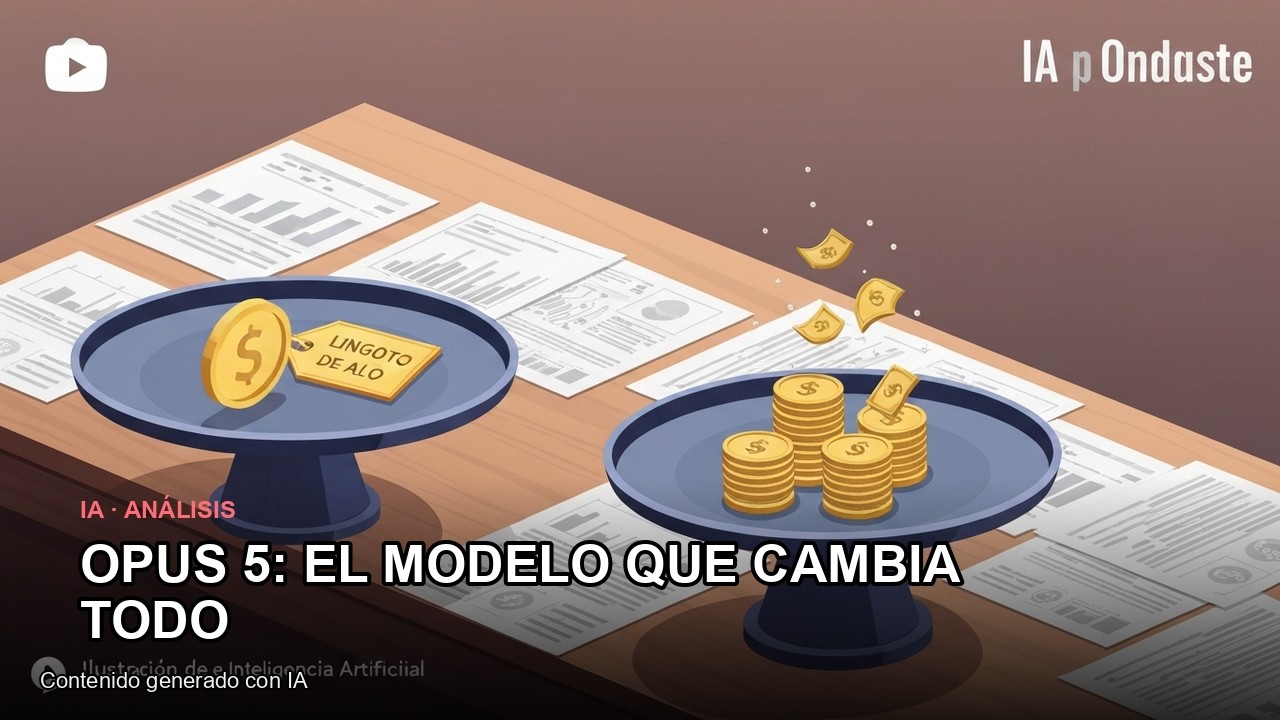
Is Claude Opus 5 worth it? We analyze Anthropic's new Artificial Intelligence model, its performance compared with OpenAI, and its revolutionary price-to-capability ratio.

Claude Opus 5 launches today, July 24, 2026, available through the API and on Claude.ai. It costs five dollars per million input tokens, twenty-five per million output tokens. The same as Opus 4.8. Same price, but more than twice the performance on some benchmarks. That's what Anthropic says. On Frontier-Bench, which measures complex software engineering tasks, it more than doubles what Opus 4.8 could do. And on CursorBench 3.2, which evaluates coding in a real-world context, it's half a percentage point below the ceiling reached by Fable 5, while costing half as much.

Tesla Optimus faces its biggest obstacle: recreating the human hand. Elon Musk admits the technical bottlenecks in microactuators and robotics.

The United States government has just launched the largest mobilization of scientific artificial intelligence in its history, and almost no one outside the halls of power is paying attention to what is truly at stake. While public conversation remains fixated on the latest update to a text generator or the stock-market swings of Silicon Valley's biggest tech companies, a quiet but seismic movement has taken shape in Washington offices: the transformation of AI into sovereign infrastructure for deep research. We are not talking about teaching a virtual assistant to draft emails or creating digital images for social media. We are talking about coupling exascale supercomputers with the largest repositories of scientific data on Earth and in outer space to simulate physical reality itself. It is the state's attempt to take control of scientific discovery before the private sector monopolizes knowledge.