 Capital de Tokens
The race to build better artificial intelligence agents is starting to move to a different level.
For the last two years, much of the attention has been on the model: which one reasons better, which one codes better, which one has more context, or which one costs less. But when those models begin operating as autonomous agents connected to tools, data, and other agents, a different problem appears:
How do we get systems built by different vendors to collaborate without creating a proprietary integration for every possible combination?
That is where A2A, the Agent2Agent Protocol, comes in.
On August 17, 2026, Axios reported that A2A —originally created by Google and already donated to the Linux Foundation— is moving into the Agentic AI Foundation (AAIF), the specialized umbrella for open agent infrastructure.
It may look like a merely administrative change. It is not.
The move helps consolidate under common governance several pieces that are beginning to look like a standard layer for building interoperable agentic systems.
First: what is A2A?
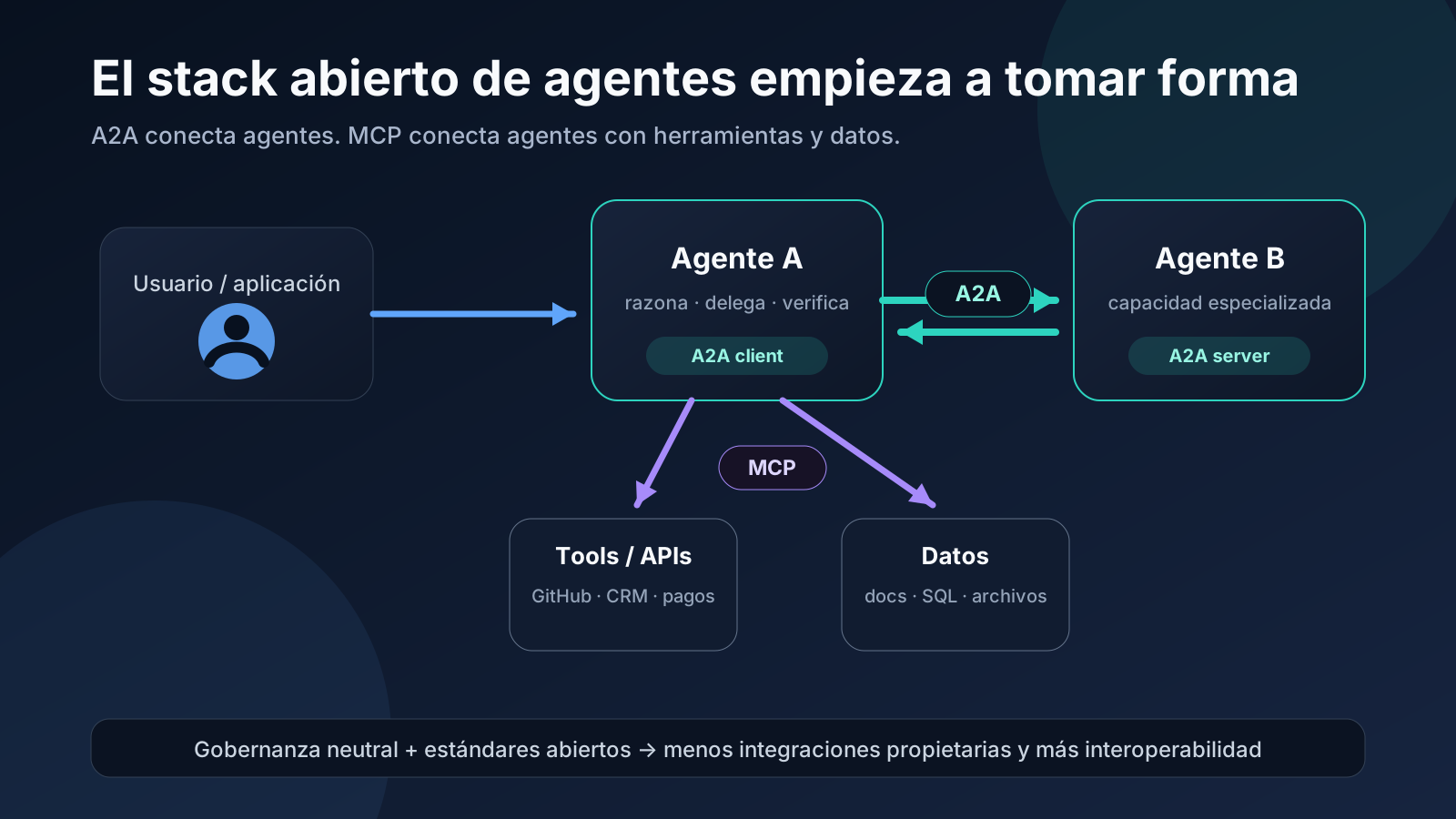
A2A is an open protocol designed so that independent agents can discover one another, communicate, and delegate work even if they were built with different frameworks, languages, models, or providers.
The official documentation describes it as an interoperability layer between potentially opaque agentic applications. That detail matters: two agents can collaborate without revealing their internal memory, private prompts, proprietary tools, or entire implementation to each other.
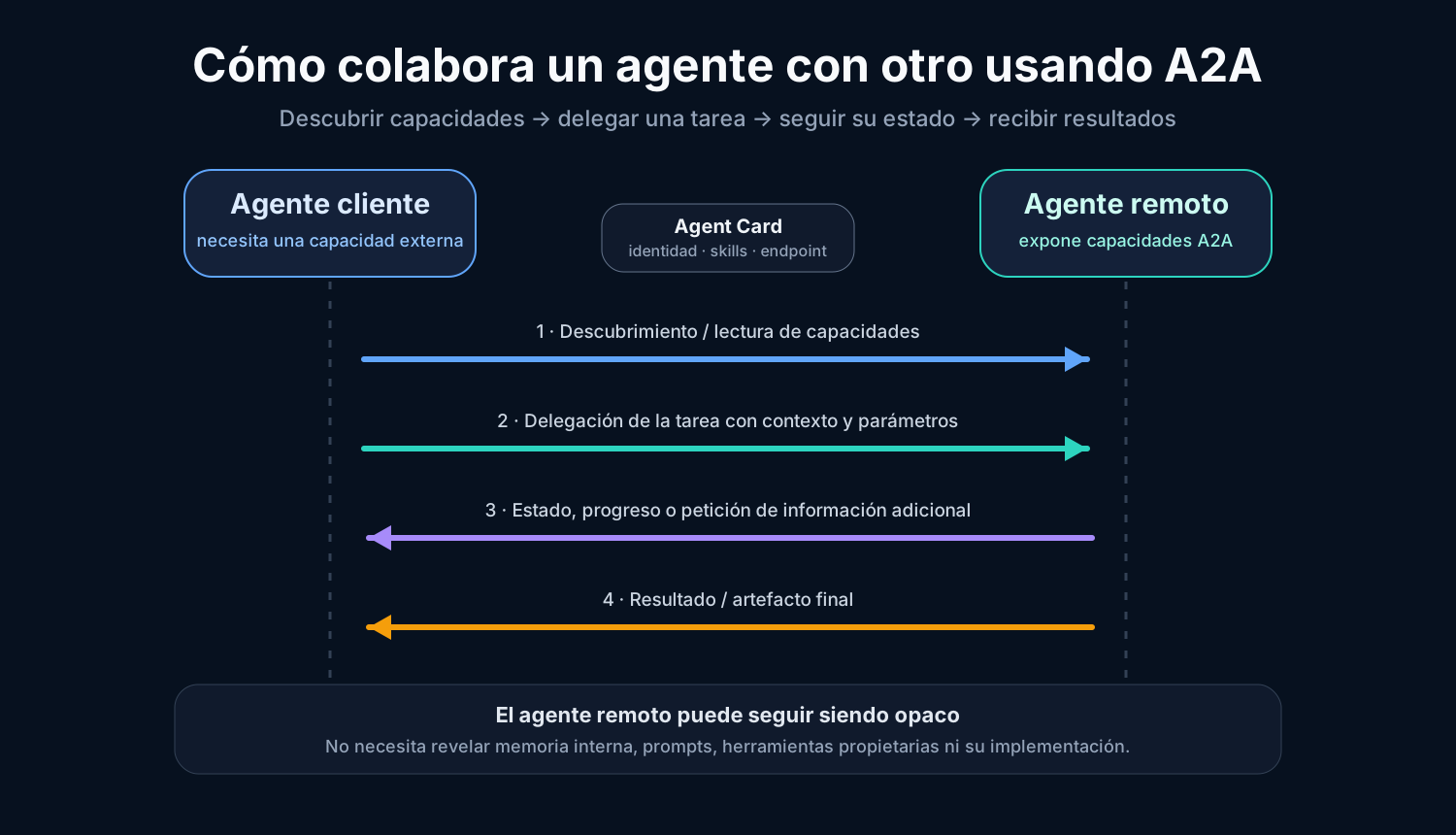
A remote agent can expose something similar to a digital business card —an Agent Card— describing who it is, what capabilities it offers, and how it can be contacted.
Another agent can then decide whether that capability is useful and delegate a task to it.
Conceptually:
Agent A
  ↓ discovers capabilities
Agent B's Agent Card
  ↓
selects a skill
  ↓
delegates a task
  ↓
Agent B works
  ↓
status / progress
  ↓
result
A2A standardizes precisely that boundary between systems.
The common mistake: thinking A2A competes with MCP
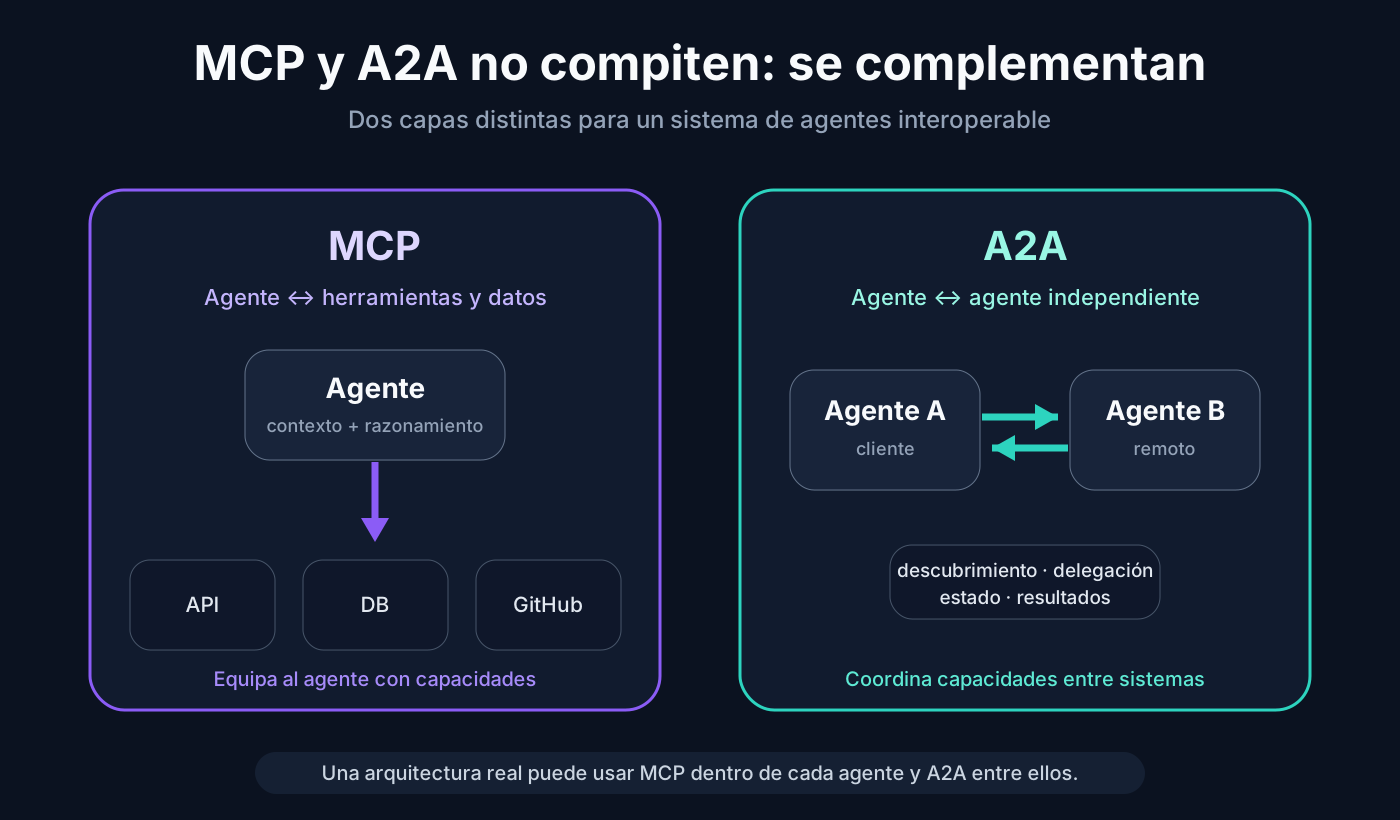
They do not compete.
They solve different problems.
MCP —Model Context Protocol— primarily standardizes communication between an agent and the tools, APIs, resources, or data sources it needs to use.
A2A, by contrast, standardizes communication between independent agents.
We can summarize it like this:
MCP
Agent ↔ tools / APIs / data

A2A
Agent ↔ agent
A2A’s own documentation describes the two protocols as complementary.
A real architecture could use MCP inside each agent to provide capabilities and A2A between agents to coordinate specialties.
For example, imagine an enterprise system made up of several agents:
Support agent
   │
   │ A2A
   ▼
Billing agent
   │
   ├── MCP → ERP
   ├── MCP → database
   └── MCP → payment system

Support agent
   │
   │ A2A
   ▼
Technical agent
   │
   ├── MCP → GitHub
   ├── MCP → observability
   └── MCP → internal documentation
The support agent does not need to know how each specialized agent is implemented. It needs to know what it can do, how to invoke it, and how to interpret the status or result of the task.
That decoupling is the real value of a protocol.
So what changes when A2A joins AAIF?
A2A had already been under the Linux Foundation since 2025.
What is new is that it is moving into a much more specific home: the Agentic AI Foundation, created precisely to group open projects and standards related to agentic infrastructure.
AAIF was launched in December 2025 with initial contributions from:
- MCP, contributed by Anthropic;
- goose, contributed by Block;
- AGENTS.md, contributed by OpenAI.
The foundation was created under the Linux Foundation to provide neutral governance for foundational technologies in the agent ecosystem.
Adding A2A places two especially important pieces under the same umbrella:
                 AAIF
                  │
        ┌─────────┴─────────┐
        │                   │
       MCP                 A2A
        │                   │
 agent ↔ tools       agent ↔ agent
That does not mean all those projects will merge or that there is a single “universal protocol.”
It means something more practical: their communities can evolve within a shared governance environment explicitly oriented toward agentic interoperability.
The real goal is to avoid an N × N explosion of integrations
Without common protocols, every vendor would have to build specific connectors for every other vendor.
Suppose we have five agent platforms:
A ↔ B
A ↔ C
A ↔ D
A ↔ E
B ↔ C
B ↔ D
...
As the number of platforms grows, the number of integrations that must be maintained grows quickly as well.
With a common protocol, the model changes:
Agent A ─┐
Agent B ─┤
Agent C ─┼── common protocol
Agent D ─┤
Agent E ─┘
Not all complexity disappears, but where it lives changes.
Instead of designing a private integration for every relationship, each system tries to speak an interoperable language.
It is exactly the kind of abstraction that allowed other layers of the Internet to grow without every application having to invent its own communication mechanism from scratch.
A2A is no longer just an experimental idea
The project’s evolution during 2026 shows that the protocol has advanced quickly.
In April, the Linux Foundation reported that more than 150 organizations supported A2A and that deep integrations already existed with platforms from Google, Microsoft, and AWS, along with production deployments in industries such as financial services, insurance, supply chain, and IT operations.
A2A 1.0 also marks the first stable, production-oriented version of the standard.
The current documentation includes SDKs for several ecosystems, including:
- Python;
- JavaScript;
- Java;
- Go;
- .NET;
- Rust.
This matters because standards only become useful when accessible implementations exist and enough participants have incentives to adopt them.
AAIF is also growing quickly
The move comes at a time when the Agentic AI Foundation itself is gaining scale.
On August 13, 2026, just days before A2A’s move became public, the Linux Foundation announced that AAIF had reached 247 member organizations after adding 57 new organizations during the quarter.
The list includes cloud companies, enterprise software vendors, financial institutions, research organizations, and technology companies from different regions.
The signal matters: the discussion around agents is no longer only about who has the best model.
It is increasingly about what shared infrastructure those agents need to operate in real systems.
The agentic stack may end up looking more like the Internet than a monolithic application
We are still early, and it would be an exaggeration to claim that A2A or MCP are already equivalent to HTTP or TCP/IP.
But the architectural direction looks similar.
We can imagine several layers:
┌──────────────────────────────┐
│ Applications and experiences │
├──────────────────────────────┤
│ Agents / runtimes / models   │
├──────────────────────────────┤
│ A2A → coordination           │
├──────────────────────────────┤
│ MCP → tools and data         │
├──────────────────────────────┤
│ APIs · DB · SaaS · systems   │
└──────────────────────────────┘
The comparison does not imply that this will be the final architecture.
What matters is the principle: important capabilities are beginning to separate into neutral protocols instead of remaining locked inside a single platform.
That could allow a company to combine:
- an agent built with one framework;
- a model from another provider;
- tools published through MCP;
- third-party specialized agents exposed through A2A;
- internal systems that remain private.
The architecture no longer has to be a single product and begins to look more like a network of interoperable components.
But shared protocols do not automatically solve every problem
Interoperability should not be confused with magic.
A2A can standardize communication between agents, but difficult questions remain:
- agent identity;
- authentication and authorization;
- trust between organizations;
- distributed observability;
- decision traceability;
- security policies;
- spending limits;
- secrets management;
- quality evaluation;
- error handling and retries;
- accountability when a chain of agents produces an incorrect result.
A company can have agents that are perfectly protocol-compatible and still operate an insecure or unreliable system.
Protocols solve one foundational piece: they define how to talk.
On their own, they do not define whom to trust, what to allow, or how to govern the entire execution.
Why this news actually matters
A2A joining AAIF is interesting less because of the institutional change and more because of what it reveals about the ecosystem’s maturity.
We are seeing a transition:
phase 1
isolated models

phase 2
models + tools

phase 3
specialized agents

phase 4
networks of interoperable agents
In that fourth phase, competitive advantage may stop depending only on having an extraordinary agent.
It will also matter how well that agent can discover external capabilities, delegate work, use tools, and collaborate with systems that were not built by the same vendor.
A2A and MCP target exactly those boundaries.
One possible interpretation: we are watching the protocol layer of agentic AI emerge
The history of computing repeatedly shows that ecosystems grow when certain interfaces stop belonging to a single company and become shared infrastructure.
We still do not know which protocols will survive, which will change, or what new layers will appear.
But the combination of MCP for tools and context and A2A for collaboration between agents, under a neutral foundation that already brings together hundreds of organizations, deserves attention.
Not because it will eliminate fragmentation tomorrow.
But because it points toward an architecture in which an agent could say:
I have a task. I do not need to know how you are built. I only need to discover what you can do, verify that I can trust you, delegate the work, and receive a verifiable result.
When that works routinely across different vendors, frameworks, and organizations, we will have moved from building isolated agents to building a true network of agents.
And that is where A2A may end up being much more important than another fashionable framework.