 Capital de Tokens
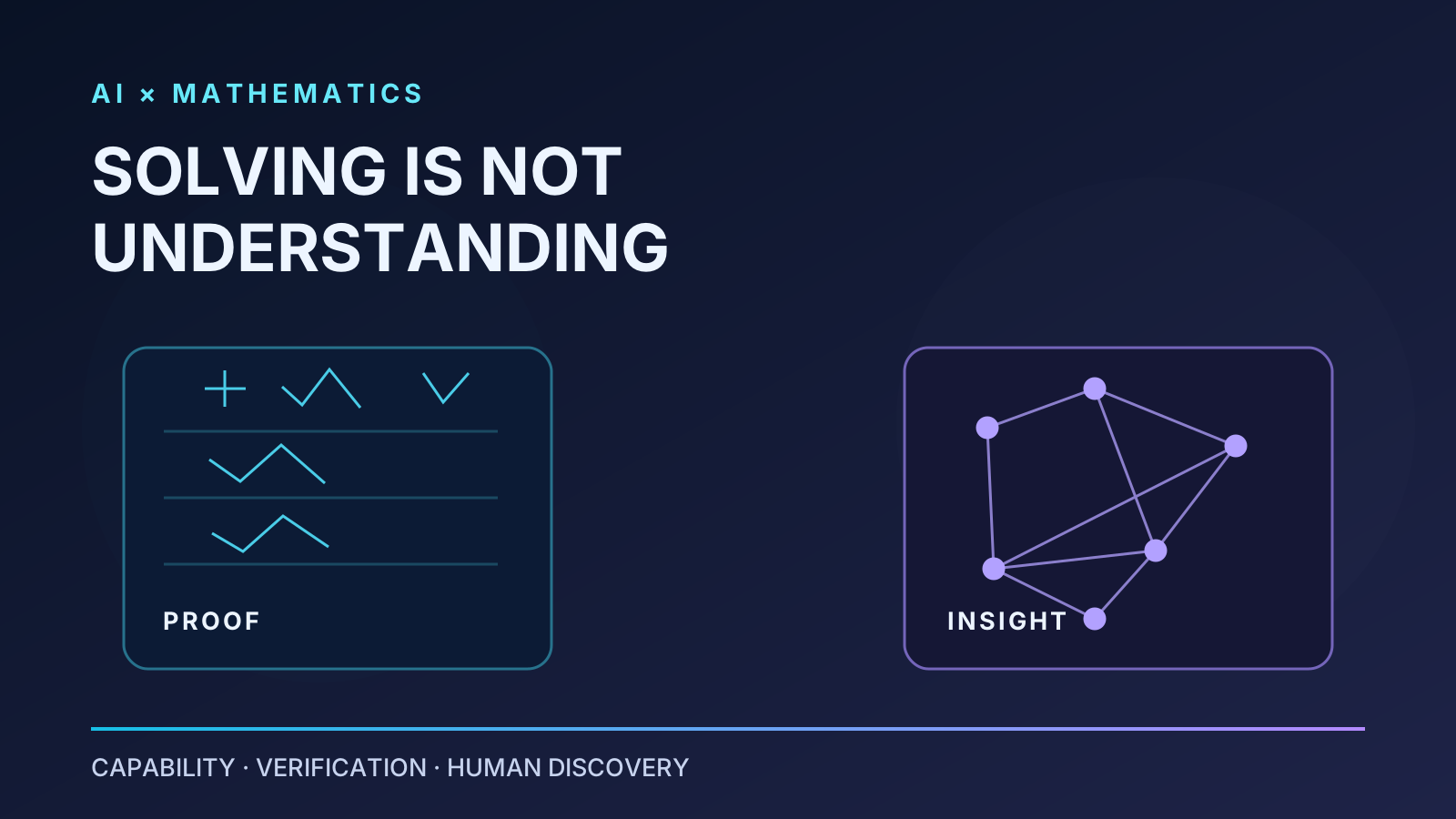
The debate about AI and mathematics has moved beyond exams and olympiads into a much more uncomfortable territory: what happens when machines start solving questions that scientists spent decades trying to understand?
In You Truly Don’t Understand What Just Happened to Mathematics, published October 9, 2026, Professor Giordano Scarciotti makes a crucial distinction. Mathematics is valuable not only because it delivers correct answers, but because of the ideas, theories, connections, and generations of researchers shaped by the search for those answers.
This concern deserves more than a dismissal as fear of progress. But it is not proof that AI will destroy mathematics. To evaluate the argument, we need to separate problem-solving capability, proof validity, understanding, scientific impact, and human incentives.
Our thesis: AI is shifting the bottleneck in mathematical research. Finding a solution may become dramatically cheaper; validating its scope, understanding why it works, and turning it into productive theory may become the harder tasks.
What actually happened in 2026
On October 6, OpenAI released mathematical results from an internal model. Its technical description of the release identified 722 manuscripts across 372 result families, with supporting material and Lean formalizations for some of the proofs. OpenAI also published ten abridged reasoning summaries and estimates of computational cost.
That should not be translated into “722 previously unsolved problems conclusively settled.” A manuscript is not necessarily a new theorem, versions can share a result family, and independent assessments of correctness, originality, and importance take time.
On September 8, OpenAI announced a proposed solution to the Navier–Stokes problem. The Clay Mathematics Institute acknowledged the significance of the announcement while emphasizing that evaluation under its prize rules is deliberately unhurried. As of October 17, 2026, Clay still listed Navier–Stokes as an active problem, not an awarded prize.
Both statements can be true: AI mathematical capability has advanced substantially, and the status of each particular result cannot be inferred from a corporate announcement.
Scarciotti’s first insight: answers are only part of discovery
Scarciotti discusses examples including Königsberg’s seven bridges and the race to the Moon. Certain questions drive the invention of tools. In trying to solve them, we create concepts that outlive the original task.
In mathematics, an argument can matter less for its final yes-or-no answer than for an unexpected lemma, a geometric representation, or a technique that transfers to another field.
Where the video is right: rewarding a scoreboard of closed problems alone risks overlooking the process that creates reusable knowledge.
Where it needs nuance: AI-created proofs can also contain genuinely new methods. Human researchers need not have invented a method first to reconstruct, teach, or extend it. The meaningful distinction is not “human versus machine author,” but isolated result versus an idea others can understand and build upon.
Computer algebra, scientific computing, and computer-assisted proofs changed mathematics without ending it. Yet those precedents do not establish that the current scale and speed are harmless.
The second insight: what does a Lean verification prove?
Lean is a proof assistant. It encodes propositions and arguments in a formal language, then uses a checking kernel to validate the steps against defined rules.
That can provide a powerful logical guarantee about the precise statement encoded and the assumptions it relies upon. It does not automatically establish that:
- the formal theorem exactly matches the natural-language claim;
- the assumptions reflect the question mathematicians intended to answer;
- novelty and attribution have been properly established;
- the proof is comprehensible, reusable, or scientifically illuminating.
This is a concrete technical concern. In October, Bastounis, Circelli, and Hansen posted a preprint discussing semantic mismatches introduced by AI autoformalization, including in the Navier–Stokes case. It is an important critical analysis to investigate, not a final verdict invalidating every result.
The layers are distinct:
Scientific claim in natural language
                  ↓ faithful translation?
Formal statement + precise assumptions
                  ↓ checked by the kernel?
Machine-checked derivation
                  ↓ novel, important, reusable?
Independent validation and human understanding
“Lean passed” directly addresses the middle checking step. That matters enormously; it is not the whole scientific process.
The third insight: the next generation of mathematicians
Scarciotti’s most unsettling concern is educational. If a student expects a machine to solve in hours the problem that might have defined a twenty-year career, why pursue that career?
The mechanism is plausible: weaker incentives to study a discipline might mean fewer people capable of asking new questions, checking discoveries, or preserving intellectual independence. Early-career researchers may be especially vulnerable if academic status rewards being first to an answer above all else.
But a possibility should not be mistaken for a measured outcome. Neither the video nor the October announcements demonstrate that young people have stopped studying mathematics because of AI. The opposite is also plausible: better tools, wider participation, more ambitious projects, and new careers interpreting and extending formal results.
The outcome depends on universities, funding, access to compute, evaluation criteria, and whether students learn to think or merely race machines.
A further risk: concentration of the research agenda
If a handful of labs control the strongest models and the compute required to use them, they may influence not just which questions are answered, but which questions get asked in the first place.
This shifts the conversation from individual talent to scientific institutions. Distributing finished solutions alone would not necessarily restore researchers’ freedom to set their own agenda.
The independent Advisory Group on Mathematics and Artificial Intelligence (AGMAI), hosted at the Institute for Advanced Study, offered a balanced statement on October 6: making results public begins rather than completes their integration into human knowledge. Mathematicians must retain the freedom to pose their own questions, and equitable access to tools and computing resources matters.
Scientific autonomy includes the ability to investigate problems an AI laboratory has not selected.
What is OpenAI doing about it?
It would be unfair to claim OpenAI has ignored these concerns. The company has shared supporting material, partial formalizations, revision protocols and process details, while pledging to improve exposition and transparency.
On October 15, it announced a $5 million contribution to support mathematicians’ efforts to understand AI-produced results. The Simons Foundation announced a $15 million joint initiative involving the foundation, OpenAI, and Anthropic, supporting evaluation, training, convenings, and community standards.
These are substantive steps, but they do not automatically solve problems of attribution, editorial quality, unequal access, or dependence on proprietary systems. Their ultimate value will depend on whether independent researchers can reproduce, challenge, and extend the claims.
Where we disagree with the bleakest prediction
The suggestion that mathematics dies when machines answer its questions assumes the universe of interesting questions is fixed.
It is not. New results usually produce new questions. An opaque proof can become a research program: what makes it work, when does it work, can it be simplified, which other structures can it illuminate, and which assumptions can be weakened?
Research may increasingly focus on designing theories, translating arguments between mathematical languages, inventing conceptual frameworks, and auditing model-generated claims.
That is no guarantee of an easy transition. If academia keeps rewarding whoever first answers a known question above everything else, incentives may break down. We will need to reconsider what counts as a contribution.
Five rules for AI-augmented mathematics
A reasonable policy for laboratories, universities, and journals could begin here:
| Rule | Practical requirement |
|---|---|
| 1. Label the status | Distinguish proposed, formalized, independently reproduced, peer reviewed, and accepted |
| 2. Record provenance | Document tools, human contributions, relevant literature, versions, and limitations |
| 3. Fund understanding | Reward explanations, new connections, and simpler proofs—not just the first answer |
| 4. Broaden research access | Support equitable access to compute and tools so labs do not monopolize the research agenda |
| 5. Preserve learning | Teach students to reconstruct arguments and ask questions without outsourcing every reasoning step |
A better success metric than the raw number of published theorems is how many results survive independent scrutiny, generate reusable ideas, and enable more people to do better research.
Conclusion: a correct answer is no longer enough
Scarciotti identifies a real risk: scientific inquiry should not be treated as a checklist. His case is strongest when defending the process of discovery and weaker when treated as a prediction of the extinction of a profession.
October 2026 may indeed be an inflection point for AI-assisted mathematical research. It does not follow that every announced proof has been accepted, or that mathematicians’ future has already been determined.
The goal should not be to stop AI from discovering theorems. It should be to prevent the speed of discovery from separating answers from understanding, validation, and humanity’s freedom to keep asking questions.
Sources and further reading
- Giordano Scarciotti’s original video, October 9, 2026.
- OpenAI: Sharing AI progress in mathematics, October 6; updated October 15.
- OpenAI Developer Community: release materials and initial counts.
- AGMAI: guidelines and October 6 statement.
- Clay Mathematics Institute: Navier–Stokes announcement.
- Bastounis, Circelli, and Hansen: limits of autoformalization, preprint.
- Simons Foundation: October 15 initiative.
For the technical background, see our previous posts on mathematical rigor versus formalization in Lean and our earlier analysis of the Navier–Stokes proposal.