 Capital de Tokens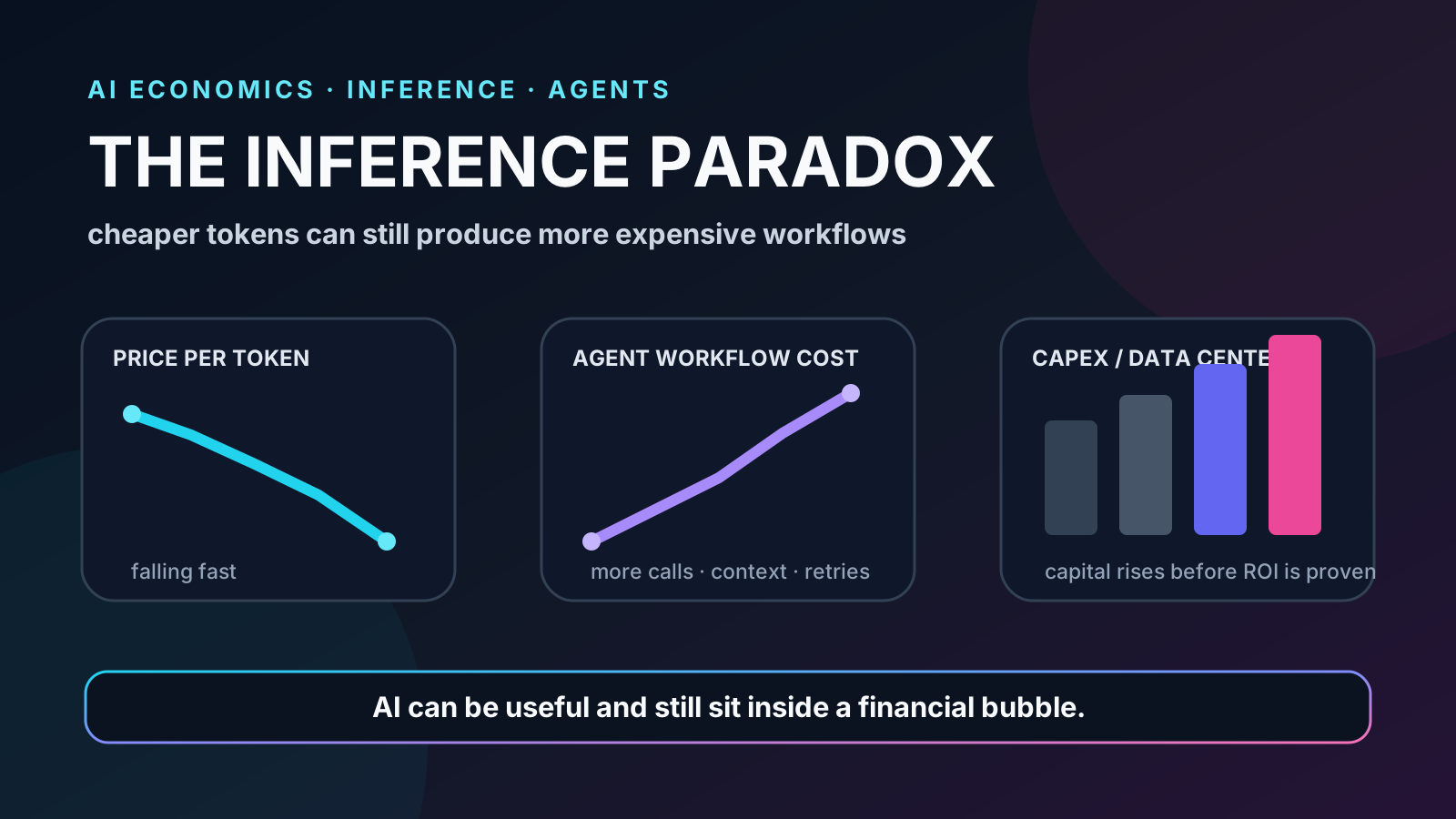
The debate over a possible artificial intelligence bubble is often framed too simply: either AI transforms the economy and today’s valuations are justified, or the technology is overhyped and the boom eventually deflates.
There is a third possibility, and it may be the most interesting one:
AI can be extraordinarily useful while a financial bubble still forms around its infrastructure and around expectations for its margins.
That is what makes the argument in the recent video The AI Bubble Is Cracking… worth examining. Its most provocative thesis can be summarized this way: the part that actually delivers value to the user — inference — can become too expensive when we try to scale it.
That claim needs nuance. Inference prices have fallen dramatically. At the same time, however, we are building systems that consume far more inference than before.
That apparent contradiction is the heart of the problem.
Training the model is not the same as using it
When discussing AI costs, it helps to separate two phases.
Training is the process of building the model. It can require enormous GPU clusters, weeks or months of compute, and a massive upfront investment.
Inference is what happens afterward: every time someone asks a question, generates an image, runs an agent, analyzes a document, or asks a model to call a tool.
Training is like building a factory. Inference is like producing every unit that comes out of it.
For traditional software, serving one more user can have a very small marginal cost. In a product built around generative models, every interaction can create new variable costs: input tokens, output tokens, GPU time, searches, context storage, tool calls, and sometimes additional reasoning cycles.
That makes inference a meaningful part of COGS, the direct cost of delivering the service.
And with agents, the problem becomes more interesting.
The chatbot made one call; the agent may make twenty
A simple chatbot can follow a flow like this:
user
  ↓
model
  ↓
answer
An agent can look more like this:
user
  ↓
planning
  ↓
search
  ↓
model
  ↓
tool
  ↓
model
  ↓
another tool
  ↓
verification
  ↓
correction
  ↓
answer
And that is the clean version.
Production systems add retries, long contexts, tool outputs fed back into prompts, validation passes, parallel calls, specialized models, and sometimes human review.
That is why price per token and cost per completed task are not the same metric.
Gartner describes this as the Inference Paradox: even as token economics improve, application complexity can grow even faster. In August 2026, the firm projected that inference cost per agentic workflow could rise more than fivefold through 2028, specifically because systems will use more tokens, more models, and more sophisticated processes.
Source: Gartner — AI inference costs per agentic workflow
The paradox can be expressed like this:
cost per token ↓↓↓

but

tokens per task ↑
calls per task ↑
context per task ↑
retries ↑
verification ↑

possible result:

total cost per task ↑
There is no contradiction. We are making each unit of intelligence cheaper while consuming many more units of intelligence.
The metric that matters is not the token
During the first years of generative AI, it was natural to compare providers by the price of one million tokens.
For agentic systems, that metric begins to resemble the price of a kilowatt-hour when what we actually want to know is how much it costs to manufacture a car.
A more useful metric looks something like this:
cost per successful outcome =
(models + tools + retrieval + retries + validation + review)
/
tasks completed correctly
Two agents can use the same model and have completely different economics.
One may solve a task in three calls.
Another may enter a loop, reread 100,000 tokens of context, execute unnecessary tools, and still require human review.
The token price is identical. The product is not.
An academic paper published in August 2026 tried to measure the evolution of the price of “intelligence” after adjusting for quality. It found a steep decline in quality-adjusted inference prices, but also a particularly important result: measured per completed task, the buyer’s price stopped falling, because reasoning models increased token consumption faster than unit prices declined.
Source: The Price of Intelligence: A Quality-Adjusted Price Index for AI Services
That result does not prove AI is economically unviable. It does show why looking only at an API price sheet can produce a misleading picture.
Companies are already discovering the problem
McKinsey published an AI FinOps survey in July 2026 in which 93% of qualified respondents said they had exceeded their AI budgets. The sample was relatively small — 75 qualified responses — so it should not be treated as a universal measurement of the market, but it is still a useful signal of the type of problem enterprises are encountering.
In the same analysis, McKinsey said roughly one fifth of respondents in another global survey had constrained AI use because of AI-related operating costs.
Source: McKinsey — Is that AI agent worth it?
A second McKinsey analysis published in August puts numbers behind the model gap. Using pricing available in early July 2026, a frontier model could cost many times more than a lightweight alternative for output tokens.
The practical conclusion is straightforward: always using the most capable model is an expensive architectural decision.
Source: McKinsey — Where AI agents pay off
This is one of the biggest changes from classic SaaS.
In a traditional application, a new feature can increase development cost, but once deployed it may serve millions of requests at extremely low marginal cost.
In an AI-native application, a more powerful feature can permanently increase the cost of serving every request.
Intelligence becomes a resource that the product consumes.
Then why are prices falling so quickly?
Because there is also a very strong argument against the most pessimistic view.
Inference is getting cheaper at extraordinary speed thanks to a combination of:
- better accelerators;
- quantization;
- batching;
- speculative decoding;
- better kernels;
- more efficient architectures;
- provider competition;
- much more capable small models;
- higher hardware utilization.
Samaritan Research, for example, found that the cost required to reach specific historical capability levels fell by roughly 9× to 900× per year, depending on the benchmark and capability threshold measured. For one GPT-4-comparable performance level, the decline was around 40× per year.
Source: Samaritan Research — LLM inference price trends
So simply saying “inference is too expensive” is incomplete.
The better question is:
Is the cost of inference falling faster than the amount of inference we want to consume is rising?
That is the race.
The rebound effect: when something cheaper gets consumed far more
Economics has a familiar dynamic called the rebound effect: making a resource more efficient can increase total consumption because new uses become economically viable.
Something similar appears to be happening with AI.
When a model call gets cheaper, a product team does not necessarily keep the workflow unchanged and pocket the savings. It may use the budget to:
- add reasoning;
- expand context;
- run verifiers;
- launch several agents;
- generate multiple candidates;
- use more capable models;
- automate tasks it previously would not have attempted.
Efficiency unlocks demand.
The result can look strange: each token costs less, but the total bill rises.
That does not make efficiency improvements useless. Quite the opposite: it means AI is finding more applications. The problem appears when the economic value created by those additional compute cycles fails to grow as quickly as the spending.
This is where the debate stops being about APIs and becomes about data centers
The economics of an individual agent are only one part of the story.
To satisfy expected demand, Microsoft, Amazon, Alphabet, and Meta are building enormous amounts of physical infrastructure: data centers, networks, electrical systems, GPUs, and new power generation.
Reuters reported in February that the four companies planned to spend more than $600 billion on AI in 2026 collectively.
Source: Reuters — US AI boom faces electric shock
That spending is not merely a technology bet. It is a bet on future demand.
A data center built today has to generate enough cash flow for years to justify land, power, cooling, networking, debt, and hardware that may become technologically dated much faster than the building itself.
That creates the classic feature of an infrastructure bubble:
capital is deployed today against revenue that still has to materialize tomorrow.
Cash flow begins to matter more than benchmarks
In July 2026, Reuters analyzed LSEG estimates for Microsoft, Alphabet, Amazon, Meta, and Oracle. Under those projections, the companies’ combined capex could exceed their free cash flow by 2027.
The analysis also estimated that each additional dollar of operating cash flow would be accompanied by roughly $1.57 of additional capital spending.
Source: Reuters — AI investment boom puts Big Tech’s free cash flow under pressure
That does not mean those companies face immediate danger. Several have exceptionally profitable businesses capable of funding enormous investment programs.
But it changes the question the market eventually asks.
During the first stage of the race, it was enough to show:
“We have the best model.”
Then:
“We have users.”
Then:
“We have agents.”
The next question is unavoidable:
“How much return does each dollar of infrastructure produce?”
And that question is much harder to answer with benchmarks.
The debt market is already asking for a premium
One useful signal is appearing outside the stock market.
Reuters reported on September 22, 2026 that corporate bond investors were beginning to demand larger concessions from AI-linked issuers because of the enormous financing needs created by data centers, chips, and infrastructure.
According to Goldman Sachs data cited by Reuters, gross hyperscaler debt issuance could reach $420 billion in 2027, about 60% above the 2026 estimate.
The article also reported spreads around 115 basis points for AI-related debt versus roughly 78 basis points for the broader investment-grade market.
Source: Reuters — Corporate bond buyers get picky with flood of AI debt
That is not a prediction of collapse.
It is something more ordinary and therefore important: capital is starting to demand better compensation for financing the expansion.
When that happens, economic discipline increases.
So is there a bubble?
It depends on what we mean by bubble.
If it means “AI is useless,” the evidence does not fit that definition very well. The technology already creates value in programming, search, support, analysis, content creation, research, and automation.
If it means some financial expectations may assume returns that are too fast or too large for the amount of capital being deployed, the question becomes much more reasonable.
Both statements can be true at once:
the technology works
        +
adoption grows
        +
productivity may improve
        +
some investments may be overvalued
        =
no contradiction
The history of the internet offers a useful precedent. The dot-com bubble destroyed enormous amounts of capital and many companies disappeared.
The internet, meanwhile, became even more important than much of the market had imagined.
A technology can win while many of its financial vehicles lose.
Architecture will be the real battleground
For teams building AI products, this debate has a much more practical consequence than trying to guess when a stock will rise or fall.
Architecture will have to optimize value per unit of inference.
That means moving away from:
“What is the smartest model?”
toward:
“What is the cheapest model that can complete this step correctly?”
An economically healthy system will probably combine several tiers:
classification / extraction
        ↓
small, inexpensive model

ambiguous task
        ↓
mid-tier model

hard reasoning
        ↓
frontier model

critical case
        ↓
frontier + verifier
Then add caching, deduplication, context limits, workflow budgets, stop conditions, batching, and local execution when it makes economic sense.
The future of agents is probably not one giant model doing everything.
It is a system that carefully decides when expensive intelligence is worth buying.
Five metrics that matter more than token price
To judge whether the economics are improving, five signals matter:
- Cost per correctly completed task, not just per token.
- Gross margin of the AI-native product, after inference and tools.
- Revenue generated per workflow versus execution cost.
- Utilization and return on infrastructure capex.
- Free cash flow and financing cost of the companies building that infrastructure.
If those metrics improve while adoption grows, today’s enormous investment may eventually look early but rational.
If they deteriorate while capex and debt continue rising, the bubble thesis becomes stronger even if the models keep getting better.
The uncomfortable conclusion
The question “Is AI a bubble?” combines two different problems.
One is technological:
Can the models do things that are useful enough?
Every year it becomes harder to answer no.
The other is economic:
Can all that usefulness generate enough revenue and savings to justify the cost of serving it and the infrastructure we are building?
That answer is still being written.
The most interesting thesis, then, is not that AI will disappear.
It is almost the opposite:
AI can become foundational economic infrastructure and, precisely because of that, attract much more capital than some participants will ever recover.
Tokens can keep getting cheaper. Models can keep improving. Agents can keep doing more.
And there can still be a bubble.
Because a technological revolution answers the question “What is possible?”
A profitable investment must answer one more:
“At what cost?”
Sources
- Awesome — The AI Bubble Is Cracking…
- Gartner — AI inference costs per agentic workflow
- McKinsey — Is that AI agent worth it?
- McKinsey — Where AI agents pay off
- Zhu — The Price of Intelligence
- Samaritan Research — LLM inference price trends
- Reuters — US AI boom faces electric shock
- Reuters — AI investment boom puts Big Tech’s free cash flow under pressure
- Reuters — Corporate bond buyers get picky with flood of AI debt