 Capital de Tokens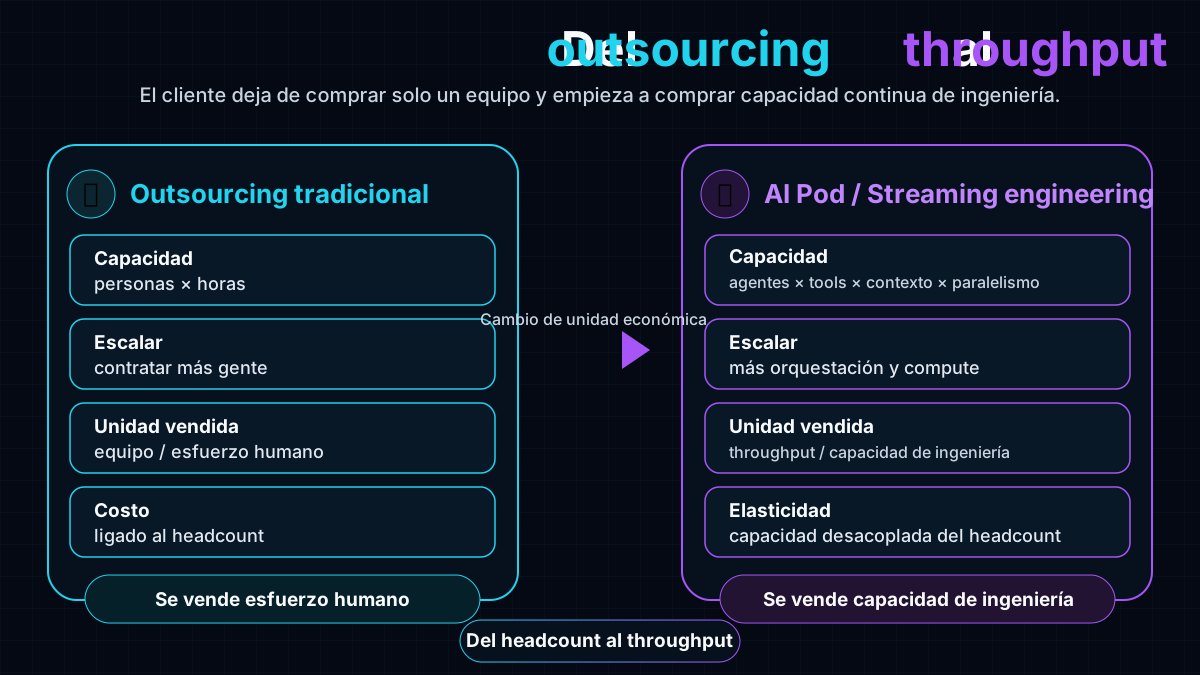
For decades, software consultancies have sold a very clear economic unit: people by the hour. A client buys architects, developers, QA, and project managers, and pays for their work capacity over a period of time. AI Pods aim to change that fundamental unit.
The idea is not simply to put ChatGPT in front of a human team. An AI Pod is a production unit in which AI agents execute a significant part of the work while humans shift toward defining objectives, supervising, resolving exceptions, and validating results.
The leap is not from “developer with AI” to “faster developer.” It is from selling human effort to selling engineering capacity.
From outsourcing to throughput
In traditional outsourcing, scaling means hiring more people. Capacity is tied to headcount, hours, and hourly rates. In an AI Pod, capacity starts to depend on agents, models, tokens, tools, context, parallelism, and orchestration quality.
The client no longer necessarily buys a fixed team and instead starts buying throughput: continuous capacity to produce engineering artifacts. That is where the idea of streaming engineering comes from: consuming engineering more like cloud capacity than assembling a project team.
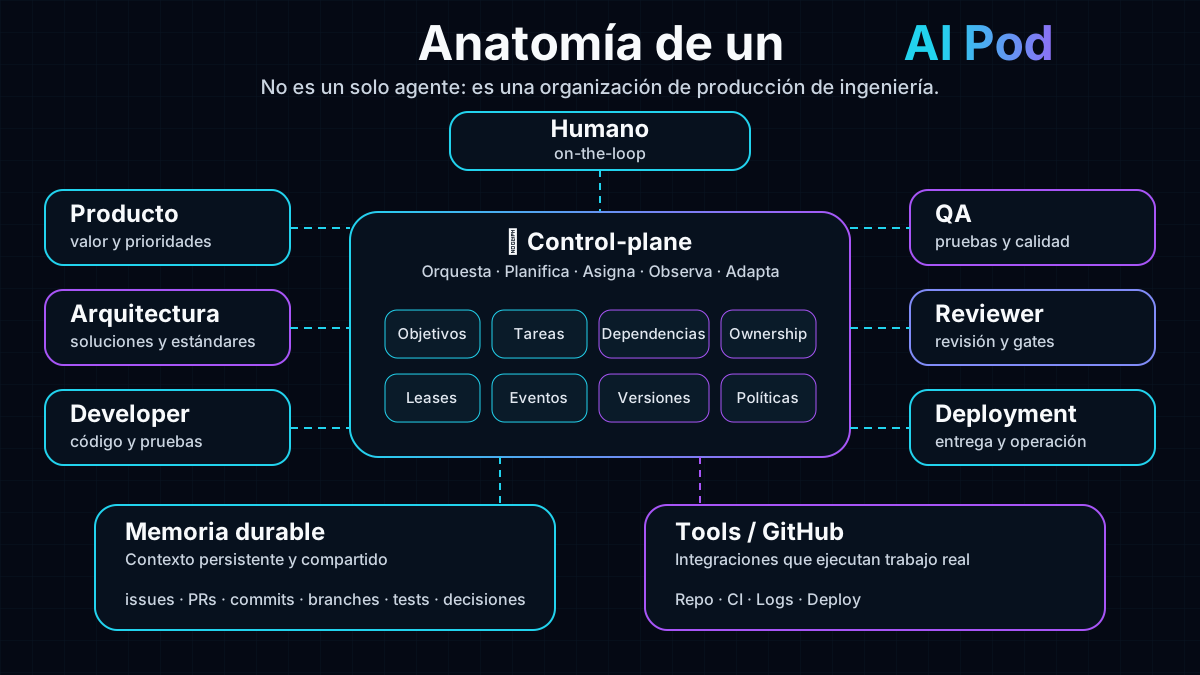
A Pod is not an agent: it is an organization
The Pod is the complete system. Agents are specialized workers. There may be a product agent, an architecture agent, several developers, QA, a reviewer, and deployment. Above them sits an essential component: the control plane.
Five intelligent agents do not automatically form an intelligent team. Without coordination, a developer may implement a decision that was already rejected, QA may test an old version, and a reviewer may inspect an obsolete commit. The control plane maintains objectives, tasks, dependencies, ownership, priorities, versions, leases, events, and policies. It decides what should happen, who should do it, and what evidence allows the workflow to advance.
Roles, permissions, and durable memory
Agents can use the same base model and still have different responsibilities. What changes is the prompt, context, tools, permissions, and authority. An architect can propose decisions without merging code; a developer can modify the repository without redefining requirements; a reviewer can block a change without approving their own work.
A mature architecture should not rely only on the model remembering its role. Authority should be reflected in permissions and APIs.
The Pod also needs persistent operational memory: what we are building, why, what decisions were made, what tasks exist, who is working on each one, what code changed, and which tests are failing. That history cannot live indefinitely inside prompts.
GitHub fits naturally: commits as versioned state, branches as workspaces, issues as work units, PRs as proposals, reviews as validation, Actions as deterministic execution, and merge as acceptance. Agents can be ephemeral while the project preserves durable memory.
Tools: when AI stops chatting and starts acting
A model without tools can explain what it would change. An agent with tools can read the repository, modify files, run tests, create branches and PRs, inspect logs, and deploy. The difference between a chatbot and a digital worker lies largely in this action layer.
That is why an AI Pod looks much more like a multi-agent system with a control plane, memory, tools, and policies than a conventional SaaS application.
The human changes position
The human does not necessarily disappear. They move from directly producing much of the work to defining intent, resolving ambiguity, reviewing exceptions, and approving risk. It is the shift from human-in-the-loop doing the work to human-on-the-loop supervising the system.
Some sufficiently bounded and verifiable tasks may eventually run without human intervention in every cycle, as long as clear escalation policies exist.
Swarm versus AI Pod
A swarm primarily describes a technical architecture: multiple agents collaborating. An AI Pod adds what is needed to turn that architecture into an operable and sellable unit: a control plane, workflows, persistent context, tools, governance, observability, human supervision, SLAs, and billing.
That is why a swarm can be a technical experiment. To become a Pod, it needs to be governable, measurable, and reliable.
Probabilistic where necessary; deterministic where possible
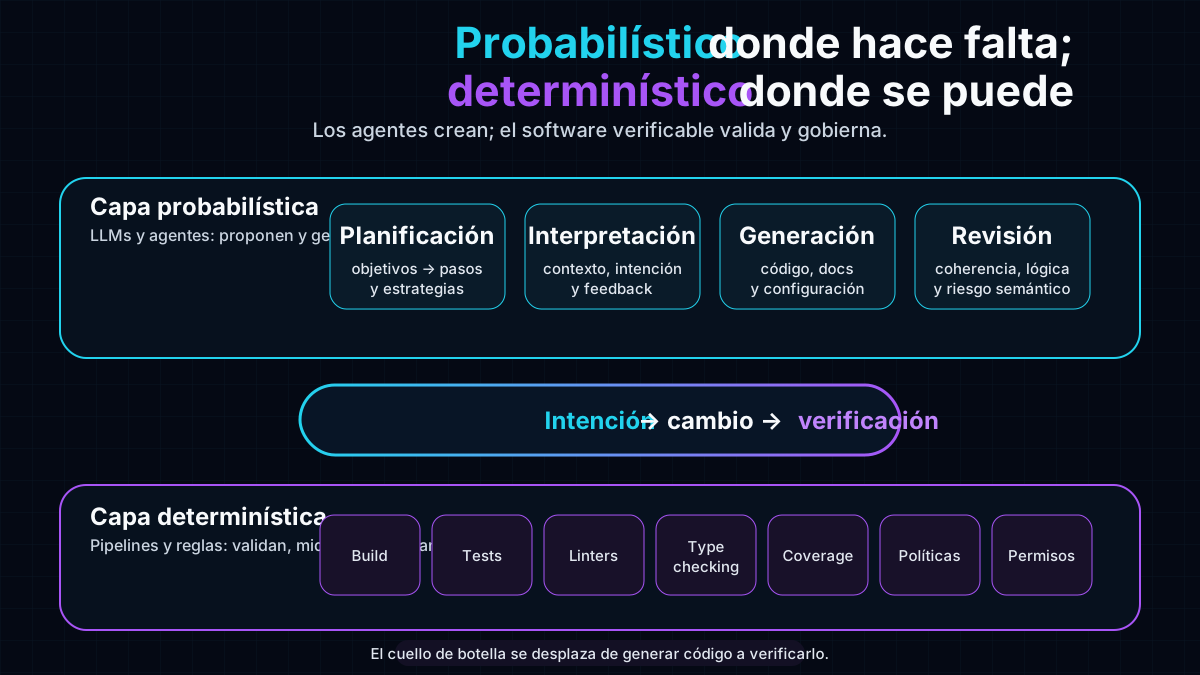
An LLM can decide how to implement a function, but we should not ask it whether the code compiles when a compiler can answer that. It can conceptually review an architecture, but we do not need its opinion to know whether a test suite passed.
The probabilistic layer is useful for planning, interpretation, generation, and semantic review. The deterministic layer is useful for builds, tests, linters, type checking, coverage, policies, and permissions. The more agents produce, the more important this separation becomes: the bottleneck shifts from generating code to verifying it.
The economics change: from headcount to elastic capacity
In a traditional consultancy, capacity approximates people multiplied by hours. In an agentic system, it begins to look more like compute multiplied by agents, parallelism, tool access, and orchestration quality.
Scaling agents is not free: inference, context, observability, security, evaluation, and supervision all carry costs. But the elasticity is different. Increasing capacity no longer necessarily requires hiring proportionally more people.
From SaaS to Service-as-Software
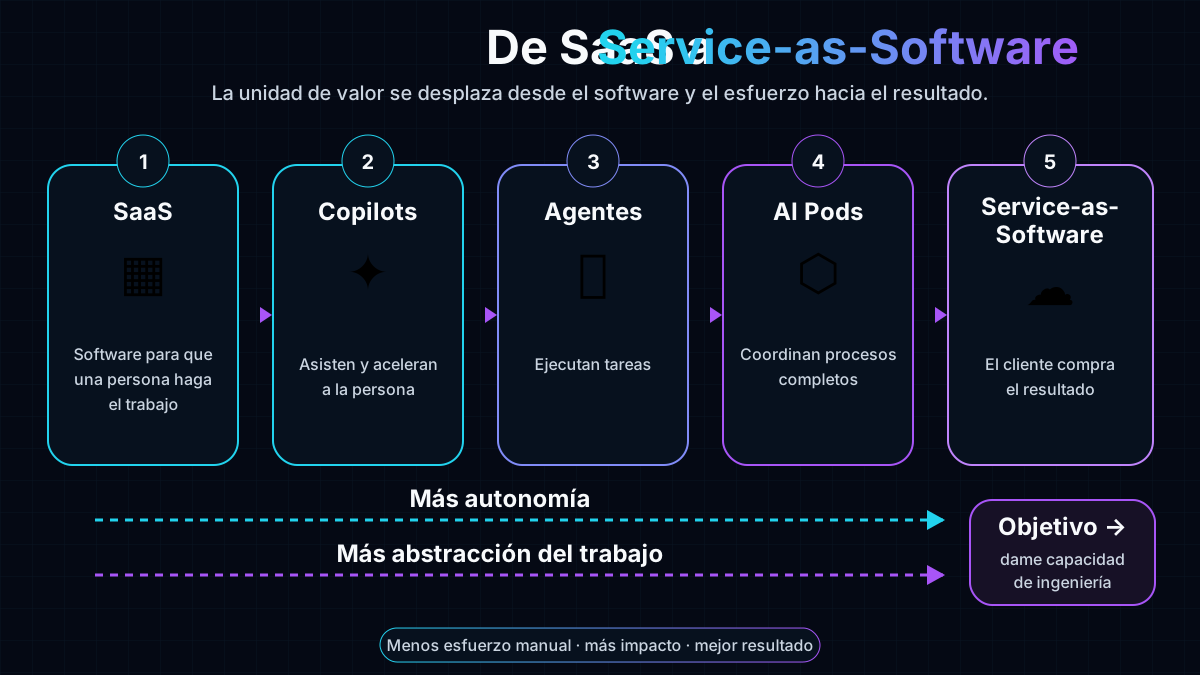
SaaS sells software so a person can do a job. Copilots help that person. Agents execute tasks. AI Pods coordinate complete processes. At the limit, the customer stops buying software or effort and buys the outcome.
That creates a powerful analogy with cloud computing. The cloud turned physical servers into programmable capacity: API → give me compute. An AI Pod points toward a similar abstraction: objective → give me engineering capacity.
A company that needs to modernize twelve microservices could assign a Pod, load the context, generate a plan, distribute tasks, and begin producing PRs without rebuilding a human organization from scratch for every initiative.
Programmable organizations
An AI Pod starts to resemble a miniature company: it has roles, authority, memory, workflows, policies, coordination, and metrics. The difference is that much of that organization can be expressed as software.
That opens a new frontier: partially programmable organizations. We can version roles, change policies through code, measure throughput, run workers in parallel, and replace components without redesigning the whole team.
The real product is not code
The serious challenge is not producing thousands of lines. It is producing changes that are correct, consistent, auditable, and aligned with the business. Mature systems will compete on time to acceptable PR, rework, escaped defects, cost per validated change, and autonomy before escalation.
The real product of an AI Pod is not code. It is reliable capacity to transform intent into acceptable changes.
Conclusion
The AI Pod concept joins two worlds: multi-agent architecture and business model. Technically, it resembles a swarm governed by a control plane, with durable memory, tools, permissions, workflows, and human supervision. Economically, it packages all of that as a consumable production unit.
If cloud computing virtualized infrastructure, AI Pods point toward something even more ambitious: virtualizing parts of an organization.
The decisive change will arrive when a company stops asking “how many developers do I need?” and starts asking “how much engineering capacity do I need?”
This analysis builds on the discussion of AI Pods in this video and their relationship with multi-agent systems, control planes, and new models for engineering services.