 Capital de Tokens
The easy headline is that Bill Gates wants to slow down artificial intelligence.
But that oversimplifies what he is proposing.
In a long essay published on August 26, 2026, and in interviews given the same day, Gates describes something more ambitious: a political architecture for living with a technology that, in his view, will advance faster than institutions can adapt.
His starting point is uncomfortable for someone who has spent his life defending technological innovation. Gates says that if there were a credible plan to slow the global advance of AI, he would probably support it. At the same time, he believes that scenario is unrealistic because economic and geopolitical incentives push the United States, China, companies, and laboratories to keep accelerating.
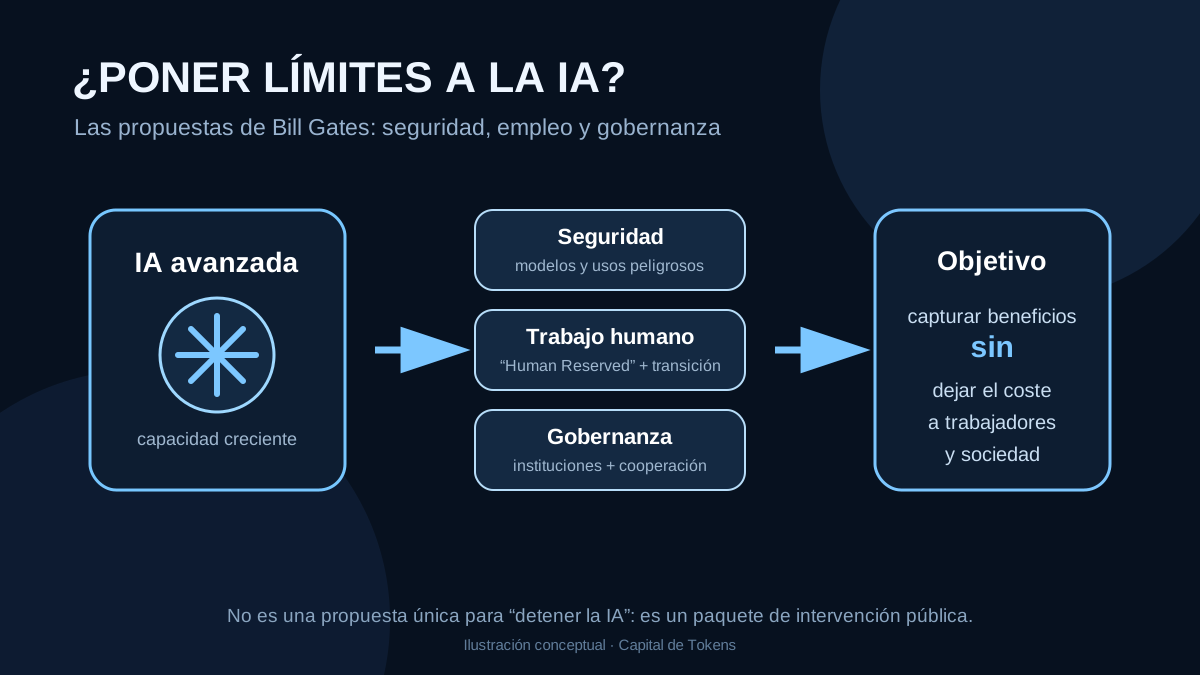
That is why his practical proposal is not simply “stop AI.”
It looks more like this:
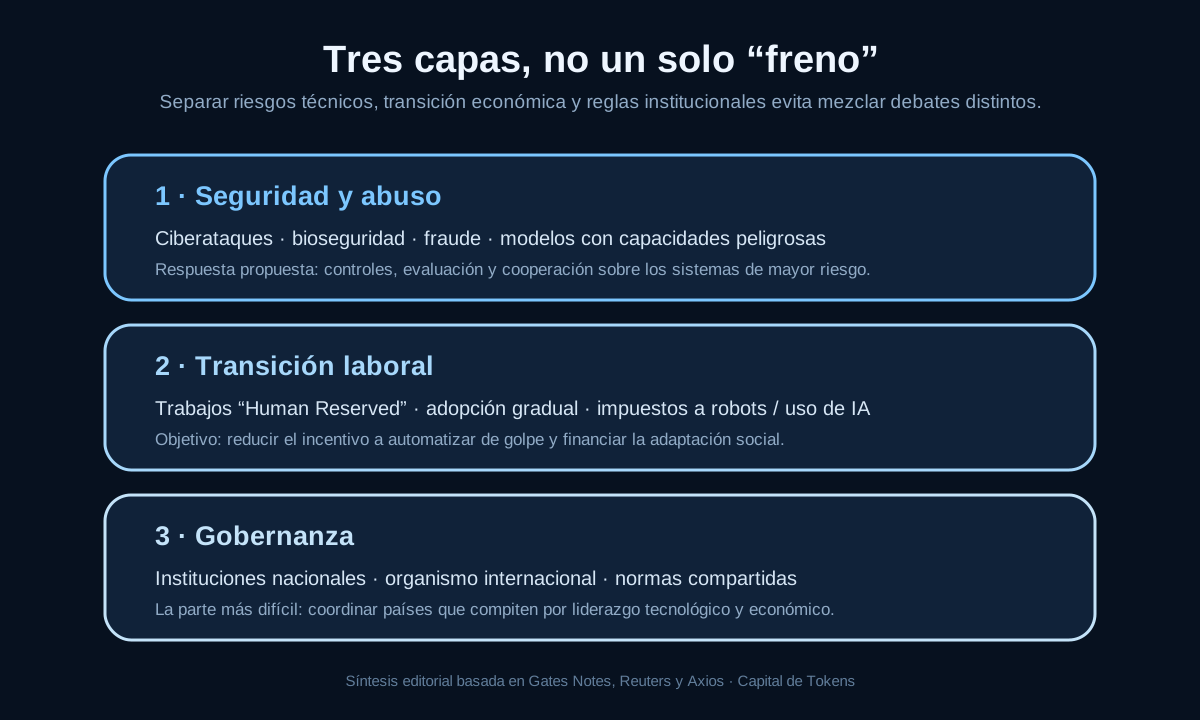
- put controls around the most dangerous uses and capabilities;
- intervene in the labor market so automation does not replace people as quickly as it technically could;
- create new national and international institutions capable of governing a technology that crosses borders and sectors.
Why Gates changed his tone
Gates has spent years talking about AI as a technology capable of transforming health, agriculture, education, productivity, and science.
That has not disappeared.
In his new essay he still argues that AI can produce enormous benefits. The difference is that he now gives much more weight to the speed of the transition and the harms that can appear before those benefits are distributed.
His core argument is that analogies with earlier technological revolutions can mislead us.
Agricultural mechanization, the automobile, the PC, and the Internet took decades to fully transform the economy. AI has several characteristics that can compress that transition:
- it runs on devices and infrastructure that already exist;
- it uses natural language, so users do not need to learn a completely new interface;
- it can absorb work procedures directly from existing documents, conversations, videos, and data;
- it improves at both cognitive tasks and, when combined with robotics, physical tasks.
The result, according to Gates, is that entire sectors may feel the impact within a decade instead of across several generations.
The three risks Gates puts front and center
Although public debate often reduces AI to productivity versus unemployment, Gates groups his concerns into three broad categories.
1. Structural job destruction
Gates does not believe that every job destroyed by AI will automatically reappear as a new profession.
His reasoning is that previous waves of automation eliminated tasks but left many others reserved for human cognitive capabilities. If AI systems can also perform much of that cognitive work, that reserve shrinks.
Entry-level and mid-level jobs worry him especially because they are the jobs through which people gain experience before reaching more complex roles.
This directly affects software, support, administration, law, medicine, manufacturing, and other sectors where AI can start as an assistant and end up executing complete workflows with very little supervision.
2. Abuse, cybersecurity, and dangerous capabilities
The second risk does not require AI to be “conscious.”
It is enough for highly capable systems to let malicious actors do things that previously required specialized teams: automate cyberattacks, scale fraud, design manipulation campaigns, or lower the barriers to biological threats.
Gates also includes a more extreme risk: systems acting in ways their designers did not anticipate as their capabilities and autonomy increase.
Here his concern looks less like labor regulation and more like a control regime for high-impact technologies.
3. Children and human relationships
The third risk is social.
Gates worries that extremely agreeable artificial assistants and companions could replace some of the difficult experiences that help develop judgment, independence, and social skills.
This is not an argument against every AI tutor or assistant. In fact, Gates continues to support educational uses. His concern is what happens when a system designed to sustain engagement becomes a permanent substitute for human relationships, especially during developmental stages.
“Human Reserved”: jobs we decide not to automate
The most striking proposal is a category Gates calls Human Reserved.
The idea is easy to explain and extremely difficult to implement:
even if a machine can perform a task, society may decide that certain functions should remain human.
Gates compares the concept to a nature reserve. Technically, we could build on protected land, but we decide not to because we want to preserve something we consider valuable.
Applied to work, that could mean several things.
Some functions could remain permanently reserved for people for reasons of legitimacy, trust, or human connection. Axios mentions examples discussed by Gates such as childcare or certain functions in the justice system.
In other sectors, protection could be temporary: allowing a profession to use AI without immediately replacing most of its workers.
In healthcare or education, for example, the goal would not have to be banning AI. It could be keeping the human professional while allowing them to rely on automated tools.
Axios reported that Gates even imagined, in an extreme scenario, initially reserving as much as around 40% of jobs for humans. He himself acknowledged how difficult it would be to reach even that percentage.
The economic problem: today automation may have a tax advantage
Gates also revisits an idea he had defended years ago: a robot tax.
In this new discussion he broadens the concept toward taxes associated with AI use, including the possibility of taxing tokens or equivalent mechanisms.
The logic is twofold.
First, a tax system heavily based on human labor may end up encouraging its replacement: hiring a person involves payroll, taxes, and contributions, while automating part of the work may avoid a fraction of those costs.
Second, if fewer people work or if hours and wages fall, the state may collect less revenue precisely when it needs to finance more labor transition, training, and social protection.
A tax on automation would try to change both curves:
automation
     │
     ├── lower private cost for the company
     │
     └── higher social transition cost

tax / fee
     │
     └── tries to return part of the social cost
         to the economic calculation of automating
The challenge is definition.
What exactly gets taxed?
A physical robot? A model call? Generated tokens? Estimated labor savings? Additional productivity?
Each option creates different incentives and different opportunities for avoidance or arbitrage.
A new institutional architecture for AI
The most ambitious part of Gates’s proposal is not the tax or the reserved jobs.
It is the creation of new national and international institutions dedicated to managing the AI transition.
Gates argues that existing institutions were not designed for a technology that can simultaneously affect employment, national security, education, healthcare, energy, information, and social relationships.
His reference point is not a single existing agency. He talks about combining elements from several governance models:
- inspection regimes associated with nuclear control;
- international aviation rules;
- multilateral agreements like those used to protect the ozone layer.
Reuters also reported that Gates wants to bring these ideas into conversations with international leaders, including Chinese President Xi Jinping. His hypothesis is that certain restrictions on especially dangerous models would have a better chance of becoming a global norm if the United States acted first and China accepted equivalent mechanisms.
That point is critical.
A country can regulate domestic AI use. It is much harder to regulate a capability that can be developed in another jurisdiction and distributed digitally.
The biggest obstacle: everyone wants cooperation and competitive advantage at the same time
The proposal sounds reasonable when described in the abstract.
Execution is another story.
A strong international regime would have to answer enormous questions:
- what level of capability makes a model “dangerous”?;
- what tests would be mandatory before deployment?;
- who audits the labs?;
- how are closed models and open models inspected?;
- how do we prevent a country from using the rules to slow competitors?;
- what happens if a jurisdiction decides not to participate?;
- how are the rules updated when capabilities change every few months?
The difficulty increases because the same nations that need to cooperate are also competing for leadership in chips, models, data centers, robotics, and applications.
That conflict between collective safety and strategic advantage will probably be the main bottleneck for any global system.
“Human Reserved” also has hard problems
Reserving jobs for humans can protect dignity, legitimacy, and social stability.
But it also opens uncomfortable questions.
Who decides which work deserves protection?
A well-organized profession could lobby to reserve its jobs while workers with less influence remain exposed to automation.
Do we protect a profession or a task?
A doctor can use AI without ceasing to be a doctor. A programmer can delegate code generation while retaining responsibility for architecture and validation.
The boundary between assistance and replacement is not always clear.
What happens to international competition?
If a U.S. company is required to keep more human workers while a foreign competitor fully automates, labor protection may become a cost disadvantage.
That pushes the problem back toward international agreements.
How long should protection last?
Reserving certain tasks for five years to enable a transition is different from banning their automation forever.
Designing an exit may be as important as designing the initial reservation.
The most important part of Gates’s argument
The most interesting aspect is not any single proposal.
It is the change in the unit of analysis.
Much of the AI conversation is still centered on what the next model can do.
Gates is asking something else:
what institutions do we need when models can do more and more?
That moves the debate from benchmarks and capabilities toward adaptation mechanisms:
- how we distribute productivity;
- how we preserve human accountability;
- how we finance the transition;
- how we measure risk;
- how we coordinate rival countries;
- which parts of life we decide not to optimize solely for efficiency.
What this means for people building AI agents
For teams developing agents, copilots, and automation, this debate is not abstract.
If the direction Gates proposes gains influence, several practices that seem optional today could become normal requirements.
Traceability
Systems will need to record what the agent did, what tools it used, what decisions it made, and which actions remained under human approval.
Limits on autonomy
Not every domain will have the same degree of freedom. An agent that summarizes documents does not have the same risk profile as one capable of moving money, modifying infrastructure, or carrying out biological actions.
Evaluation before deployment
Tests would stop measuring only quality. They would also need to measure abuse capabilities, privilege escalation, control evasion, and out-of-distribution behavior.
Human-in-the-loop as policy, not a patch
In certain workflows, keeping a human decision may stop being a temporary product limitation and become a deliberate part of institutional design.
The economics of automation
If taxes, fees, or regulations tied to labor substitution appear, the ROI calculation for an agent could include more than tokens, infrastructure, and avoided salaries.
This is not an anti-AI argument
Gates remains explicitly optimistic about many applications of artificial intelligence.
The Gates Foundation works with companies such as OpenAI, Anthropic, Google, and Microsoft to apply AI to healthcare, education, and agriculture.
His thesis is not that the benefits are false.
It is that they will not emerge fairly or safely by default.
And that is the fundamental difference between two views of the transition.
One trusts that the speed of innovation will solve the problems created by innovation itself.
The other argues that some consequences are too large to leave exclusively to the market and to the companies developing the technology.
Gates is clearly moving toward the second view.
The question that remains open
It is easy to say that we need limits.
The hard part is designing them without freezing innovation, enabling regulatory capture, protecting professions because of political influence, or moving development to countries with weaker rules.
That is why the important debate is not regulation yes or no.
It is much more specific:
what capability do we regulate, with what evidence, for how long, under what authority, and with what review mechanism?
AI will keep advancing while those answers are debated.
That gap —between the speed of software and the speed of institutions— is precisely the problem Gates is trying to put on the table.
Sources
- Bill Gates, Gates Notes, “The turbulent AI era is here. The choices we make now are critical.” August 26, 2026: https://www.gatesnotes.com/a-turbulent-ai-era-and-critical-choices-to-make
- Reuters, “Bill Gates, alarmed by AI, has policy ideas he wants to discuss with China’s Xi Jinping.” August 26, 2026: https://www.reuters.com/world/china/bill-gates-alarmed-by-ai-has-policy-ideas-he-wants-discuss-with-chinas-xi-2026-08-26/
- Axios, “Bill Gates wants to keep some jobs off-limits to AI.” August 26, 2026: https://www.axios.com/2026/08/26/bill-gates-wants-to-keep-some-jobs-off-limits-to-ai
- TechCrunch, “Bill Gates wants to see a robot tax and ‘Human Reserved’ jobs to mitigate harms from AI.” August 26, 2026: https://techcrunch.com/2026/08/26/bill-gates-wants-to-see-a-robot-tax-and-human-reserved-jobs-to-mitigate-harms-from-ai/
- The Washington Post, “Bill Gates was an AI optimist. Now he’s scared of what could go wrong.” August 26, 2026: https://www.washingtonpost.com/technology/2026/08/26/bill-gates-says-he-worried-ai-will-harm-workers-kids-society/