 Capital de Tokens
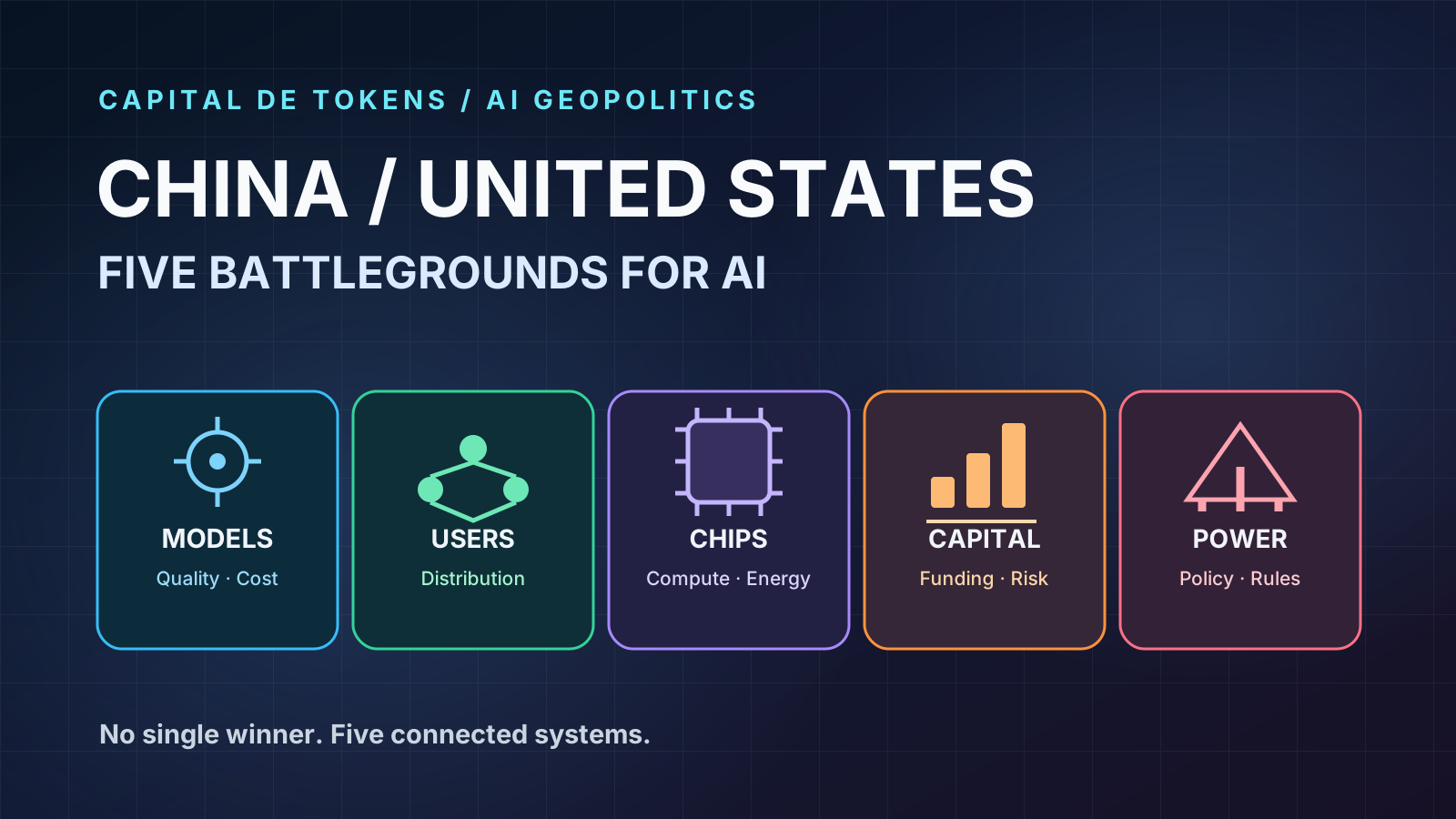
Who is winning artificial intelligence: China or the United States? The question is appealing because it sounds like a race with two runners and one finish line. In reality, AI has no universal scoreboard. One country may lead in models, another in financing, while different companies dominate distribution, infrastructure or particular tasks.
Gustavo Entrala’s documentary CHINA: El JUEGO de TRONOS de la Inteligencia Artificial, published on October 29, 2026, uses the rival houses of Game of Thrones to explain the struggle. It is an effective metaphor. But its claims deserve checking, and we should distinguish three things: verifiable facts, interpretations of political incentives and predictions that cannot yet be confirmed.
The landscape becomes clearer when we separate five battlegrounds.
1. Models: quality, cost and openness
In January 2025, DeepSeek-R1 showed that a Chinese laboratory could compete in reasoning with leading US systems. The launch included downloadable weights and an MIT license for R1, although derivative models can inherit conditions from their base models. According to its official announcement, DeepSeek also offered API access. These are different products: downloading weights does not eliminate the cost of running a model, and paying for an API does not give you control over the weights.
Alibaba develops the Qwen family, including language and multimodal models available to developers and enterprises. The broader field includes GLM (Zhipu), Kimi (Moonshot AI) and MiniMax, with different approaches to models, assistants, coding and generated media. They are not interchangeable copies of ChatGPT or Claude.
The 2026 Stanford AI Index puts the gap between the leading US and Chinese models at 2.7% in March 2026, under the report’s chosen comparison. The gap varies by evaluation and over time; it does not establish an absolute winner. On another measure, the best closed model led the best open model by 3.3%.
An essential distinction: “open weights,” “open source,” and “fully reproducible training” are not synonyms. A permissive license does not by itself guarantee privacy, quality or security.
2. Distribution: from the lab to millions of phones
An excellent model can lose the commercial race if nobody uses it. Companies with existing ecosystems enjoy an advantage that is different from pure technical performance.
ByteDance, owner of TikTok and Douyin, distributes Doubao and combines audiences, applications and cloud services. Tencent has WeChat and its Yuanbao assistant. Baidu combines search, services and ERNIE, while Alibaba links Qwen to its cloud and commerce businesses.
This contest cannot be settled by benchmarks alone. User acquisition cost, retention, integration into daily tasks and conversion of free use into sustainable revenue all matter. That is why asking “Which is China’s ChatGPT?” is too simple: DeepSeek resembles certain competitors in its technical strategy, while Doubao resembles others in consumer distribution.
In the West, OpenAI, Anthropic, Google, Meta and xAI also compete from very different positions. Mapping each Chinese company to a US equivalent is helpful for orientation but can conceal genuine advantages and business-model differences.
3. Chips, electricity and data centers
AI is not merely software. It depends on accelerators, semiconductor fabrication, networks, electricity, cooling and data centers.
Infrastructure is a major US advantage. The 2026 AI Index counts 5,427 data centers in the United States and notes how advanced chip manufacturing is concentrated in a major Taiwanese foundry. This also reveals a shared dependency: American firms rely on international supply chains.
Restrictions on exporting chips to China are real, but they are not a single, frozen, universal blockade. In January 2026, the US Commerce Department shifted license reviews for certain chips, including Nvidia H200 and AMD MI325X, toward case-by-case decisions subject to security requirements. Any account of the “silicon war” must reflect those changes.
China is working to reduce technology dependencies and expand computing capacity, while the United States seeks to preserve strategic advantages. Neither side controls the entire supply chain alone.
4. Money: private investment and public support
Another crucial difference concerns who bears the costs and risks. According to Stanford, private AI investment in 2025 amounted to approximately US$285.9 billion in the United States versus US$12.4 billion in China. This does not measure China’s total AI investment, because state-guided funds and other public instruments are incompletely captured by the private-investment series.
China uses industrial policy and public support; the United States also employs procurement, incentives and regulation. The contrast between “the American market” and “the Chinese state” captures tendencies, but becomes misleading when treated as absolute.
More capital does not guarantee better models, and a low API price does not establish profitability. Understanding sustainability requires examining inference costs, infrastructure utilization, cash flow, real demand and service quality.
5. Political power: what happened and what can be inferred
The video builds much of its narrative around Jack Ma, founder of Alibaba. Following his public criticism of regulators, Chinese authorities suspended Ant Group’s planned US$37 billion stock market listing in 2020. Reuters’ November 2020 reporting documents the episode.
This is concrete evidence of the Chinese state’s regulatory power over major companies. It does not, by itself, prove that every AI lab founder avoids publicity out of fear, or that every corporate decision follows a political directive. That is one interpretation of the documentary, not an established fact about every person mentioned.
The United States also has political pressure, regulation, public negotiations and debates about concentrated power. Institutional mechanisms differ and deserve precise comparisons rather than automatic equivalence.
What the Game of Thrones metaphor oversimplifies
A compelling story needs protagonists, betrayals and winners. Technology is less dramatic and far more interdependent.
- There is no single crown: leadership in chatbots, programming, robotics, video or data centers needs different metrics.
- Openness is not a national flag: both countries have open and closed models, with different licenses and levels of transparency.
- Viral numbers need context: stock-market losses, startup valuations, active users and annualized revenues are not interchangeable measurements. Rumored valuations or future IPOs should not be presented as accomplished facts.
- Access changes: regulation, licensing, model versions and API pricing evolve. A snapshot from 2025 does not automatically describe 2026.
A practical guide to selecting AI technology
For a company or developer, the result of this competition should not be choosing sides based on nationality. It should be greater bargaining power.
Before relying on a model, compare its accuracy on your own tasks, total cost per task, license, data location and handling, self-hosting options, and how easily you could switch vendors. Maintain reproducible evaluations and an exit plan: the cheapest API today may not be the best answer to your problem tomorrow.
Conclusion: China and the United States are producing increasingly competitive AI systems, but the contest plays out simultaneously across models, users, hardware, capital and political power. Understanding those five battlegrounds is more useful than prematurely declaring a winner.
Sources and context
- Gustavo Entrala — CHINA: El JUEGO de TRONOS de la Inteligencia Artificial (original video, October 29, 2026).
- Stanford HAI — AI Index 2026, technical performance.
- Stanford HAI — AI Index 2026, overview.
- DeepSeek — official DeepSeek-R1 release.
- Alibaba Group — Qwen model family.
- Bureau of Industry and Security — semiconductor export license policy, January 2026.
- Reuters — Ant Group IPO suspension, November 2020.