 Capital de Tokens
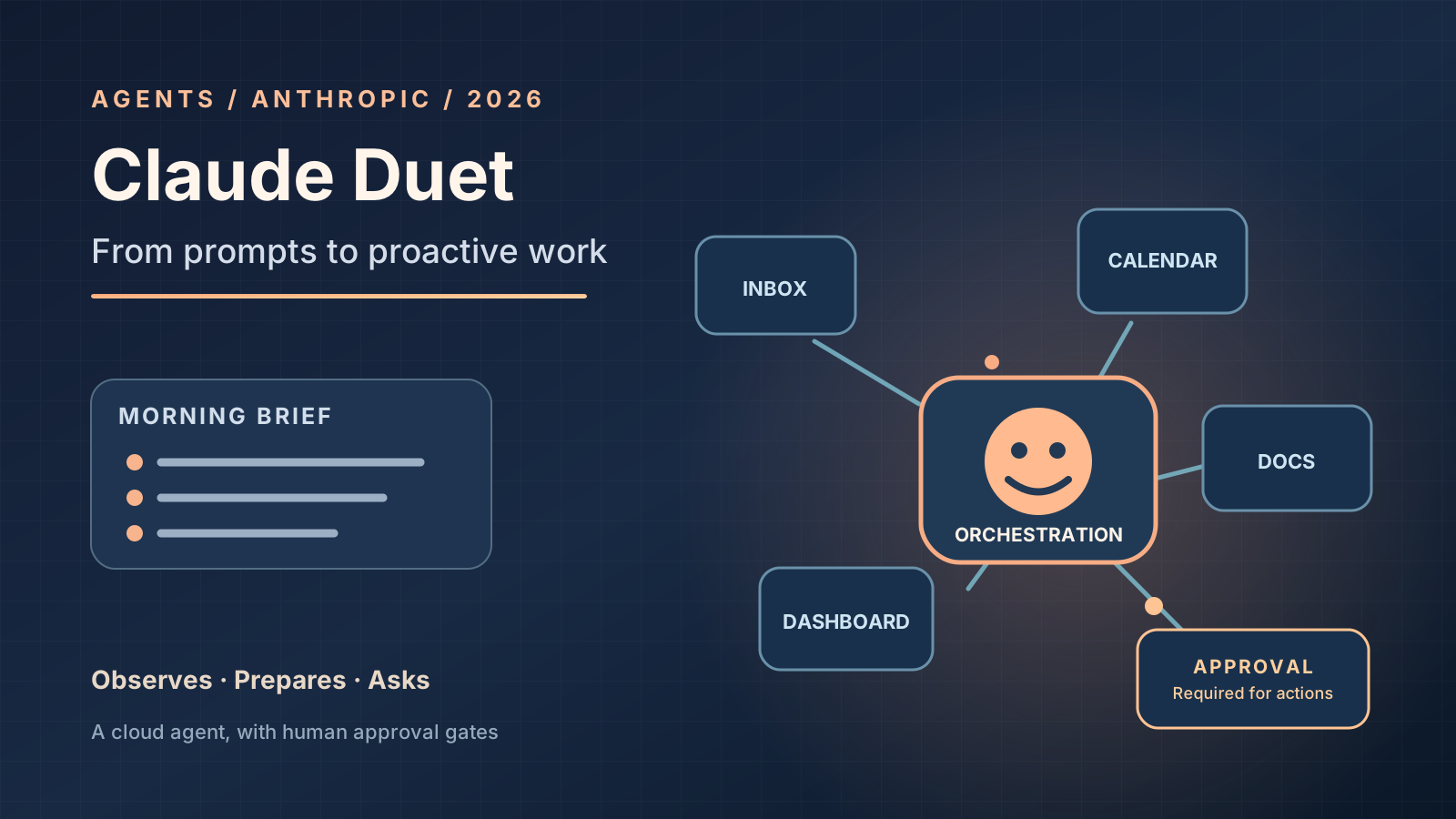
For years, the dominant interaction with AI has been reactive: you enter a question, the model answers, and the exchange stops until your next message. On October 21, 2026, Anthropic introduced Claude Duet with a different proposition: an agent that identifies outstanding matters, carries out tasks, and reaches out when a decision is needed.
This is more than a chat window with reminders. Duet combines a language model, memory, connected applications, and a virtual cloud computer to complete work while the user is away. Its significance lies in the shift in relationship: from requesting assistance to delegating work under supervision.
The release has important limits. It is a waitlisted research preview for Pro and Max subscribers in the United States, not a general launch. And proactive activity draws on the same usage limits as Claude. Both details matter when assessing the product beyond its demo.
From answering questions to noticing what matters
According to Anthropic’s announcement, Duet prepares a morning briefing based on connected applications. It then checks those apps periodically and interrupts only when it judges that something deserves attention.
That seemingly small change reshapes the workflow:
| Conversational assistant | Proactive agent such as Duet |
|---|---|
| The user chooses when to ask | The agent looks for relevant signals within its authorized scope |
| An answer usually ends the exchange | A task can continue in the background |
| Context is repeatedly supplied across chats | Memory, skills, and connected apps carry into one continuous thread |
| The chat is the primary interface | Chat coexists with execution, notifications, and approvals |
| The typical output is an answer | The output may be a document, prepared workflow, or approved action |
Consider a small business: a calendar deadline, an unpaid invoice, and an urgent email may be scattered across several tools. An agent could combine those signals, recommend priorities, and prepare work without someone manually inspecting every dashboard.
That does not mean it knows the true importance of every event. It means Anthropic is trying to automate the allocation of human attention, not just the generation of text.
Under the hood: context, connectors, and a cloud computer
Anthropic describes four core building blocks:
- Model and judgment. Duet is built around Claude Opus 5.5. The model helps select steps and tools and decides when to request intervention.
- Persistent context. It reuses memory, skills, and connected apps from the Claude account. Work unfolds in an ongoing conversation through text or voice.
- Tools. It can use the more than 6,000 connectors and plugins available through the Claude Marketplace, including integrations such as Gmail, Slack, Stripe, QuickBooks, Gusto, and Shopify, depending on granted access.
- Remote execution. Its virtual machine includes a browser, so tasks can continue without the user’s phone or laptop staying on.
Announced use cases include preparing meetings, finding overdue invoices, drafting replies, assembling reports, producing dashboards and financial or sales forecasts, and prototyping or building web applications. These are product capability examples, not guarantees of reliability across every workflow and connector.
Does “always on” really mean continuous monitoring?
No. Anthropic says Duet checks connected accounts every few hours to avoid consuming plan limits too quickly. Users can indicate the kinds of notifications they want and their preferred frequency.
This distinction matters for time-sensitive operations: an email may arrive between checks. On its own, Duet is not a replacement for a real-time transaction monitor, an infrastructure alerting system, or a service with formal uptime guarantees.
Approvals are an architectural boundary, not just a UI detail
The difference between a chatbot and a tool-using agent goes beyond productivity: mistakes can turn into real-world actions. A misaddressed message, incorrectly paid invoice, or prematurely sent document can have consequences far beyond an inaccurate answer.
Anthropic says Duet can read, summarize, and prepare work, but must display and request approval before sending messages, making payments, signing documents, or deleting content. Trading securities and moving money between accounts are prohibited even with user approval.
The company describes several defenses: credential handling that does not directly expose passwords or tokens to the model; controls derived from its auto mode classifier; defenses against hidden instructions and prompt injection; adversarial testing; and an additional classifier meant to prevent disclosure of especially sensitive information. Anthropic says credit card numbers and government identifiers receive strict restrictions, while other sensitive data requires explicit instructions.
These are security measures reported by the vendor, not independent proof that vulnerabilities are absent. An agent reading multiple sources faces a fundamental trust-boundary problem: distinguishing the user’s legitimate instructions from malicious directions embedded in emails, documents, or websites.
A practical starting point is to grant narrow permissions, review proposed actions, and retain evidence of what the agent did. Approval gates reduce risk, but do not replace least privilege or human review.
The less visible cost: autonomous work still consumes compute
During the preview, Duet is included in eligible Pro and Max plans but has no separate usage allowance. Background checks count against the shared Claude limits, while multi-step tasks use more model turns than a short chat.
This is not an announcement of unlimited autonomous service. Team and Enterprise plans are not yet included, and access in the US is controlled by a waitlist.
| Dimension | Status on October 22, 2026 |
|---|---|
| Release stage | Waitlisted research preview |
| Initial audience | US Pro and Max subscribers |
| Devices | Standalone iOS and Android apps; web access at claude.ai |
| Core model | Claude Opus 5.5 |
| Integrations | More than 6,000 connectors and plugins in the ecosystem |
| Usage limits | Shared with Claude; background checks count |
| Team / Enterprise | Not included yet |
The economics depend heavily on polling frequency. Checking ten sources every few minutes creates a different load than reviewing them a few times daily. Autonomy does not remove costs; it shifts them from visible chat turns into background work.
What is not solved yet
Anthropic acknowledges that Duet may misread a thread, misjudge urgency, or miss an update between checks. It also says personal errands—such as ticket booking—are weaker than professional tasks and that users cannot yet see the agent’s browser.
Three questions matter before delegating a real process:
- Accuracy: does the system identify the fact correctly and preserve context, or quietly turn an inference into certainty?
- Observability: can the user examine which sources it consulted, what steps it took, and why it acted?
- Control: which permissions does it have, what requires approval, and how can access be revoked?
An end-to-end demo does not answer these questions by itself. Reliability needs to be measured over time and across real-world cases, not just through launch videos.
A broader shift: the interface is no longer the destination
Claude Duet belongs to an emerging generation of proactive assistants alongside initiatives such as OpenAI Dots and Meta Muse. Their shared ambition is to turn AI from a destination people visit into a system that coordinates work across services and seeks human judgment when needed.
Competition is therefore not just about the strongest language model. Connector quality, useful memory, permissions, error recovery, auditability, and the cost of keeping agents active become just as important.
For developers and small businesses, the architectural lesson is to separate observation, planning, preparation, and authorization of external effects. The first three stages can tolerate more autonomy; the fourth needs explicit trust boundaries, traceability, and reversibility where possible.
Conclusion
Duet signals a meaningful change in the AI experience: rather than waiting for every new instruction, it tries to manage pending work and request attention at the right moments. That is compelling if it delivers on two promises simultaneously: reducing administrative overhead and leaving the user in control.
As of October 2026, it remains a limited research preview with shared usage costs and acknowledged restrictions. Its real test will not be how many tasks it can start, but how many it can finish correctly, verifiably, and without unpleasant surprises.
Sources
- Anthropic — Introducing Claude Duet (October 21, 2026): primary announcement, architecture, limits, and reported safety design.
- Claude — Claude Duet product page: availability, features, and FAQ.
- Claude Help Center — Release notes: official record of the preview launch.
- Reuters — Anthropic unveils Claude Duet AI agent app (October 21, 2026): independent news context.