 Capital de Tokens
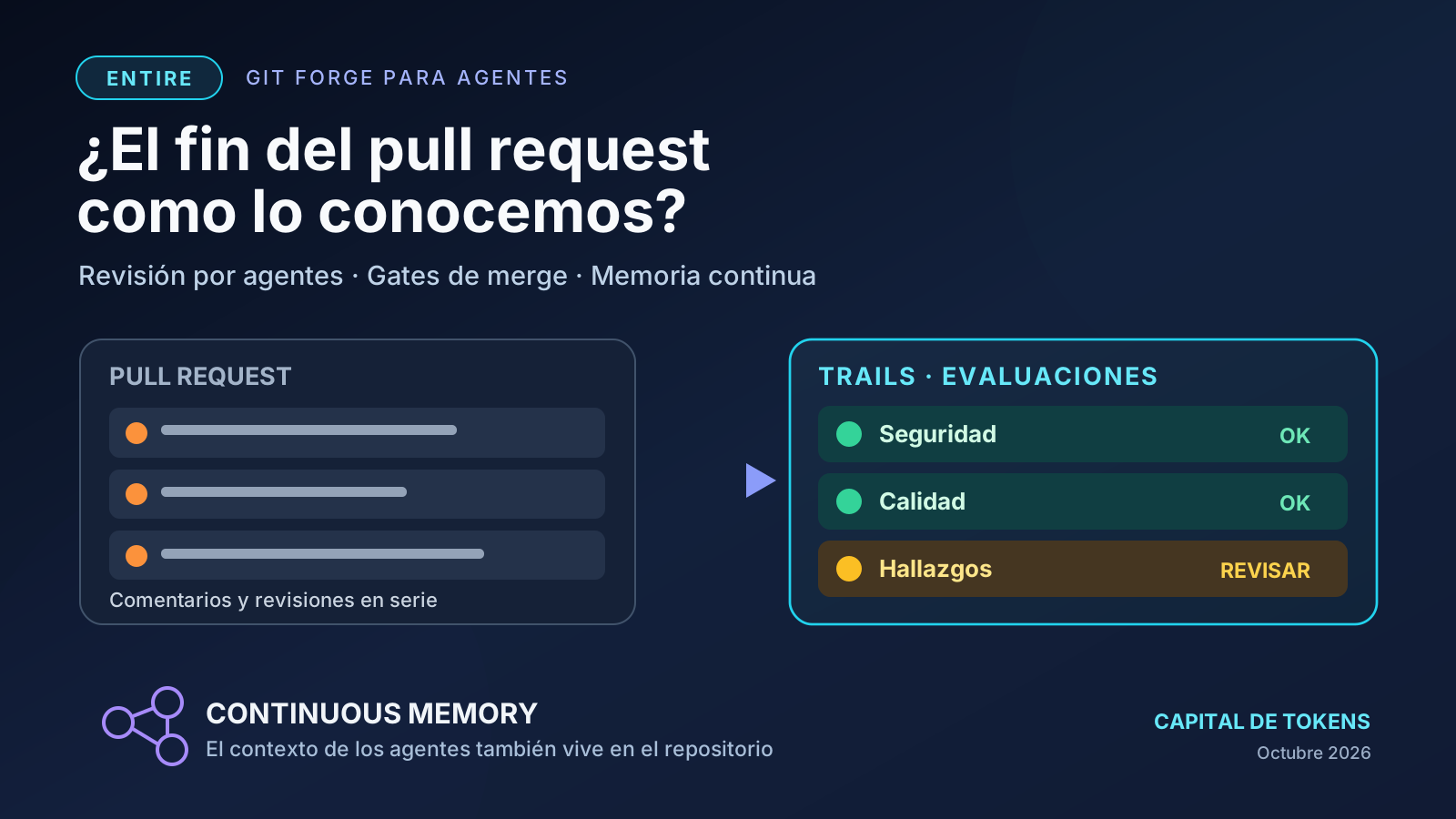
What if the bottleneck in AI-assisted development is no longer writing code, but deciding which changes are safe to merge? That is the bet behind Entire, the company led by former GitHub CEO Thomas Dohmke.
On October 26, 2026, Entire unveiled its full Git hosting and collaboration platform for teams working with coding agents. It is not merely adding a review bot to pull requests: it wants continuous evaluation of changes, agent-session history, and delivery to become parts of one workflow.
The announcement matters, but we should distinguish what ships today, what the vendor claims, and what remains unproven in independent real-world use.
The problem: agents produce changes faster than humans review them
In a conventional workflow, a developer opens a pull request, reviewers inspect a diff, CI runs tests, and comments accumulate. When multiple coding and review agents operate simultaneously, this becomes a long stream of findings, fixes, and repeated checks.
Entire reframes the task: rather than finding the latest “looks good” comment, developers should see an explicit state of the change, with evaluation scores on every push, unresolved findings, trends across runs, and clear merge requirements.
This is a product design thesis, not proof that pull requests have stopped working. Teams can already orchestrate multiple automated reviewers and tests on GitHub. Entire makes that coordination the first-class interface.
1. Trails: from reviewing diffs to evaluating every push
Its central concept is a Trail. A Trail can begin from an issue or coding agent, and may cover multiple repositories. The lifecycle is:
- A developer or coding agent proposes a change and pushes it.
- Independent review agents analyze the change in isolated cloud sandboxes and return scores, explanations, and findings. Entire provides evaluators for code quality, security, and slop (unnecessary or low-quality code), as well as configurable custom evaluators.
- The coding agent addresses findings and pushes again. The UI shows the current run plus five previous runs to help spot whether the evaluations are converging.
- Repository-level Gates can require findings to be resolved, CI to pass, and human approval before merging.
Entire says its evaluations use Claude Code and Codex in cloud sandboxes from Daytona and E2B. These are helpful signals, not guarantees that a green score means bug-free or vulnerability-free code. Testing, authorization, and project-specific policies remain essential.
| Traditional workflow | Entire’s approach |
|---|---|
| Pull request and chronological comments | Trail with front-and-center evaluation scores |
| Reviewer outputs scattered across threads | Per-push results and iteration history |
| CI status attached to the conversation | CI integrated into merge Gates |
| Agent context kept separately, if at all | Sessions linked to the work and repository |
An important distinction: Entire does not necessarily remove humans from the process. Human approval can still be mandatory; the ability to merge without reading every changed line should not be mistaken for a universal security recommendation.
2. Distributed Git: up to 89 times faster — at what, exactly?
Entire now supports native hosting of private repositories with regional replication across the US, Europe, India, and Australia. Its hosting layer remains Git-compatible while using its own distributed object storage and transactional reference infrastructure.
The company publishes an open-source benchmark reporting 418 pushes per second, versus 4.7 for GitHub and 65 for Cursor Origin. These comparisons explain its headline figures: up to 89× and 6×, respectively.
These are vendor-reported measurements for a specific benchmark, not independently established improvements for every workload. They do not mean CI builds or deployments become 89 times faster.
There is another key caveat: in mirror mode, where GitHub remains the source of truth, push traffic still goes through GitHub. This lets teams try Trails without migrating, but does not provide the same push-performance benefit as Entire-native hosting.
3. Continuous Memory: preserving the why behind the code
Potentially the most durable idea is Continuous Memory: helping coding agents recover earlier decisions and session context rather than rediscovering everything when a new session begins.
Entire introduces two open-source, local-first components:
entire-graph: creates a searchable code map containing definitions, callers, routes, and change impact, using local tree-sitter analysis without network or model calls to build the graph.entire-brain: connects that map to agent sessions and prompts saved with the repository, helping agents find the practical reasoning behind earlier choices. It can also connect to Entire’s backend for shared team memory.
Entire says entire-graph saved up to 71% of tokens in its testing. That does not mean every Entire customer will reduce their total AI bill by 71%. Savings depend on the workload and baseline.
A significant operational concern is data handling: storing prompts and sessions can expose credentials, personal data, or sensitive internal context unless retention, filtering, and access controls are designed before syncing logs.
4. CI integrations and what is still missing
At launch, Entire integrates with Buildkite and Depot for continuous integration. Buildkite can convert existing pipelines; Depot can reuse workflows compatible with GitHub Actions. This does not mean GitHub Actions runs natively inside Entire without migration or integration.
As of October 27, 2026, Entire lists public repositories, self-hosted Git nodes, and additional integrations as future capabilities. A complete migration is therefore premature for open-source projects that rely on public hosting.
Entire also announced a $60 million seed round in February. That is useful business context, but funding does not independently validate review-agent accuracy or performance.
Should a team migrate from GitHub today?
For small and medium teams whose review automation, tests, and deployment already work, there is no compelling need to migrate immediately. There may be value in a controlled experiment when coordinating several review agents is becoming expensive or error-prone.
An evidence-based experiment would be:
- Pick a noncritical private repository and keep GitHub as the origin via mirroring.
- Try Trails with explicit evaluation criteria; compare findings against the current review process.
- Keep automated tests, access controls, and human approvals for sensitive changes.
- Measure false positives, missed defects, time to merge, number of iterations, and token costs.
- Evaluate Continuous Memory using sanitized sessions before storing real operational traces.
This is editorial advice, not an official Entire migration procedure.
Conclusion: trust is the next bottleneck
Entire’s launch does not mean GitHub is obsolete. It means a competitor now treats agent activity and evaluations as core platform artifacts, rather than extra comments in a pull request.
The important shift is not “AI writes code and AI approves it.” It is this: if coding agents multiply change volume, the evidence, auditability, and control mechanisms must improve at the same pace.
Whether Trails outperforms a carefully automated GitHub workflow still requires independent testing and operational experience. In the meantime, the most useful lesson may be to adopt iterative evaluation and persistent memory before rushing to replace infrastructure that already works.
Sources
- Entire — The Git Forge for Agent-Human Collaboration (Thomas Dohmke, October 26, 2026) — architecture, Trails, and vendor-reported metrics.
- Entire — official launch announcement (October 26, 2026) — availability, CI partners, funding, and roadmap.
- Entire — ForgeMark benchmark (code and methodology) — vendor benchmark, not an independent validation.
- The New Stack — Ex-GitHub CEO launches a GitHub rival that reinvents the pull request (October 26, 2026) — independent coverage of the announcement.