 Capital de Tokens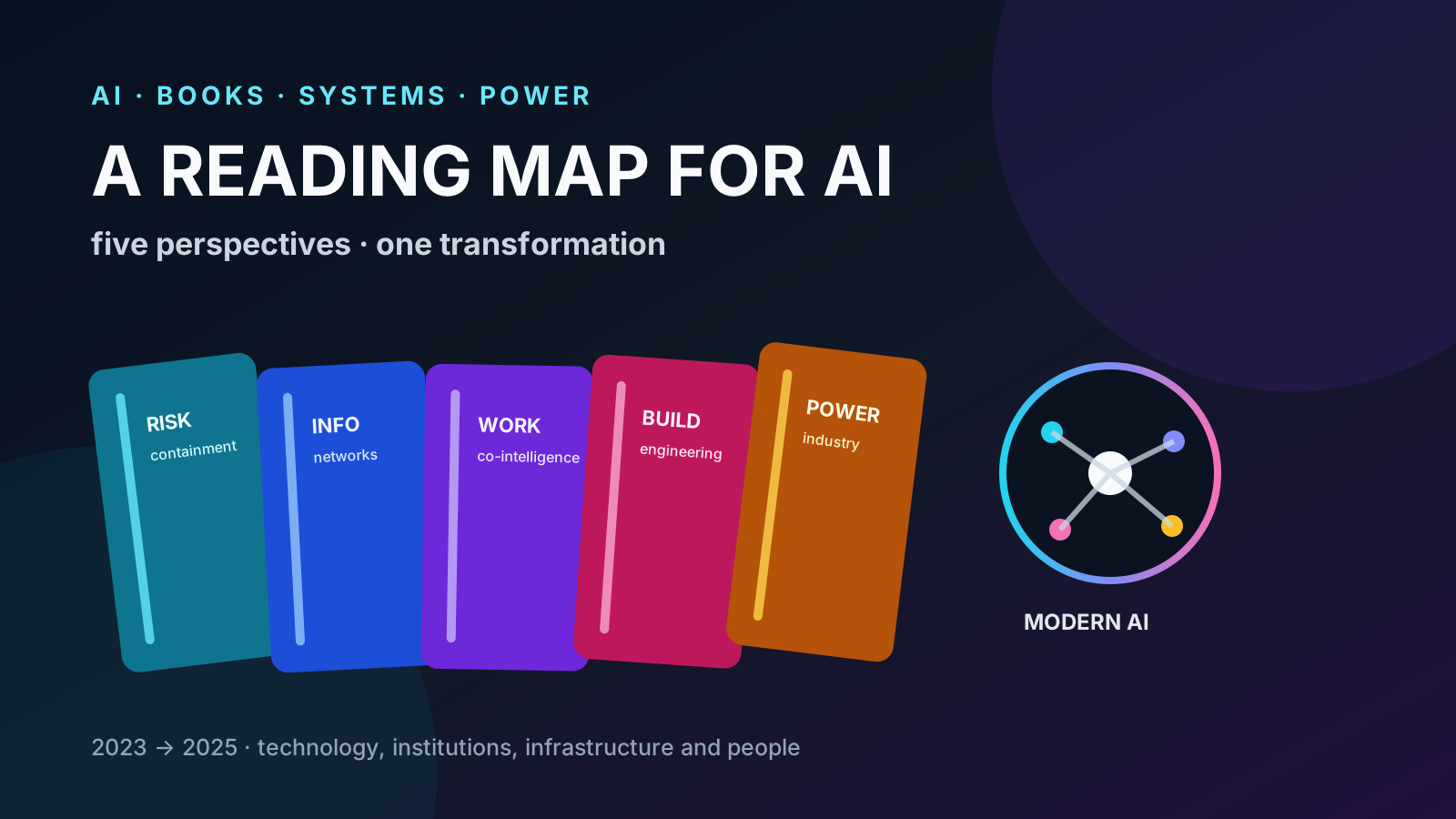
The conversation around artificial intelligence moves so quickly that one book is rarely enough.
Some authors explain what could go wrong. Others treat AI as a new information network. Others focus on how to work with it, how to build real products, or how power is concentrating around companies such as OpenAI.
Instead of searching for “the best AI book,” it is more useful to build a reading map.
This selection brings together five books published between 2023 and 2025 that cover complementary perspectives and that, as of September 2026, have a Spanish edition or a clear path for reading them in Spanish.
The quick map
| Book | Original year | What it adds | Spanish edition | Spanish audiobook |
|---|---|---|---|---|
| The Coming Wave — Mustafa Suleyman and Michael Bhaskar | 2023 | Risk, power, and technological containment | Yes | Yes |
| Nexus — Yuval Noah Harari | 2024 | Information networks, history, and AI | Yes | Yes |
| Co-Intelligence — Ethan Mollick | 2024 | Practical AI for work and learning | Yes | Yes |
| AI Engineering — Chip Huyen | 2025 | Building applications with foundation models | Yes | Not verified in Spanish |
| Empire of AI — Karen Hao | 2025 | OpenAI, Sam Altman, compute, resources, and power | Yes | Audible: verified in English |
The important point is that these books are not substitutes for one another. They answer different questions.
1. The Coming Wave: can we contain technologies everyone wants to deploy?
The Coming Wave, by Mustafa Suleyman and Michael Bhaskar, was originally published in 2023.
Suleyman writes from inside the industry: he co-founded DeepMind and later became the leader of Microsoft AI. The book revolves around a tension that is easy to state and difficult to solve: the most powerful technologies create economic and strategic incentives so strong that slowing their proliferation becomes extremely hard.
AI occupies much of the argument, but the book also discusses synthetic biology and other rapidly diffusing technologies.
Its central concept is containment: how to capture the benefits of a technology without losing the ability to control its use.
A Spanish edition has existed since 2023, and Audible offers an unabridged Spanish-language version narrated by Roger Serradell, released in July 2025.
Sources: Penguin Libros · Audible
2. Nexus: before understanding AI, understand information networks
In Nexus, published in 2024, Yuval Noah Harari widens the frame.
Artificial intelligence appears as the latest stage of a much longer story: how humans build networks that store, transmit, and organize information.
The book moves from ancient societies and bureaucracies to modern media, algorithms, and artificial intelligence.
Its central question is not “which model is best?” but something more structural:
What happens when an information network starts making decisions and producing content with an autonomy that once belonged to humans?
For readers who want to understand AI beyond benchmarks, models, and products, that historical perspective can be useful.
Nexus has had an official Spanish edition since 2024. Audible offers both Castilian Spanish and a Latin American Spanish edition narrated by Carlos Manuel Vesga.
Sources: Penguin Libros · Audible — Latin American Spanish edition
3. Co-Intelligence: less futurism, more “what do I do with this tomorrow?”
Ethan Mollick takes a different route in Co-Intelligence.
Instead of devoting most of the book to superintelligence, geopolitics, or extreme scenarios, he focuses on everyday coexistence with generative models.
AI appears as a coworker, tutor, coach, and creative tool.
That makes the book a bridge between two conversations that are often kept separate:
- the abstract debate about AI’s future;
- the practical use of ChatGPT and similar systems for work and learning.
The Spanish edition has an unabridged Latin American Spanish audiobook narrated by Luis Solís.
Source: Audible
4. AI Engineering: moving from using models to building systems
The first three books can be read without any intention of writing software.
Chip Huyen’s AI Engineering is different.
The original, AI Engineering: Building Applications with Foundation Models, was published by O’Reilly in 2025 and focuses on turning foundation models into real applications.
Topics include:
- model selection;
- evaluation;
- prompting and context construction;
- RAG;
- fine-tuning;
- agents;
- data engineering;
- latency and cost;
- user feedback;
- AI system architecture.
The author explicitly frames the book around durable fundamentals rather than a particular API or framework.
That matters in an ecosystem where tools can change every few months.
O’Reilly’s Spanish edition, Ingeniería de IA: Creación de aplicaciones con modelos fundacionales, appeared in November 2025 and is available as a Spanish ebook. The audio edition we could verify on Audible is the English original; we did not find sufficient evidence to claim that a full official Spanish audiobook currently exists.
Sources: official book repository · Apple Books — Spanish edition
5. Empire of AI: looking inside the OpenAI race
If The Coming Wave studies the problem from above, Karen Hao’s Empire of AI enters one of the organizations that accelerated that wave.
The original book appeared in 2025. Hao had been covering OpenAI since 2019 and built the book from years of reporting and more than 250 interviews, according to the Spanish publisher.
The focus is not only models and products.
It also examines the resources required to scale AI:
- chips and compute capacity;
- data;
- human labor to prepare and moderate information;
- energy;
- water;
- capital;
- organizational structures and concentrations of power.
That makes the book a strong complement to AI Engineering.
One explains how to build systems with foundation models. The other asks what industrial structure makes building them at scale possible.
The Spanish edition from Península was published on November 26, 2025 as El imperio de la IA: Sam Altman y su carrera por dominar al mundo. Audible carries Empire of AI, but the edition we verified is narrated in English by Karen Hao.
Sources: Ediciones Península / Planeta · Audible
There is no single reading order
A useful sequence depends on the question you want to answer.
For the big-picture impact and risks of AI, The Coming Wave offers the most direct frame.
For the relationship between information, institutions, and decision-making, Nexus widens the lens.
For putting the technology to work in everyday tasks, Co-Intelligence is the practical bridge.
For people building software with LLMs, AI Engineering shifts the conversation from “using ChatGPT” to evaluating, deploying, and operating AI systems.
And for understanding why OpenAI, Microsoft, Google, chips, data centers, and capital keep appearing in AI news, Empire of AI adds the corporate and industrial dimension.
What about Supremacy?
A sixth book fits this map extremely well: Parmy Olson’s Supremacy: AI, ChatGPT, and the Race That Will Change the World, published in 2024 and winner of that year’s Financial Times & Schroders Business Book of the Year.
It reconstructs the competition between OpenAI and DeepMind and the roles of Microsoft and Google.
It is one of the most direct companions to Empire of AI. However, while preparing this guide we did not find a sufficiently clear full commercial Spanish edition to place it in the main list of books available in Spanish.
Source: Google Books
An AI library needs different perspectives
The AI industry is often explained from one of two extremes: technological enthusiasm or warnings about risk.
These books show a wider landscape.
There is a technology layer: models, agents, evaluations, data, and systems.
There is an infrastructure layer: chips, energy, data centers, and capital.
There is an organizational layer: OpenAI, DeepMind, Microsoft, Google, and their incentives.
And there is a societal layer: information, institutions, work, and the distribution of power.
Understanding modern AI means moving between all of them.
That may be the best principle for building a library on the subject: do not look for one book with every answer. Look for several books that ask different questions about the same transformation.