 Capital de Tokens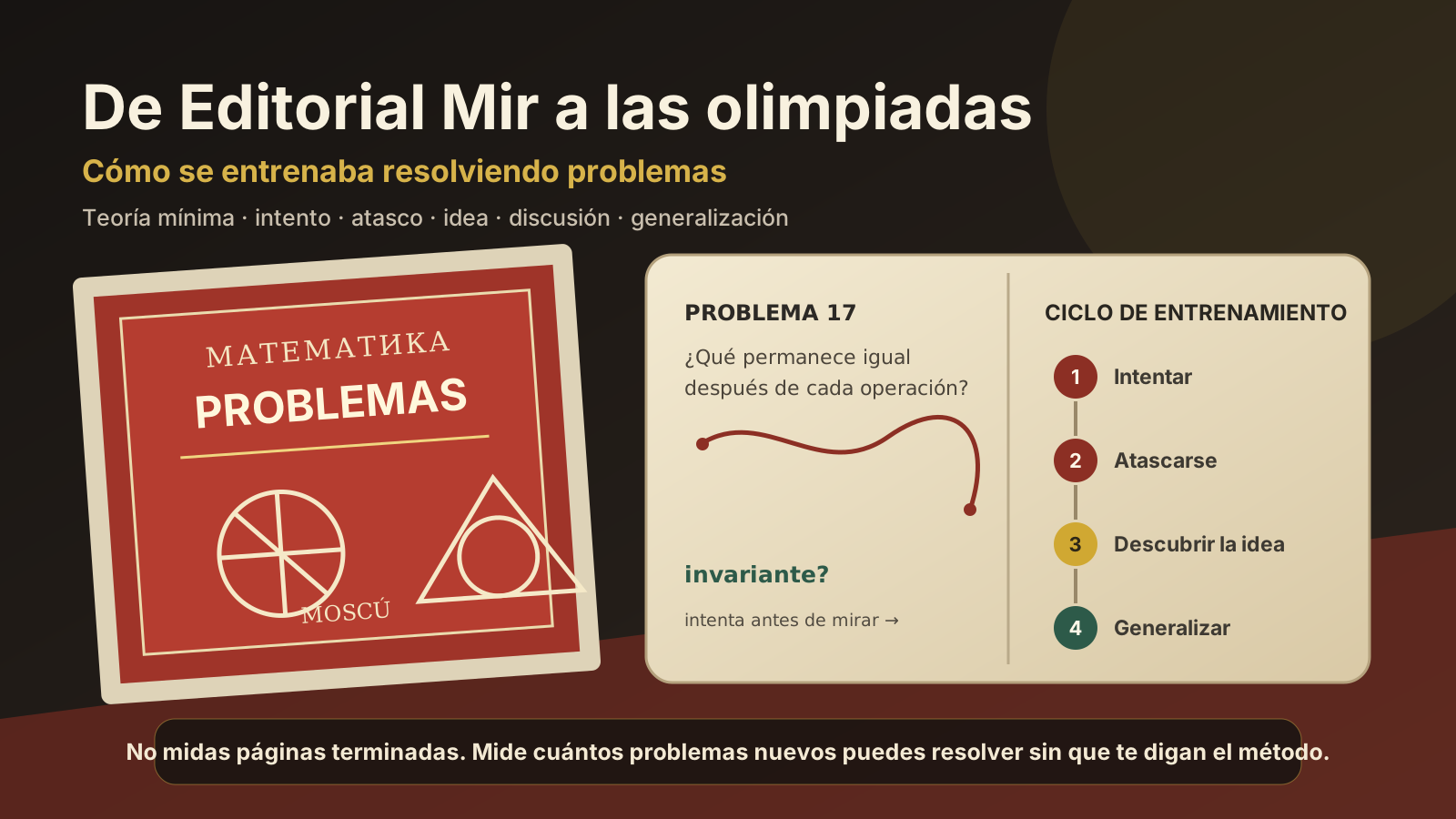
For generations of students in Cuba, Latin America, India, and elsewhere, Mir Publishers became associated with a very specific object: Soviet mathematics and physics books, careful translations, modest paper, and an intimidating density of exercises.
That raises a natural question: was this also how Soviet contest students trained?
The useful answer is yes, but with an important qualification.
Soviet students did not prepare for Olympiads simply by working through a Mir edition from cover to cover. Mir was primarily an international window into Soviet scientific and technical literature. Inside the USSR, competition culture relied on the original Russian texts, problem collections, past Olympiads, specialized schools, and—crucially—mathematical circles.
What Mir exported was a visible slice of a broader educational philosophy: learn mathematics and physics by wrestling with problems that force you to think.
Mir was not an Olympiad academy
It helps to separate two things that are easy to blend together in retrospect.
On one side were books such as:
- N. Piskunov — Differential and Integral Calculus.
- B. Demidovich — Problems in Mathematical Analysis.
- I. E. Irodov — Problems in General Physics.
- collections on geometry, algebra, differential equations, and mathematical physics by many Soviet authors.
Many of these were university-level books. Demidovich is not a school Olympiad manual, and Irodov was not written specifically as a secondary-school Physics Olympiad book. They can build formidable technical skill, but their goals are not identical to elementary competition mathematics.
On the other side was literature explicitly aimed at non-routine problem solving and contests. A classic example is The USSR Olympiad Problem Book by Shklarsky, Chentzov, and Yaglom, which still appears in modern problem-solving reading lists such as MIT’s Putnam Seminar.
The distinction matters: Mir did not create the Soviet Olympiad method; it helped spread internationally many books produced by the same mathematical culture that nourished it.
The basic unit of training was the problem
A conventional course often follows this pattern:
explanation → worked example → exercises that imitate the example.
The mathematical-circle tradition could reverse the relationship:
problem → attempt → dead end → new idea → discussion → generalization.
A student might receive a problem without being told which method applied. It did not necessarily say “use induction,” “apply Cauchy-Schwarz,” or “solve with conservation of energy.” The first task was to discover the hidden structure.
That changes what studying means.
The goal is no longer merely to remember recipes. It is to build a mental library of patterns:
- parity;
- invariants;
- extremal arguments;
- divisibility;
- symmetry;
- auxiliary constructions;
- contradiction;
- bounds;
- changes of representation;
- conservation laws;
- dimensional analysis.
The problem is not merely a test after learning. It becomes part of the learning mechanism itself.
1. Learn the minimum theory needed to enter the problem
Strong students obviously needed theory. But problem training did not require consuming hundreds of pages before attempting anything.
A useful strategy was to acquire enough language and tools to enter a topic, then start solving.
A text such as Piskunov could provide a calculus foundation. A geometry book could establish key theorems. A mechanics text could introduce the governing laws. After that came the harder skill: recognizing when each tool should be used.
Knowing a formula and realizing that the formula unlocks an unfamiliar problem are different abilities. Competitions measure the second one heavily.
2. Attempt before looking
Large problem books lose much of their value if they become collections of solutions to read passively.
The struggle phase matters.
When a student spends 20, 40, or 90 minutes on a problem, tries approaches, and discovers why they fail, they build information that a polished solution hides. Once you see the official solution it can look inevitable. Before seeing it, it rarely does.
A useful discipline is to distinguish three states:
- Solved without help.
- Solved after a hint.
- Not solved; the solution had to be studied.
All three can produce learning, but they should not be confused.
3. Compare solutions, not merely answers
In contest mathematics, the final numeric answer may be the least interesting part.
Two students can prove the same result through intellectually different routes. Discussing those routes reveals another layer of learning:
- what observation opened the problem?
- which steps were essential?
- which solution generalizes better?
- which uses less machinery?
- which idea can be reused tomorrow?
The Moscow Mathematical Olympiad, whose tradition goes back to 1935, exemplifies this culture of nonstandard problems. Modern collections emphasize that some problems may require hours of contemplation and that studying multiple solutions is itself a way to develop mathematical insight.
4. Extract the idea and compress the experience
After ten inequality problems, a student should not retain only ten unrelated solutions.
Something more abstract should begin to appear:
“When I see this form, normalization may help.”
Or:
“This operation changes many quantities, but it preserves parity.”
Or in physics:
“Before writing equations of motion, perhaps there is a conserved quantity that eliminates most of the calculation.”
That is a major transition from routine practice to competition training: compress many concrete problems into a small set of transferable ideas.
5. Return to failed problems
A problem you failed to solve can be more valuable than five routine exercises.
A powerful method is to study the solution, then return days or weeks later and reconstruct it without looking.
An even better step is to change the problem:
- what if one hypothesis is removed?
- does it still work for negative integers?
- does the geometry survive in three dimensions?
- can “maximum” be replaced by “minimum”?
- what quantity stops being conserved if friction is introduced?
Now the solution is no longer merely an answer. It becomes an object of study.
6. Mix topics with real contest collections
Once technical repertoire grows, past Olympiads serve a different purpose: they remove the label from the technique.
In a chapter titled “Diophantine equations,” you already know what family of ideas to search. In a real contest, you do not.
That difference is enormous.
The student must decide whether a problem is really number theory, disguised combinatorics, geometry, an invariant argument, or an unexpected mixture.
The Soviet Union Mathematical Olympiad ran nationally for decades and generated a substantial problem literature. AMS/MAA historical material documents a 32-year history for the all-Union competition from 1961 to 1992, alongside older regional traditions in places such as Moscow and Leningrad.
Where do Demidovich and Irodov fit?
This is perhaps the most useful distinction.
Demidovich: analytical muscle
Demidovich trains volume, precision, and pattern recognition in mathematical analysis. Working many variations can make limits, derivatives, integrals, series, and differential equations much less fragile.
That does not automatically make it school-Olympiad preparation. It makes it a machine for technical fluency.
Irodov: reduce physics to principles
Irodov became internationally famous as a difficult problem book. An English edition of Problems in General Physics was published by Mir in Moscow, and its problems frequently require combining principles instead of substituting numbers into an obvious formula.
For advanced university or competition physics, the habit is valuable: identify the model, choose the system, search for symmetry or conserved quantities, and calculate only after the structure is clear.
Olympiad collections: train the choice of idea
Olympiad-specific books add something different: they reduce dependence on advanced university content and increase the weight of the unexpected idea.
A complete training stack can therefore combine three layers:
theory          → acquire tools
problem book    → build fluency and depth
olympiads       → learn to choose the idea without being told which one
Why mathematical circles mattered
Circles may be the most important ingredient that disappears when we only see the books.
They were not simply extra lectures. Students gathered around carefully selected problems, usually under the guidance of a teacher or mathematician. There was time to attempt, present, fail, debate, and compare approaches.
The tradition survives internationally. The AMS Mathematical Circles Library and books such as Mathematical Circles: Russian Experience explicitly preserve the link between problem sequences, discussion, and the formation of mathematical taste.
This is why downloading a list of “100 great Soviet books” does not reproduce the system. The social method mattered as much as the material.
A good trainer did more than hand out difficult exercises. The trainer designed a sequence: one approachable problem that exposes an idea, another that forces the student to deform it, and a third where the same idea appears in disguise.
A modern version of the method
The philosophy transfers easily to competitive programming, mathematics, or physics.
A practical loop might look like this:
1. Pick a topic and learn only the theory needed to begin.
2. Solve 3–5 problems without reading tags or solutions.
3. Record where you became stuck.
4. If you need a hint, use the smallest possible hint.
5. After solving, find a different solution.
6. Write the transferable idea in one sentence.
7. Retry failed problems a week later.
8. Periodically mix topics in a timed session.
For competitive programming the mapping is almost direct:
problem book                    → curated problem set
mathematical circle             → editorial + discussion + review
past olympiad                   → virtual contest
official solution               → editorial
reusable mathematical idea      → pattern / invariant / algorithmic technique
The modern temptation is obvious: the solution is always one click away.
That makes the discipline of remaining inside the problem for a while even more valuable.
Do not measure pages; measure independence
Perhaps this is the most durable idea from that training culture.
Finishing a book does not prove that you can solve new problems. Seeing 500 solutions does not either.
A harsher and more useful measure is:
How many unfamiliar problems can I solve when nobody tells me which technique to use?
That is the deep connection between old Soviet problem books, mathematical circles, Olympiads, and modern training environments such as competitive programming platforms.
Mir’s books are memorable for their authors, translations, reach, and affordability. But their most interesting legacy may not be a particular formula or collection.
It is a way of studying: attempt, fail, discover, compare, abstract, and try again.
Sources and further reading
- MIT OpenCourseWare — Mathematical Problem Solving (Putnam Seminar): Readings
- American Mathematical Society — Mathematical Circles Library
- AMS/MAA — historical material on the Soviet Union Mathematical Olympiad
- Springer — Grade Five Competition from the Leningrad Mathematical Olympiad: 1979–1992
- Open Library — I. E. Irodov, Problems in General Physics, Mir Publishers
- U.S. Office of the Historian — Soviet foreign scientific and technical publishing