 Capital de Tokens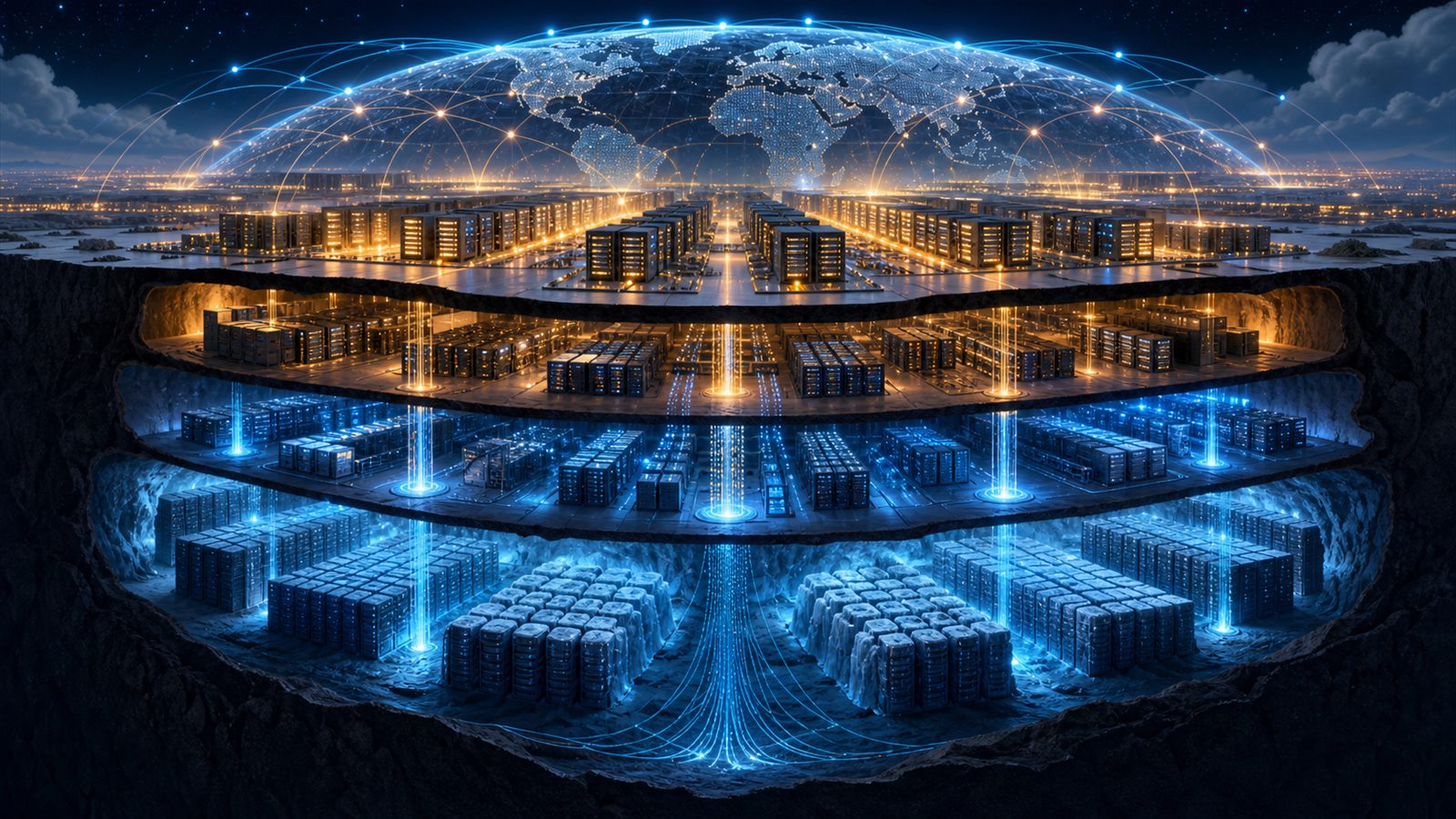
Every minute we upload videos, photographs, messages, documents, and audio to services such as YouTube, Telegram, Instagram, or Google. From the user’s perspective, the behavior seems almost magical: the files are still there months or years later even as the total amount of data keeps growing.
At first glance, the equation seems impossible. If millions of people continuously produce content, how can these companies preserve it without storage costs becoming unmanageable?
The answer is less mysterious and, at the same time, more interesting: the cloud does not work like one gigantic hard drive. It works as a combination of distributed systems, tiered storage, compression, efficient redundancy, distribution networks, automation, and economies of scale.
A file does not necessarily live on a single disk
On a personal computer we usually imagine a direct relationship:
file → diskOn a global platform, that abstraction is no longer enough. A large object can be split into blocks and distributed across different disks, servers, or even availability zones.
video.mp4
    ↓
┌──────┬──────┬──────┬──────┐
│ B1   │ B2   │ B3   │ B4   │
└──────┴──────┴──────┴──────┘
The system keeps metadata that tells it where each fragment is located and how to reconstruct the file when someone requests it.
This approach enables horizontal scaling: instead of relying on an ever-larger machine, more nodes are added to the system. It is one of the fundamental ideas behind much of modern distributed-storage infrastructure.
Redundancy without tripling everything
Hardware fails. Disks die, servers disconnect, and in extreme cases an entire facility can become unavailable.
The simplest way to protect a file would be to keep several complete copies. If we store three copies, one logical terabyte could become three physical terabytes.
That works, but at petabyte or exabyte scale it becomes expensive.
That is why techniques such as erasure coding exist. Instead of keeping several identical copies, the system divides information into data fragments and adds parity fragments.
D1 D2 D3 D4 D5 D6 + P1 P2If part of the data is lost, the remaining pieces and parity allow it to be reconstructed. The result is fault tolerance with less overhead than full replication several times over.
The idea changes the economics of storage: the question is not only how to store information, but how much redundancy we need and what the cheapest way is to achieve it without sacrificing durability.
Not all data deserves the same kind of storage
Imagine two videos:
- one published an hour ago and watched millions of times;
- another published twelve years ago that gets one view every few months.
Storing both in exactly the same way would be inefficient.
That is why large-scale systems often separate data into tiers:
HOT
 ↓
WARM
 ↓
COLD
 ↓
ARCHIVE
Hot content needs low latency and high read capacity. Cold content can remain on cheaper media because almost nobody accesses it. The archive tier prioritizes durability and cost over immediate speed.
The transition can be automatic. A popular file may initially live in fast storage, move over time to a cheaper tier, and be promoted again if it suddenly regains traffic.
The question stops being “where do we store this file?” and becomes “which tier should it live in today?”
Cost per terabyte changes radically at scale
When an individual buys storage, they pay a retail price that includes commercial margin, support, redundancy, software, operations, and other costs.
Large platforms operate under a different economy. They can buy hardware in volume, design data centers, optimize servers, automate replacements, build private networks between regions, and negotiate energy and infrastructure directly.
That is why the marginal cost of preserving an additional terabyte can be far lower than the price an end customer sees.
At this scale, even small improvements matter. Reducing wasted capacity, internal traffic, or power consumption by a few percentage points can translate into huge savings when multiplied across millions of disks and hundreds of millions of users.
Storage density keeps increasing
Another force helps sustain growth: over time, the same amount of physical space can store more data.
A rack that years ago held a certain number of terabytes can now hold many times that capacity without multiplying the building, cabling, staff, or floor area by the same amount.
Large platforms live in a race between two curves:
total stored volume ↑↑↑

        versus

effective cost per TB ↓↓↓
As long as technological and operational improvements reduce unit cost enough, infrastructure can continue expanding even while data volume keeps increasing.
Compression completely changes the equation
Video is one of the best examples.
When someone uploads a file to a platform such as YouTube, what is eventually served to users does not have to be an exact copy of the original file. The platform can transcode it into different resolutions, bitrates, and codecs.
Original
   ↓
transcoding
   ↓
4K
1440p
1080p
720p
480p
360p
At first glance, producing several versions seems like it should increase storage. To some extent it does, but modern codecs aggressively reduce the number of bits needed to represent the same visual content.
Also, not every intermediate artifact has to be kept forever. Many temporary files from ingestion or transcoding can be deleted once the pipeline finishes.
The real optimization is to represent the content with the fewest bits compatible with the quality and experience the platform wants to offer.
Storing data and serving data are different problems
This point is easy to miss.
The fact that a file is preserved does not mean the system has to read it constantly. On many platforms, a small fraction of the content concentrates a huge share of the traffic.
Conceptually, we might imagine something like:
1 PB   → very high traffic
9 PB   → occasional traffic
90 PB  → almost never accessed
The figures are illustrative, but the pattern matters: storing old data can be relatively cheap if it rarely has to move across the network.
In fact, in some systems the cost of reading, transferring, and serving data repeatedly can become as important as the cost of keeping it stored.
That is why storage and distribution have to be designed together.
Popular content moves closer to the user
When a video goes viral, it would be very inefficient for every playback to travel to a single central server.
Platforms use content distribution networks and caches to place copies close to the regions where demand exists.
                 ORIGIN
                   │
        ┌──────────┼──────────┐
        ↓          ↓          ↓
      Miami      Madrid      Tokyo
       cache       cache       cache
If thousands of people in Florida request the same content, a nearby copy can serve those requests. That reduces latency, long-distance traffic, and pressure on origin storage.
The system can keep many copies of something popular and practically no extra copies of forgotten content.
That introduces another key principle: the number of replicas of an object can depend on demand.
“Free” does not mean storage is free
Preserving information costs money. The point is that the user does not always pay that cost directly.
Platforms can fund infrastructure through advertising, premium subscriptions, enterprise services, complementary products, or revenue generated by other parts of their ecosystem.
From that perspective, storage can function as a strategic subsidy. Keeping your photos, videos, messages, or documents inside a platform increases the value you get from it and also increases the likelihood that you continue using it.
So the right economic question is not simply “how much does it cost to store this file?” but:
what value does the platform generate by keeping this data inside its ecosystem?
A billion users do not imply a billion separate infrastructures
A global platform does not build an independent system for every person. Users share enormous common layers:
- software;
- networks;
- data centers;
- authentication;
- security;
- caches;
- observability;
- internal tools;
- automation;
- operations teams.
The initial infrastructure is extremely expensive, but once it exists, serving one additional user can cost proportionally much less.
That effect is one reason large-scale platforms can offer capabilities that would be economically absurd for a small company operating in isolation.
Can it grow forever?
No.
There is no infinite storage or free infrastructure. The model only works while the economics remain reasonable.
A conceptual way to express it would be:
cost growth
        <
revenue growth
+ reduction in cost per TB
+ efficiency gains
That is why there is a constant race to improve codecs, deduplication, erasure coding, disk density, cold storage, caches, automation, specialized hardware, private networks, and energy efficiency.
A 1% improvement can look irrelevant in a small application. On a platform that processes and preserves gigantic amounts of data, that same 1% can become millions of dollars.
The real magic of the cloud
The achievement of platforms such as YouTube, Telegram, Google, or Meta is not that they invented unlimited storage.
It is that they make users perceive their data as almost permanently available while, underneath, a gigantic infrastructure continuously decides:
- where to place each fragment;
- how much redundancy it needs;
- what storage class it should live in;
- when to move it to a cold tier;
- when to replicate it closer to users;
- which compressed representation is worth keeping;
- how much it costs to continue preserving it.
The cloud is not infinite. It is an enormous machine for technical and economic optimization.
And perhaps that is the most interesting part: what looks from the outside like “keeping files forever” is actually a system making millions of decisions to make every stored bit a little cheaper.
This article is an editorial adaptation for Capital de Tokens based on the topic originally developed on Telegraph.