 Capital de Tokens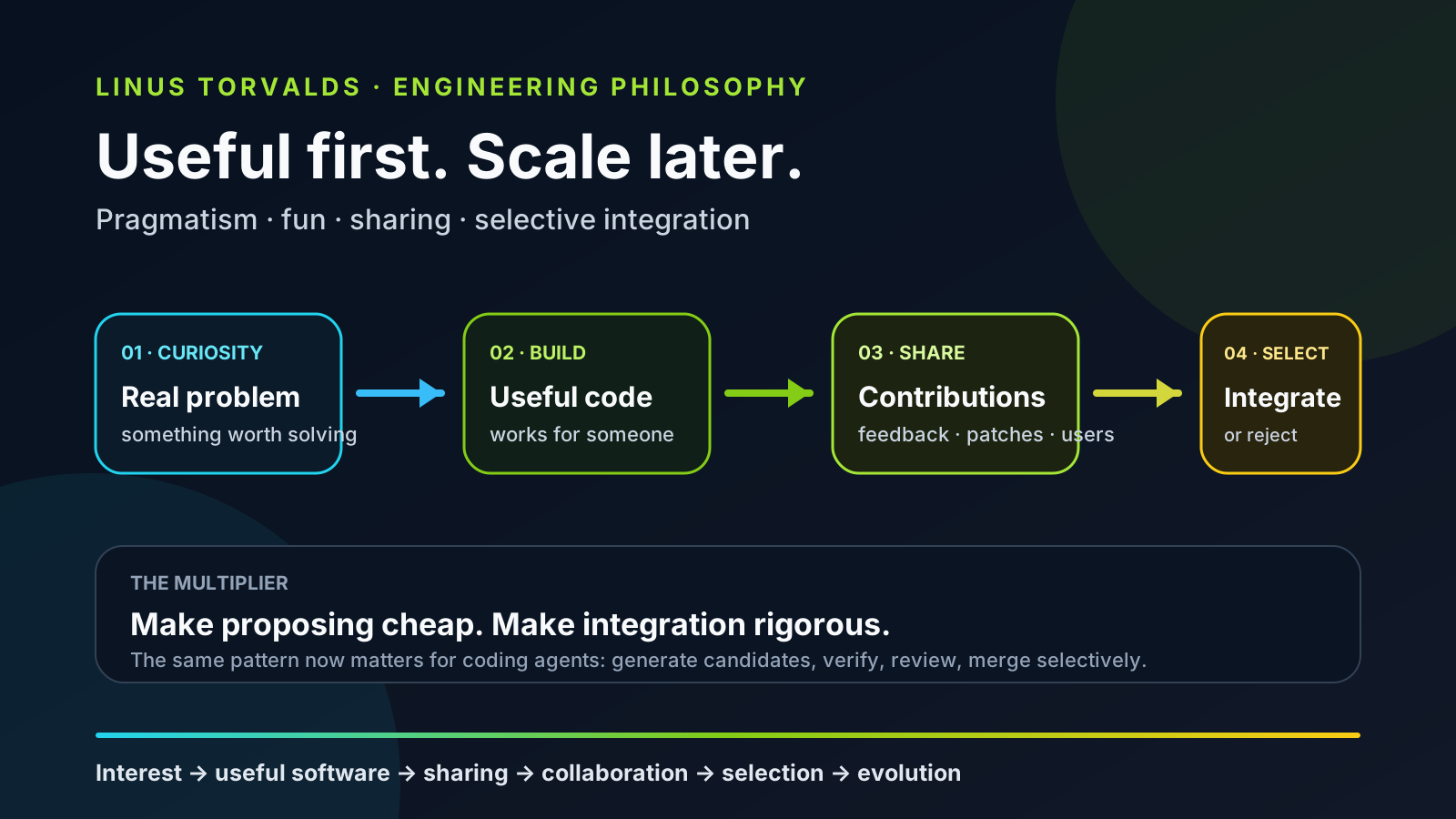
There is a common way to tell the Linux story: a student creates an operating system, publishes it on the Internet and, almost accidentally, ends up changing computing.
That story is broadly true, but it can hide the most interesting part.
What matters is not only that Linux grew. It is how it started and what kind of system allowed it to grow.
The philosophy associated with Linus Torvalds can be compressed into an unusually ungrandiose sequence:
solve something that interests you, make it useful, share it, receive improvements, and let collaboration expand what one person could build.
This is neither a universal recipe nor a formal doctrine. Torvalds has repeatedly stressed that his relationship with open source is more pragmatic than ideological.
That is precisely what makes the lesson useful.
1. “Don’t dream big” does not mean think small
Jim Zemlin, executive director of The Linux Foundation, summarized one lesson from Linux with a deliberately provocative phrase: “Don’t Dream Big.”
The point is not to reject ambition.
It is to prevent a gigantic vision from replacing concrete work.
When Torvalds published the first versions of Linux in 1991, he did not present a plan for conquering data centers, smartphones, cloud infrastructure or supercomputers. It was a personal project addressing a real technical need.
The Linux Foundation describes the attitude directly: Torvalds put Linux on the Internet as something he was doing “for fun,” without predicting what it would eventually become.
That changes how we can think about large projects.
Instead of:
GIANT VISION
      ↓
ARCHITECTURE FOR EVERYTHING
      ↓
YEARS OF BUILDING
      ↓
DOES ANYONE NEED IT?
the pattern looks more like:
REAL PROBLEM
      ↓
USEFUL SOLUTION
      ↓
USERS
      ↓
FEEDBACK
      ↓
IMPROVEMENTS
      ↓
NEW PROBLEMS
      ↺
Scale comes later.
It does not necessarily need to be designed on day one.
2. “Just for Fun” is a theory of motivation
The phrase Just for Fun sounds lightweight until you hear Torvalds explain it.
In a 2017 conversation published by Linux.com, Torvalds described a simple progression: survival comes first, then social connection, and once those needs are reasonably secured, something else becomes important — doing things because they are interesting, stimulating or fun.
For him, fun often means a technical challenge.
That distinction matters in engineering.
Many extraordinary projects do not begin with a spreadsheet proving their financial return. They begin because somebody finds a problem interesting enough to keep investing energy in it for a long time.
Fun does not replace discipline.
It can sustain it.
In complex systems, long-term fuel may be curiosity itself:
- understanding why something fails;
- removing an unnecessary abstraction;
- making a tool faster;
- building something you personally want to use;
- discovering a more elegant solution.
That kind of motivation has a special property: it can survive before any obvious external reward exists.
3. Torvalds did not arrive at open source through a grand theory
A 2004 CRN interview contains one of Torvalds’ clearest explanations.
When asked how he came to believe in the philosophy of open source, he said it was not so much about “believing in a philosophy” as doing what he wanted to do.
He wanted to share his work.
He wanted comments.
And he wanted improvements to come back.
Later in the same interview he is even clearer: his position on open source is pragmatic. He believes cooperation and open sharing of knowledge lead to better development.
This separates two questions that are often mixed together:
- Is opening software morally right?
- Does an open cooperation model produce better systems?
Torvalds has historically leaned toward the second.
That does not invalidate ethical arguments about free software. Richard Stallman, for example, builds much of his position around user freedoms.
Torvalds more often evaluates the mechanism through its results.
Does it let more people participate?
Do better patches appear?
Are bugs found earlier?
Do users turn the software into something its creator never imagined?
If so, the mechanism is working.
4. Sharing does not merely give value away — it creates a multiplier
Another lesson Zemlin extracts from Linux is “Give It All Away.”
Taken literally, that can sound economically absurd.
Open source changes the unit of analysis.
One person shares code and loses exclusivity.
In exchange, the project may receive:
- reviews;
- bug fixes;
- drivers;
- new architectures;
- tests;
- documentation;
- users;
- unexpected use cases;
- companies willing to fund work;
- maintainers able to own whole subsystems.
The important thing is not only the code that left.
It is the contribution system that came back.
Torvalds summarized the principle in the CRN interview: people should be able to use the work, but improvements should flow back.
This reveals one of open source’s most powerful properties:
a good contribution can increase the project’s future capacity to receive more contributions.
A driver enables new users.
New users discover new bugs.
Some users become contributors.
Some contributors eventually become maintainers.
The project acquires capacity its original creator never possessed.
5. The real product is also the collaboration process
Linux is usually described as a kernel.
From an engineering perspective, Linux is also a massive change-integration system.
Thousands of people can propose modifications without all of them having direct authority over the core project.
That requires structure:
CONTRIBUTORS
      ↓
PATCHES
      ↓
REVIEW
      ↓
MAINTAINERS
      ↓
SUBSYSTEMS
      ↓
INTEGRATION
      ↓
KERNEL
The trick is not accepting everything.
It is building a process in which it is cheap to propose and comparatively rigorous to integrate.
That difference is fundamental.
A collaborative project does not scale merely because many people write code.
It scales when mechanisms exist to:
- divide responsibility;
- review changes;
- reject weak contributions;
- catch regressions;
- maintain interfaces;
- preserve technical context;
- delegate authority to people who have demonstrated judgment.
The software matters.
The process that decides what software enters the system is also part of the system.
6. Linux ended up doing things Torvalds never imagined
In a LinuxCon 2015 conversation, Torvalds explained that Linux had done everything he expected it to do within its first months.
Everything after that became something different: other people solving new and interesting problems.
That statement contains a large idea.
The success of a platform is not perfect execution of its creator’s imagination.
It is enabling things its creator did not imagine.
A truly extensible project starts escaping its author.
That can be uncomfortable because it means losing direct control.
It also means the system has acquired a life of its own.
Linux eventually ran in places that were never part of the initial problem:
- servers;
- supercomputers;
- phones;
- routers;
- televisions;
- cars;
- embedded systems;
- cloud infrastructure.
Not because Torvalds designed every one of those futures.
Because other people could build on the base that already existed.
7. The counterpoint: pragmatism still needs boundaries
Torvalds’ philosophy should not become another absolute slogan.
“Start small” does not mean ignore architecture.
“Do it for fun” does not mean ignore maintenance.
“Share it” does not guarantee a community.
“Let others contribute” does not mean accept every change.
Linux works precisely because there is tension between openness and selection.
Entry into the process can be broad.
Final integration is much stricter.
That balance avoids two extremes:
TOTAL CONTROL
nobody can contribute
        ↕

UNFILTERED OPENNESS
everything gets merged
The healthier model sits between them:
PROPOSING IS EASY
        ↓
REVIEW IS SERIOUS
        ↓
INTEGRATION IS SELECTIVE
That structure matters far more than simply making source code public.
8. The connection to agent-assisted engineering
This is where the Linux philosophy becomes surprisingly current.
Coding agents dramatically reduce the cost of producing proposed changes.
An agent can:
- investigate an issue;
- modify several files;
- write tests;
- open a pull request;
- respond to feedback;
- fix failures;
- repeat the cycle.
That means the bottleneck is no longer exclusively writing code.
The new problem is integrating work produced at high speed without destroying system quality.
The Linux pattern offers a clue.
We do not need every agent to be perfect.
We need an environment in which many agents can produce candidates and a harness can select the ones that deserve to enter.
ISSUE
  ↓
AGENT
  ↓
CANDIDATE CHANGE
  ↓
TESTS
  ↓
CI
  ↓
REVIEW
  ↓
EVALUATION
  ↓
MERGE / REJECT
  ↺
That looks much more like the social architecture of an open-source project than the traditional image of one programmer manually typing every line.
9. From “writing code” to “designing a system that produces good code”
With agents, one of a team’s most valuable capabilities will be building the environment that converts uncertain work into reliable changes.
That environment includes:
- clear enough issues;
- executable tests;
- linters;
- types;
- contracts;
- observability;
- CI;
- benchmarks;
- reviewers;
- merge rules;
- rollback;
- automated feedback.
The agent produces.
The system selects.
This is a useful reinterpretation of the Torvalds lesson:
Do not try to build the entire result yourself. Build a process in which many contributions can improve the system without destroying it.
Linux demonstrated that pattern with humans.
Agent engineering is beginning to test it with mixtures of humans and machines.
10. The philosophy in one sequence
We can reduce the whole idea to this:
INTEREST
  ↓
REAL PROBLEM
  ↓
USEFUL SOLUTION
  ↓
SHARE
  ↓
FEEDBACK
  ↓
CONTRIBUTIONS
  ↓
SELECTION
  ↓
EVOLUTION
  ↺
The counterintuitive part is that scale does not appear at the beginning.
It emerges from a system that solves real problems and lets others participate.
Linux did not become Linux because someone designed a perfect day-one plan to dominate global infrastructure.
It became Linux because a useful solution found users, users became collaborators, and the project developed mechanisms capable of turning mass collaboration into coherent software.
In an era obsessed with autonomous agents, massive code generation and AI engineering teams, that may be Torvalds’ most current lesson:
the real multiplier is not producing more. It is building a system that can absorb, evaluate and improve contributions from many.
Sources
- Video that motivated this analysis: La FILOSOFÍA de Linus Torvalds.
- The Linux Foundation: Jim Zemlin at TEDx: What We’ve Learned from Linus Torvalds.
- CRN: CRN Interview: Linus Torvalds.
- Linux.com: Linus Torvalds On Fun, the Linux Kernel, and the Future.
- Linux.com: LinuxCon 2015 Report: Dirk Hohndel Chats with Linus Torvalds.
- Linux.com: Linus Torvalds’ Linux 0.02 Release Post from 1991.