 Capital de Tokens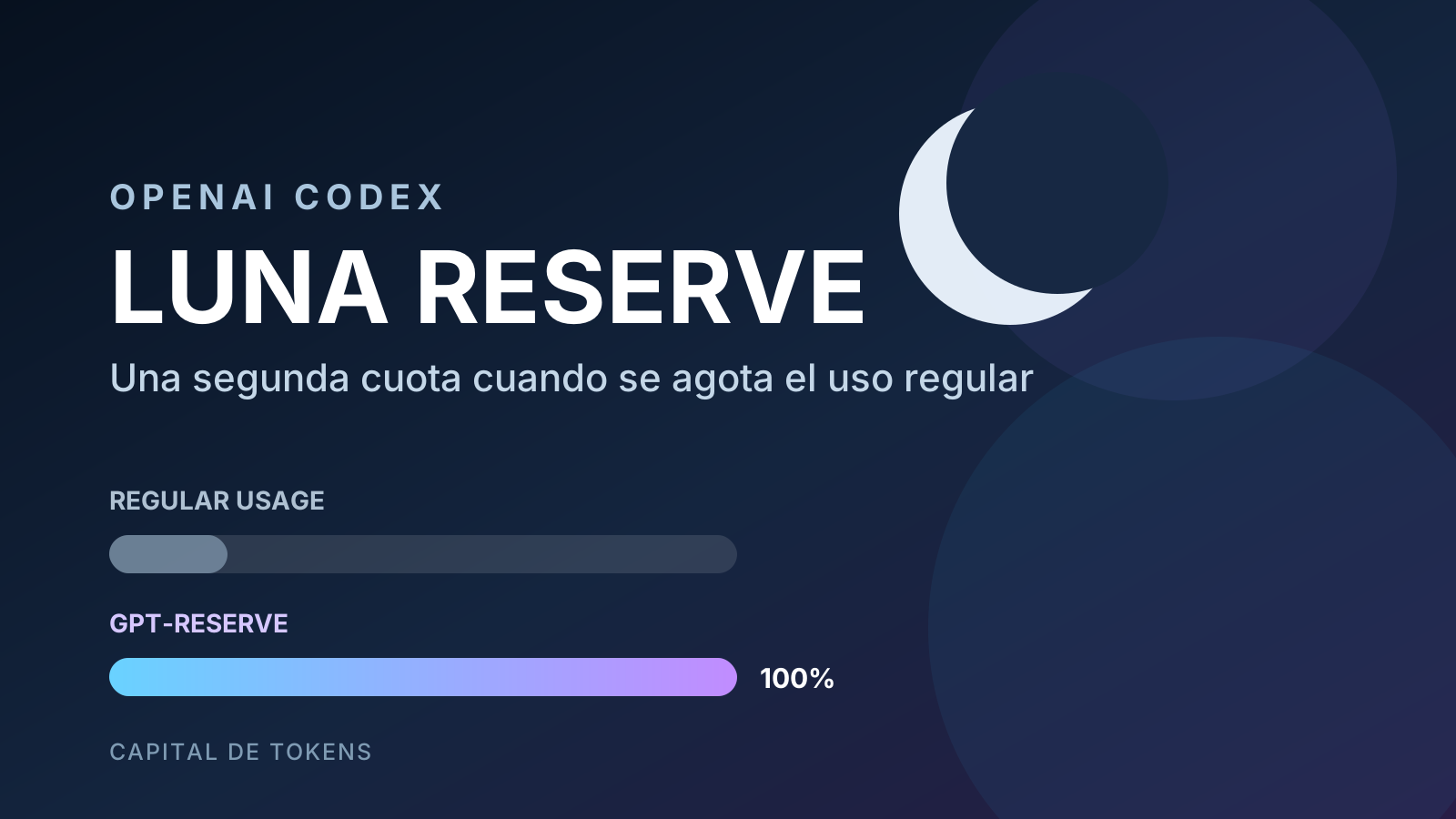
If you recently opened the Codex usage panel and saw a new line called gpt-reserve Weekly limit, you are not looking at a bug or a second subscription.
OpenAI is rolling out Luna Reserve, a separately metered fallback allowance that lets selected accounts keep working with GPT-5.6 Luna after their regular Codex usage has been exhausted.
What makes the feature especially interesting is how it appeared.
There was no big product announcement first. The feature began surfacing in real accounts, was then discovered inside the Codex client, and only afterward appeared in official OpenAI documentation.
That sequence lets us reconstruct the launch fairly well.
The short answer: when did OpenAI announce it?
We could not find a dated OpenAI launch post saying, in effect, “today we are launching Luna Reserve.”
What can be verified is this sequence:
- August 20, 2026: public user reports begin appearing about an unknown
gpt-reservemodel in Codex. - August 22: users also show a separate
gpt-reserve Weekly Limitmeter. - August 23: RuntimeWire publishes an investigation of the Codex client and finds references to
gpt-reserve,reserve_enabled, andluna_reserve, while still describing the feature as publicly undocumented. - August 27: users in OpenAI’s community are already reporting that Codex offers Luna Reserve after the normal limit is reached.
- Around August 27: OpenAI’s official help page, “Luna Reserve in Codex and ChatGPT Work,” appears to have been updated around that time.
So the most accurate summary is:
the public rollout began no later than around August 20, 2026, and OpenAI documented it officially about a week later.
The August 27 date should be treated as an approximation based on the help page’s update marker, not as a formally published launch date from OpenAI.
What Luna Reserve actually is
OpenAI’s official documentation describes Luna Reserve as a fallback mode available only to selected accounts.
The idea is straightforward:
regular Codex usage
        ↓
regular allowance is exhausted
        ↓
Luna Reserve is available for the account
        ↓
Codex continues with GPT-5.6 Luna
        ↓
a separate reserve allowance is consumed
It is not an extra purchase, it does not restore your normal allowance, and it does not unlock the most capable models once regular usage has been exhausted.
It is, in practical terms, a second tank.
OpenAI also confirms that regular usage and Luna Reserve have separate allowances. Reserve has its own limit and can display its own reset timing.
That explains why some users see something like:
Weekly limit
██████░░░░  60% remaining

gpt-reserve Weekly limit
██████████  100% remaining
The second bar does not mean your main allowance increased by another 100 percent. It means there is another pool that has not yet been used.
Why the CLI says gpt-reserve while OpenAI says Luna Reserve
There are two names here for two layers of the product.
Luna Reserve is the name OpenAI uses in the user experience and in its public documentation.
gpt-reserve appears as a technical identifier inside the Codex ecosystem and in usage interfaces exposed by some clients.
RuntimeWire’s August 23 investigation found several elements inside a distributed Codex client that tied the two concepts together:
gpt-reserve
reserve_enabled
luna_reserve
The analysis also described eligibility logic, independent metering, temporary model switching, and restoration of the user’s original model selection afterward.
That mattered because OpenAI had not yet publicly explained the mechanism at the time.
The rollout was visible before the documentation
The earliest public trace we found is from August 20.
A ChatGPT Plus user posted that gpt-reserve had appeared in Codex’s model picker. Other users replied over the following days saying they had started seeing it too.
On August 22, an even more revealing signal appeared: Codex users showed a separate limit for gpt-reserve.
That changed the interpretation.
It no longer looked like just another model alias. It had a separate allowance attached to it.
The next day, RuntimeWire examined a production Windows build of the Codex client and concluded that OpenAI had built a reserve system controlled by feature flags and server-side eligibility.
The investigation was published on August 23, 2026, and at that point described Luna Reserve as active but still not officially documented.
What OpenAI later confirmed
The official help page removes much of the speculation that surrounded the early rollout.
OpenAI confirms that:
- Luna Reserve provides additional usage with GPT-5.6 Luna after regular usage is exhausted;
- it is available only to selected personal Plus and Pro accounts;
- it is not available to every user;
- it is not available in Business or Enterprise workspaces;
- it applies to supported Codex and ChatGPT Work experiences;
- it does not add API credits;
- it has a separate, finite allowance;
- when regular usage becomes available again, users can return to the models normally available under their plan.
The word selected is important.
Having Plus or Pro does not guarantee Luna Reserve.
Availability depends on the account, a supported app version, and whatever rollout OpenAI is currently running.
So when does Reserve start getting consumed?
Conceptually, Luna Reserve exists for the moment when regular usage can no longer keep the session running normally.
OpenAI’s documentation says that once the regular limit is reached, an eligible account may receive a Luna Reserve notice and continue using Luna while reserve capacity remains.
That means seeing:
gpt-reserve Weekly limit: 100%does not necessarily mean you should switch to it immediately.
It may simply mean your reserve pool is untouched because you have not yet entered the fallback scenario.
In practice, exact behavior has varied between clients and accounts during the rollout. Some users report automatic switching, while others have seen differences between Codex Desktop and the CLI.
That is why it helps to separate two things:
Confirmed fact: OpenAI offers a separate Luna fallback allowance to selected accounts after regular usage is exhausted.
Implementation behavior: exactly when the selector, warning, or transition appears can depend on client version and account rollout state.
It is not a second Sol or Terra allowance
This is probably the most important detail for anyone running long Codex tasks.
Luna Reserve does not restore full access to the normal model lineup.
If you were using a more capable model and regular usage runs out, Reserve is designed to let you continue with Luna.
Continuity therefore comes with a technical tradeoff: the capabilities available during fallback may not be identical to those of the model that started the task.
On August 27, for example, a user in OpenAI’s community described hitting the limit while working with Sol and then being offered Luna Reserve. During the continuation, the user observed differences in browser-related capabilities used by the task.
One user report does not define the behavior of the entire product, but it illustrates an important design consequence: continuing the task does not necessarily mean continuing with exactly the same capabilities.
An interesting architecture for AI usage limits
Luna Reserve also reveals a broader product idea.
The traditional subscription model for AI usage looked like this:
allowance available
      ↓
0%
      ↓
wait for reset or pay
Reserve adds an intermediate layer:
PRIMARY MODELS
      ↓
regular allowance exhausted
      ↓
CHEAPER FALLBACK
      ↓
Luna Reserve
      ↓
reserve exhausted
      ↓
reset / credits / upgrade
For OpenAI, this can help manage compute capacity without turning every usage limit into a complete interruption.
For users, it means a long programming session has a better chance of finishing, even if it has to continue on a different model.
And for agentic products such as Codex, that distinction matters: stopping halfway through a refactor, test run, or repository operation can be much more expensive than temporarily degrading to a cheaper model.
What we know and what we still do not
As of September 1, 2026, OpenAI explains the general purpose of Luna Reserve, but it does not publish every parameter behind it.
We know officially that Reserve:
- is separate from regular usage;
- is finite;
- uses GPT-5.6 Luna;
- is restricted to selected Plus and Pro accounts;
- appears in supported Codex and ChatGPT Work experiences.
The documentation we reviewed does not publish a universal number of tokens, tasks, or hours granted to every account.
It is also unsafe to assume that a visible percentage maps to an identical fixed quantity for all users.
OpenAI itself directs users to their account’s usage information to see remaining capacity and whatever reset timing is shown there.
Conclusion
gpt-reserve Weekly limit is one of those features that reached the product before it reached the documentation.
The earliest public sightings we found date to around August 20, 2026. On August 23, an analysis of the Codex client had already identified its architecture and the Luna Reserve name. By approximately August 27, OpenAI was documenting the mechanism officially.
The idea is simple but useful:
when your regular Codex allowance runs out, selected accounts can receive a second, finite reserve that keeps work moving with GPT-5.6 Luna.
That makes gpt-reserve less of a mysterious extra model and more of a new continuity layer in the economics of Codex usage.
Sources
- OpenAI Help Center — Luna Reserve in Codex and ChatGPT Work
- RuntimeWire — OpenAI Is Testing “Luna Reserve,” a Codex Fallback Tier
- Reddit / r/ChatGPT — earliest public GPT-Reserve report we found, August 20, 2026
- Reddit / r/codex — report of the separate gpt-reserve meter, August 22, 2026
- OpenAI Developer Community — Luna Reserve report after reaching a limit, August 27, 2026