 Capital de Tokens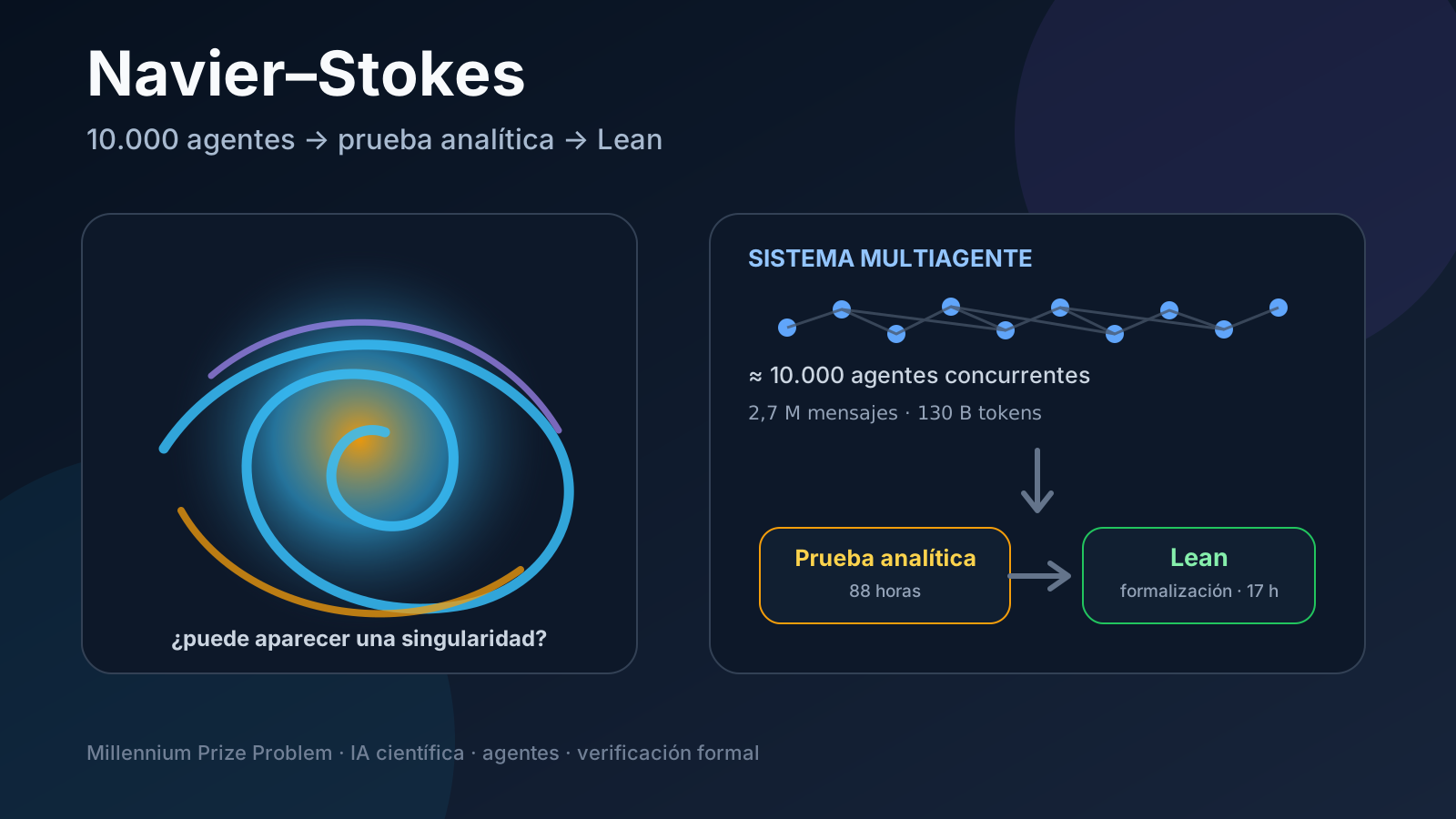
On September 8, 2026, OpenAI published a result that, if it survives independent mathematical scrutiny, could become one of the most important milestones in AI-assisted research: a proposed solution to the Navier–Stokes existence and smoothness problem, one of the seven Millennium Prize Problems created by the Clay Mathematics Institute.
The announcement stands out for two separate reasons.
The first is mathematical: Navier–Stokes has resisted a complete resolution for decades and carries a $1 million prize.
The second is methodological: OpenAI says the result was found using a system of roughly 10,000 concurrent agents, followed by a formalization of the proof in Lean.
But three different claims need to be kept separate:
OpenAI published a proof
        ↓
the proof was formalized in Lean
        ↓
the mathematics community and Clay must validate it
So, for now, the careful wording is: OpenAI says it has solved Navier–Stokes and has published a verifiable proof; Clay has not officially closed the problem yet.
What the Navier–Stokes problem actually asks
The Navier–Stokes equations describe the motion of fluids such as air and water. They appear, directly or indirectly, in areas as different as:
- aerodynamics;
- weather forecasting;
- ocean dynamics;
- blood flow;
- mechanical engineering;
- turbulence.
The Millennium Problem is not asking whether the equations are useful. They have been useful for a very long time.
The deep question is whether, for a three-dimensional incompressible fluid that starts in a sufficiently smooth state, the evolution described by the equations always remains smooth, or whether a finite-time singularity can appear.
Intuitively, a singularity would be a situation in which some quantity in the solution, such as velocity, grows without bound while the mathematical evolution still reaches that breakdown in finite time.
Viscosity tends to smooth the fluid’s motion. The challenge is to prove rigorously whether that dissipation always prevents a mathematical blow-up or whether there is a configuration that can still produce one.
What OpenAI says it proved
In its publication, OpenAI says it constructed an initially smooth solution that develops a singularity in finite time.
The setup includes a smooth external force. At first glance that may sound like a different version of the problem, but the official Clay formulation allows several valid ways to resolve it.
OpenAI says it established variants C and D of the official formulation: a counterexample in which a smooth solution fails to remain regular.
According to OpenAI’s explanation, the construction is based on a vortex that becomes increasingly concentrated and elongated while keeping finite energy. The technical challenge is to make the acceleration, pressure, momentum transport, and viscosity terms balance with extraordinary precision so that the external force remains smooth even while velocity grows without bound.
OpenAI published two key artifacts:
- a written mathematical proof;
- a formalization of the proof in the Lean proof assistant.
The primary source is here: On the Navier–Stokes Millennium Prize Problem, OpenAI.
Lean helps enormously, but it does not eliminate mathematical review
A proof formalized in Lean has a major advantage: the proof assistant’s kernel can mechanically check that the formalized steps follow from the definitions, axioms, and theorems accepted within the system.
That dramatically reduces certain kinds of human error in long proofs.
But it does not automatically mean Clay should declare the problem solved the next day.
The community still has to examine questions such as:
- Does the formalization represent exactly the hypotheses required by the official problem?
- Do the definitions match the mathematical formulation that is supposed to be resolved?
- Are there additional assumptions hidden in the abstractions?
- Do the written proof and the formal proof capture the same result?
- Does the result satisfy Clay’s publication and administrative rules?
Lean is an extremely powerful verification layer, not a replacement for the entire scientific process.
The number that changes the story: roughly 10,000 concurrent agents
Possibly the most important part of the announcement for the history of AI is not a specific equation, but how the proof was found.
OpenAI describes a multi-agent system powered by an internal model that was still in training and, according to the company, significantly more capable than GPT-6 Astra.
The process looked roughly like this:
different variants of the problem
        ↓
groups of agents explore different approaches
        ↓
groups share useful intermediate results
        ↓
Codex consolidates promising ideas
        ↓
new rounds of search
        ↓
analytical proof
        ↓
Lean formalization
The group that produced the Navier–Stokes proposal grew to on the order of 10,000 concurrent agents.
OpenAI reports extraordinary numbers for that experiment:
- about 88 hours from launching the first agents to arriving at the solution;
- 2.7 million messages among agents during the Navier–Stokes work;
- approximately 130 billion output tokens;
- another 17 hours for Lean formalization and verification using GPT-6 Astra.
Across all attempted problems, OpenAI reports 4.9 million messages and roughly 300 billion output tokens.
This no longer looks much like asking a chatbot a difficult question.
It looks more like a computational research laboratory in which thousands of artificial researchers explore in parallel, exchange hypotheses, abandon dead ends, and concentrate resources on the most promising branches.
Before Navier–Stokes, the agents solved a related Euler variant
OpenAI says it initially launched groups on all open Millennium Problems and on several related questions considered somewhat easier.
One of those was a regularity question for the Euler equations, which can be viewed as a related limit of Navier–Stokes when the viscosity term is removed.
According to OpenAI, nearly 100 agents worked for about 50 hours and produced a counterexample for an unforced Euler variant.
That result led the team to concentrate more resources on Navier–Stokes. The agents were given the Euler insights, and different groups began exchanging ideas through a process OpenAI describes as cross-pollination.
The sequence matters because it reveals something important about autonomous research systems: an intermediate discovery can immediately become context for thousands of new research branches.
The seven Millennium Prize Problems and the $1 million attached to each
The Clay Mathematics Institute created the Millennium Prize Problems in 2000 and set aside a total fund of $7 million: $1 million for the solution of each problem.
At the time of OpenAI’s announcement, Clay still showed only one of the seven as officially solved: the Poincaré Conjecture.
| Problem | What it asks, in short | Official status | Prize established |
|---|---|---|---|
| Birch and Swinnerton-Dyer Conjecture | Connects rational solutions of elliptic curves with the behavior of their L-functions. | Open | US$1 million |
| Hodge Conjecture | Asks which topological classes on certain algebraic varieties can be represented by algebraic cycles. | Open | US$1 million |
| Navier–Stokes existence and smoothness | Asks whether smooth 3D solutions remain smooth or can develop singularities. | Clay still lists it as open; OpenAI published a proposed solution on September 8, 2026. | US$1 million |
| P vs NP | Asks whether every problem whose solution can be checked quickly can also be solved quickly. | Open | US$1 million |
| Poincaré Conjecture | Characterizes the three-dimensional sphere topologically. | Solved by Grigori Perelman. | US$1 million; Perelman declined the money |
| Riemann Hypothesis | Describes where the nontrivial zeros of the zeta function lie and is deeply connected to the distribution of prime numbers. | Open | US$1 million |
| Yang–Mills and the mass gap | Asks for a rigorous mathematical construction of quantum Yang–Mills theory with a positive mass gap. | Open | US$1 million |
The official list and prize fund are described at The Millennium Prize Problems, Clay Mathematics Institute.
The Poincaré Conjecture was solved by Grigori Perelman, who was formally awarded the Millennium Prize in 2010 but later declined the $1 million. Clay redirected those funds toward mathematical research initiatives.
That leaves six problems that, from Clay’s official point of view, remain open at this moment.
So, has OpenAI already won the million dollars?
No.
And OpenAI explicitly says it does not intend to claim the prize.
Clay’s rules also make an instant declaration impossible.
Before the institute will consider a solution, several conditions have to be met. Among them:
- the solution must be published in an outlet that satisfies Clay’s requirements;
- at least two years must pass after publication;
- the solution must receive general acceptance in the global mathematics community.
The official rules are available at Rules for the Millennium Prize Problems.
So even if OpenAI’s proof is completely correct, there is an important difference between:
"we have a proof"
        and
"the Millennium Prize Problem is officially solved"
The first claim can be made today. The second requires time and consensus.
Why this could matter beyond Navier–Stokes
If the proof survives independent review, the mathematical result will be important on its own.
But it may be even more important as a demonstration of a research architecture.
For much of the LLM era, the dominant pattern has been:
human asks → model answersThe experiment described by OpenAI looks more like:
human defines an objective
        ↓
thousands of agents research in parallel
        ↓
agents produce intermediate results
        ↓
other agents verify and recombine them
        ↓
resources concentrate on promising branches
        ↓
the result is formalized
That pattern is easy to imagine across many fields:
- mathematics;
- theoretical physics;
- algorithm design;
- software verification;
- computational chemistry;
- experiment design;
- vulnerability research;
- materials engineering.
The scale also changes the economic intuition. A question that once depended on a handful of specialists working for months or years can become a search tree where thousands of agents try approaches simultaneously.
That does not guarantee correctness. But it radically changes how many hypotheses can be explored.
The next test is not performed by OpenAI: it is performed by the mathematics community
Now begins what may be the most important phase.
Independent specialists will need to study the proof, reconstruct the arguments, and verify that the Lean formalization corresponds exactly to the official problem.
There are three broad possible outcomes:
- the proof is correct and complete;
- the core idea is correct, but there are repairable gaps;
- there is a fundamental error and the proposal does not solve the problem.
The existence of a formal proof makes the case especially interesting, but reviewing the assumptions and the correspondence between the formal theorem and the original question remains essential.
Conclusion
The most responsible headline is not yet “AI definitively solved Navier–Stokes.”
It is something more interesting:
OpenAI has published a proposed solution to one of the world’s most prestigious mathematical problems, produced using roughly 10,000 concurrent agents and accompanied by a Lean formalization.
If the proof is correct, mathematics textbooks will need an update.
But so will our mental model of what an “AI agent” can be.
This is not an assistant drafting an answer. It is the beginning of systems capable of organizing massive, parallel, verifiable scientific searches.
And that may ultimately be the most consequential part of the story.