 Capital de Tokens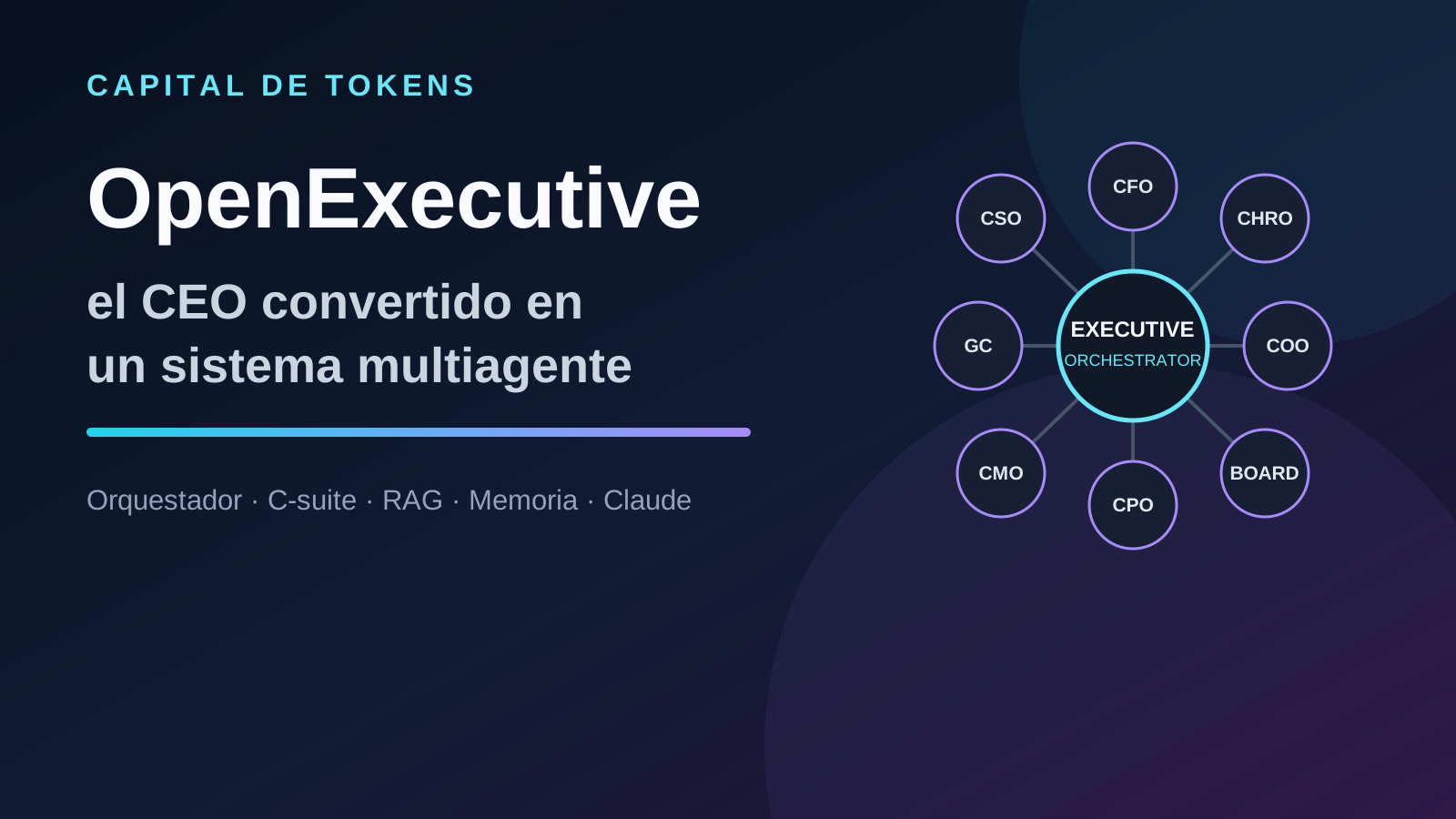
OpenExecutive: when the CEO becomes a multi-agent system
The headline sounds deliberately provocative: an AI designed to replace CEOs.
And, in part, the provocation is intentional.
Futurism tells the story of a group of engineers who say they lost their jobs during an AI-driven transformation and decided to turn the argument upward: if a company believes artificial intelligence can replace workers, why not apply the same logic to leadership?
The result is OpenExecutive, an open-source project presented as a virtual executive team.
But reducing it to “a chatbot pretending to be a CEO” misses the most interesting part.
OpenExecutive is a clear example of where agentic software is heading: one visible interface, a central orchestrator, and several specialized agents working underneath.
The real story is not whether CEOs disappear tomorrow.
The real story is that part of management work can already be modeled as software.
It is not one giant prompt wearing a suit
OpenExecutive starts from a simple idea: the user does not chat with eight separate bots.
The user speaks to one entity: The Executive.
That Executive acts as an orchestrator and can delegate work to eight specialists representing common C-suite functions:
- CSO: strategy.
- CFO: finance.
- CHRO: human resources.
- General Counsel: legal.
- COO: operations.
- CMO: marketing.
- CPO: product.
- Board Communications: communication with the board.
The simplified flow looks like this:
user
  ↓
Executive Orchestrator
  ↓
tool use
  ↓
CSO / CFO / CHRO / GC / COO / CMO / CPO / Board
  ↓
RAG + company context
  ↓
synthesis
  ↓
one executive response
The important detail is that the internal architecture is not exposed to the user as a collection of chatbots.
The multiple agents are an implementation mechanism. The external experience tries to maintain one coherent voice.
That pattern is increasingly common in mature agent systems: multiple internal roles, one external interface.
The orchestrator decides when to call specialists
OpenExecutive uses Claude models as its backbone.
According to the project’s current documentation, claude-sonnet-4-6 is the default model for the Executive and most specialists, while areas such as strategy, finance, legal, and board communications can use claude-opus-4-7 for deeper reasoning.
Delegation happens through tool use.
That means the orchestrator can decide that a question requires, for example, financial and strategic analysis, launch both specialists, and then synthesize the result.
Conceptually:
"Should we open an office in another country?"

Executive
  ├── CSO → strategic fit
  ├── CFO → financial impact
  ├── GC  → legal risk
  └── CHRO → hiring implications

             ↓
       unified response
That looks much more like an organization than a traditional chatbot.
RAG: the agent needs to know the company
A generic CEO is not very useful.
The value appears when the system understands the specific situation of the company.
OpenExecutive uses ChromaDB for retrieval. Specialists can consult two knowledge layers:
- built-in business knowledge provided by the project;
- documents supplied by the company.
A financial question therefore does not have to rely only on the model’s general knowledge. It can incorporate strategy, internal documents, and organization-specific context.
That changes the nature of the system.
This is not simply:
LLM + CEO personalityIt is closer to:
LLM
+ orchestration
+ specialists
+ corporate knowledge
+ memory
+ tools
That bundle is the harness.
And, as with many modern agent systems, the harness can matter as much as the model.
Memory: remembering what it recommended last month
One of the classic problems with enterprise assistants is amnesia.
A model can produce an excellent recommendation today and remember nothing about it in the next session.
OpenExecutive includes an episodic memory layer in SQLite.
After conversations, another process extracts relevant decisions, recommendations, and initiatives. In later sessions, that history can be inserted back into context.
The goal is for the Executive to remember something like:
Three weeks ago we recommended:
- freezing engineering hiring;
- prioritizing margin over growth;
- reviewing vendor X's contract in September.
That may look like a small detail, but it is fundamental to moving from a “useful chat” to a persistent operating system for work.
Organizations do not run on isolated answers. They run on decisions that create future commitments.
The scheduler may matter more than the chat
OpenExecutive also includes a scheduler for timed follow-ups and actions.
This introduces another important shift.
A traditional assistant waits:
human asks → AI answersAn agentic system starts to work more like this:
decision
  ↓
future action is created
  ↓
the date arrives
  ↓
the system retrieves context
  ↓
it acts or reminds the human
That turns memory into behavior.
And when memory, tools, and scheduled execution are connected, the agent stops being purely reactive.
So, can it replace a CEO?
Not in the literal sense suggested by the headline.
A company is not just a collection of analyses.
A CEO has responsibilities that are still difficult to represent as tool calls:
- fiduciary responsibility;
- legal authority;
- human negotiation;
- trust building;
- conflict management;
- organizational politics;
- relationships with investors, customers, and regulators;
- accountability when a decision goes wrong.
AI can produce a recommendation.
It cannot magically become the person legally responsible for that recommendation.
So the question “does it replace the CEO?” is probably less useful than another one:
What percentage of the cognitive work surrounding an executive can be converted into software?
That is a much more interesting question.
The C-suite as an API
Imagine a small company where a founder has continuous access to virtual specialists:
/cfo       → runway, pricing, scenarios
/cso       → strategy, competition
/legal     → contracts and risk
/product   → roadmap and prioritization
/marketing → positioning and campaigns
/ops       → processes and efficiency
They do not necessarily replace human specialists.
But they lower the cost of obtaining a first layer of structured analysis.
For a five-person startup, that could mean access to a kind of always-on virtual C-suite that used to be available only to much larger organizations.
That is probably a more realistic use case than a Fortune 500 company firing its CEO tomorrow.
Management as an orchestration problem
OpenExecutive also raises an uncomfortable idea.
For years, we have described many knowledge jobs as collections of tasks that can be automated.
Executive work can also be decomposed:
receive information
  ↓
consult specialists
  ↓
evaluate trade-offs
  ↓
make a decision
  ↓
communicate it
  ↓
remember commitments
  ↓
follow up
That is, to a large extent, a pipeline.
And pipelines are exactly the kind of structure agentic systems are starting to absorb.
The human value may move toward the parts least reducible to that pipeline: judgment under extreme uncertainty, legitimacy, relationships, leadership, and accountability.
The technical detail that matters
OpenExecutive is built with a relatively conventional stack:
Backend       Python + FastAPI
Frontend      Next.js
LLMs          Claude
RAG           ChromaDB
Memory        SQLite
Orchestration tool use + specialist agents
Scheduler     persistent jobs
License       Apache 2.0
There is no new transformer architecture here and no model trained from scratch.
The innovation is in how existing components are assembled to represent an entire organizational function.
That is exactly the shift we are seeing in agent engineering.
Increasingly, the question is no longer:
Which model is smarter?
It becomes:
Which system around the model turns intelligence into persistent, verifiable work?
From digital employees to digital organizations
During the first wave of agents, we talked about “digital employees.”
A coding agent. A support agent. A sales agent.
OpenExecutive pushes the metaphor one level higher.
It does not try to represent one task. It tries to represent an organizational structure.
An orchestrator coordinates specialists, each specialist has domain knowledge, all share corporate context, and the system preserves decisions across time.
That suggests an interesting trajectory:
chatbots
  ↓
specialized agents
  ↓
teams of agents
  ↓
complete business functions
  ↓
organizations partially executed by software
We do not know how far that sequence will go.
But OpenExecutive shows that we can already experiment with it in open source.
The right question is not who gets fired
The Futurism headline works because it reverses the usual automation narrative: this time the supposedly threatened job is at the top of the org chart.
But the technical value of the project lies elsewhere.
OpenExecutive shows that management can be modeled as a combination of orchestration, specialization, context, memory, and scheduled execution.
The CEO of the future may still be human.
But that CEO may work surrounded by a layer of agents continuously analyzing the company, reading documentation, remembering decisions, preparing scenarios, and triggering follow-ups.
In that world, AI does not necessarily replace the CEO.
It turns part of the C-suite into infrastructure.
And that idea may end up being far more transformative than the headline.