 Capital de Tokens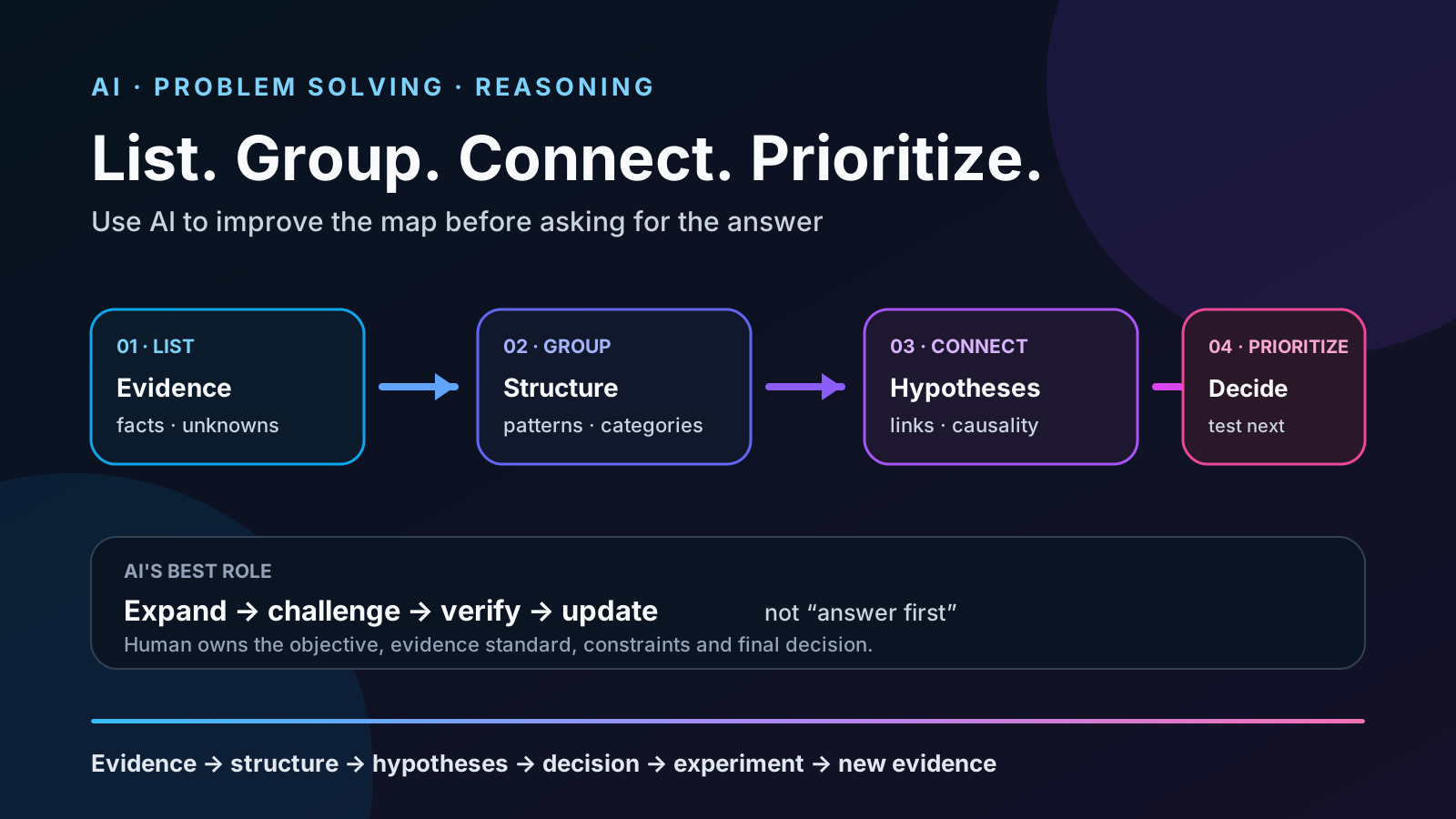
When facing a hard problem, we often ask an AI something like: “How do I solve this?”
That question can produce useful ideas, but it also pushes the model toward a solution too early. We begin evaluating answers before we know whether the problem is represented correctly.
A more robust approach is to split the work into four actions:
- list;
- group;
- connect;
- prioritize.
Without AI, these actions already form a useful problem-solving discipline. With AI, they become even more powerful because a model can help us move quickly between representations: from scattered observations to categories, from categories to hypotheses, and from hypotheses to experiments.
The key is to use AI as an amplifier of the reasoning process, not as a replacement for the person who owns the problem.
This is not another taxonomy of AI. It is an operational taxonomy of the cognitive work we perform while understanding and solving a problem.
The four actions as a cognitive pipeline
We can summarize them like this:
LIST
What do we know?

        ↓

GROUP
What patterns or categories appear?

        ↓

CONNECT
What relationships, dependencies or hypotheses explain what we see?

        ↓

PRIORITIZE
What deserves attention first?

        ↓

EXPERIMENT / ACTION
What can we test or change?

        ↓

NEW EVIDENCE
        ↺
This is not strictly linear. Every test produces new evidence, so we return to listing, regrouping, reconnecting and reprioritizing.
AI can accelerate every transition.
What AI improves at each stage
| Stage | What AI does well | What remains a human responsibility |
|---|---|---|
| List | Extract facts, detect omissions, reformulate, summarize large amounts of information | Decide which sources are trustworthy and what actually belongs to the problem |
| Group | Find semantic similarities and propose multiple taxonomies | Choose which grouping is useful for the goal |
| Connect | Propose dependencies, hypotheses and candidate causal models | Distinguish correlation, plausibility and real causality |
| Prioritize | Compare alternatives across several criteria and explore scenarios | Define the criteria, accept the risks and make the decision |
The last column matters. An AI can build a priority matrix very quickly, but if the criteria are wrong, it merely makes the mistake more systematic.
Before solving: use AI to represent the problem better
The first major improvement happens before looking for solutions.
At this stage AI is most useful as a framing assistant: it helps turn a vague situation into an explicit representation.
1. Separate facts, assumptions and unknowns
Suppose a team says:
“The application has been slow since the last deployment.”
That sounds precise, but several kinds of information are mixed together.
We can ask:
Do not propose solutions yet. Separate the information into observed facts, interpretations, assumptions, unknowns and constraints.
The output might include:
Facts
- P95 latency increased;
- the change began after the deployment;
- some routes degraded more than others.
Assumptions
- the deployment caused the problem;
- the database may be the bottleneck.
Unknowns
- whether traffic also changed;
- whether external dependencies changed;
- whether every region is affected.
That distinction changes the investigation.
“Started after the deployment” is temporal evidence.
“The deployment caused it” is a hypothesis.
Confusing the two is a classic reasoning error.
2. Ask for coverage, not answers
Early in the process, a better question is:
Which relevant categories might be missing from my list?
Not:
What is the cause?
The first prompt expands the search space.
The second closes it.
For a performance problem, the model might suggest checking:
- application;
- database;
- network;
- cache;
- infrastructure;
- external dependencies;
- traffic patterns;
- configuration;
- recent deployments;
- observability.
That does not mean every category is relevant. It means we now have a broader search space to investigate.
3. Request multiple groupings
Humans tend to anchor on the first reasonable classification they find.
AI makes alternatives cheap:
Group these observations in three different ways: by technical component, by symptom type and by possible causal mechanism.
The same dataset can reveal different structures.
By component
├── application
├── database
└── network

By symptom
├── latency
├── errors
└── saturation

By mechanism
├── increased load
├── contention
└── slow dependency
This is one of AI’s best uses: generate alternative representations before committing to one.
That connects directly to affinity mapping and issue trees.
Affinity mapping with AI
Affinity mapping looks for natural clusters among many observations.
With AI we can provide dozens or hundreds of notes and ask:
Group these observations by affinity. Do not invent data. Explain what criterion connects each group and flag ambiguous items that could belong to more than one.
The important improvement is not merely speed.
We can immediately request a second interpretation:
Now ignore that taxonomy and regroup the same observations using a different criterion.
This helps prevent the first plausible classification from becoming “the true structure” of the problem.
Issue trees with AI
An issue tree asks:
What parts make up this problem?
AI can generate an initial decomposition and then review it for overlap and gaps.
For example:
Why did growth fall?

├── fewer people arrive
│   ├── fewer impressions
│   ├── worse discovery
│   └── lower demand
│
├── fewer people click
│   ├── title
│   └── cover
│
└── fewer people stay
    ├── introduction
    ├── structure
    └── content quality
Then we can ask:
Review this tree for duplicate branches, mixed concepts and important uncovered areas.
The model acts as a critic of the structure, not as the judge of the final answer.
During problem solving: turn AI into external working memory
Once the investigation begins, the information changes continuously.
Logs, metrics, documents, test results and new hypotheses keep arriving.
AI can act as a form of external working memory that maintains the evolving model of the problem.
Listing during the investigation
Instead of manually reconstructing the whole context after each discovery, we can keep a live evidence table:
| Type | Item | Evidence | Status |
|---|---|---|---|
| fact | P95 jumped abruptly | dashboard | confirmed |
| hypothesis | new query creates contention | initial analysis | open |
| hypothesis | external dependency is slow | partial logs | open |
| missing data | latency before/after by region | — | pending |
After every test:
Update the inventory. Do not delete refuted hypotheses: mark them as refuted and keep the evidence.
That preserves the history of the investigation.
Connect: from mind maps to candidate causal graphs
AI can also turn scattered observations into explicit relationships.
For example:
more traffic
    ↓
more concurrent queries
    ↓
DB contention
    ↓
higher latency
    ↓
timeouts
But we need another discipline here.
Every connection should carry a label:
- observed;
- correlated;
- hypothetical;
- causally established.
We can ask:
Build a directed graph of the proposed relationships. For every edge, label it as observed, inferred or hypothetical, and state what evidence would strengthen it.
This makes the model an explicit hypothesis generator.
A persuasive sentence must not automatically turn a hypothesis into causality.
AI-assisted root-cause analysis
AI fits naturally with 5 Whys and cause-and-effect analysis because it can quickly generate alternative chains.
The danger appears when it creates a chain that is too neat:
A → B → C → problemReality may look more like:
A → B → C
↑       ↓
└── D ←─┘
So after asking for causes, run an adversarial pass:
For each causal chain you proposed, find alternative explanations, confounders and evidence that could refute it.
The first pass generates.
The second attacks.
The third verifies.
Systems thinking with AI
Systems thinking is especially useful when a problem contains:
- feedback loops;
- delays;
- side effects;
- incentives;
- bottlenecks;
- component interactions.
AI can help turn a list into a map like this:
more automation
      ↓
faster delivery
      ↓
more production changes
      ↓
more potential incidents
      ↓
more maintenance work
      ↓
less time to improve automation
      ↺
The value is not in treating that loop as true.
The value is being able to ask:
What reinforcing and balancing loops might exist here?
and then:
What data would tell us whether those loops actually dominate the system?
AI dramatically lowers the cost of exploring alternative models.
Prioritize with explicit criteria
After listing, grouping and connecting, we may have twenty plausible hypotheses.
Now we must decide what to investigate first.
A useful priority question is not merely:
Which one seems most likely?
Instead we can use several criteria:
- impact if true;
- current confidence;
- cost to test;
- time to test;
- reversibility;
- risk;
- ability to discriminate among several hypotheses.
A particularly useful heuristic is:
prioritize the experiment that produces the most useful information per unit of cost.
For example:
| Hypothesis | Impact | Confidence | Test cost | Discriminating power |
|---|---|---|---|---|
| new query saturates DB | high | medium | low | high |
| inter-region network | medium | low | medium | medium |
| external provider | high | low | low | high |
AI can compare those dimensions, but the criteria must be made explicit.
The best AI question: what should we test next?
For complex problems, the most useful question may not be:
What is the solution?
It may be:
What is the smallest experiment that best separates our main hypotheses?
Suppose we have:
- H1: the database is saturated;
- H2: an external API is slow;
- H3: the new code uses more CPU.
AI can help design a test whose result would look different under each hypothesis.
This is a fundamental shift.
We move from using AI as an answer machine to using it as a research-design machine.
A practical protocol: Explorer → Critic → Verifier
One AI conversation can mix generation and evaluation too early.
It is better to separate roles.
1. Explorer
Goal: expand.
Typical questions:
- what am I missing?;
- what other groupings exist?;
- what alternative hypotheses explain this?;
- what hidden variables might matter?
We want diversity, not certainty.
2. Critic
Goal: attack.
Questions:
- what assumptions are inside this explanation?;
- what evidence contradicts it?;
- what alternative explanations produce the same symptoms?;
- where are we confusing correlation with causality?
We want to reduce overconfidence.
3. Verifier
Goal: test.
Questions:
- which claims are supported by evidence?;
- what data is missing?;
- what experiment best discriminates among the hypotheses?;
- after the result, what should be updated?
The same model can play all three roles. The important part is separating the phases.
A reusable prompt
A practical template:
I want to analyze this problem without jumping directly to a solution.

1. LIST
Separate facts, symptoms, assumptions, constraints, unknowns and hypotheses.
Do not invent information.

2. GROUP
Propose at least two different ways to group the elements.
Explain the criterion behind each grouping.

3. CONNECT
Propose relationships among the elements.
Label each relationship as observed, correlated, inferred or hypothetical.
State what evidence would test it.

4. PRIORITIZE
Order what to investigate first using:
impact, confidence, test cost, reversibility and discriminating power.

5. EXPERIMENT
Propose the smallest experiment that best separates the leading hypotheses.

6. UPDATE
When I give you new results, rebuild the model without deleting
refuted hypotheses or their evidence.
This template forces the AI to work on the structure of the reasoning, not only the answer.
The main risk: converging too early
AI is very good at producing coherent explanations.
That is also dangerous.
An explanation can be:
- clear;
- complete;
- technically plausible;
- elegantly written;
and still be wrong.
Several traps deserve attention.
Anchoring
The first taxonomy proposed by the AI can shape everything that follows.
Countermeasure: request independent alternative groupings.
Invented causality
The model can connect two facts with a plausible story.
Countermeasure: label relationships by evidence level.
False precision in prioritization
A score of 8.3 versus 7.9 can imply certainty that does not exist.
Countermeasure: use ranges, uncertainty and qualitative criteria when evidence is weak.
Outsourcing the objective
AI can optimize perfectly for the wrong goal.
Countermeasure: keep the goal, constraints and success criteria under human control.
AI before and during: two different jobs
We can summarize the difference this way.
Before solving, AI improves the representation of the problem:
confusing situation
      ↓
facts + assumptions + unknowns
      ↓
categories
      ↓
hypotheses
During the investigation, AI improves the learning loop:
hypothesis
    ↓
priority
    ↓
experiment
    ↓
evidence
    ↓
model update
    ↺
The first role improves the map.
The second increases the speed at which we correct the map.
The central idea
AI does not make listing, grouping, connecting and prioritizing less important.
It does the opposite.
The faster a machine can generate alternatives, the more important it becomes to have a process that distinguishes:
- data from interpretation;
- useful groups from arbitrary groupings;
- plausible relationships from established causality;
- explicit priorities from intuition disguised as ranking.
The full pattern becomes:
DATA
  ↓
LIST
  ↓
STRUCTURE
  ↓
GROUP
  ↓
MODEL
  ↓
CONNECT
  ↓
DECISION
  ↓
PRIORITIZE
  ↓
EXPERIMENT
  ↓
EVIDENCE
  ↺
The strongest human-AI collaboration is not built around repeatedly asking “what is the answer?”
It uses AI to expand the possibility space, make our models explicit, attack them with alternative hypotheses and identify the next observation that will reduce uncertainty the most.
In other words, AI is most valuable when it helps us think better about the problem before trying to solve it.