 Capital de Tokens
A startup can have strong engineers, move fast, ship every week, and still be heading in the wrong direction.
That is one of the most useful arguments in Stephanie Davis’s article, “Many Founders Waste Time and Money Solving the Wrong Problems. Here Are 3 Big Ones”, published by Inc. on March 16, 2026.
The central idea sounds simple but has uncomfortable consequences: many problems that look like execution problems are actually strategy problems.
When sales are low, we think marketing. When the product does not take off, we think more features. When growth slows, we think hiring, raising capital, or automating. All of those responses can be reasonable if the diagnosis is correct.
But if the product does not solve an important enough problem for the right customer, executing better only lets us be wrong more efficiently.
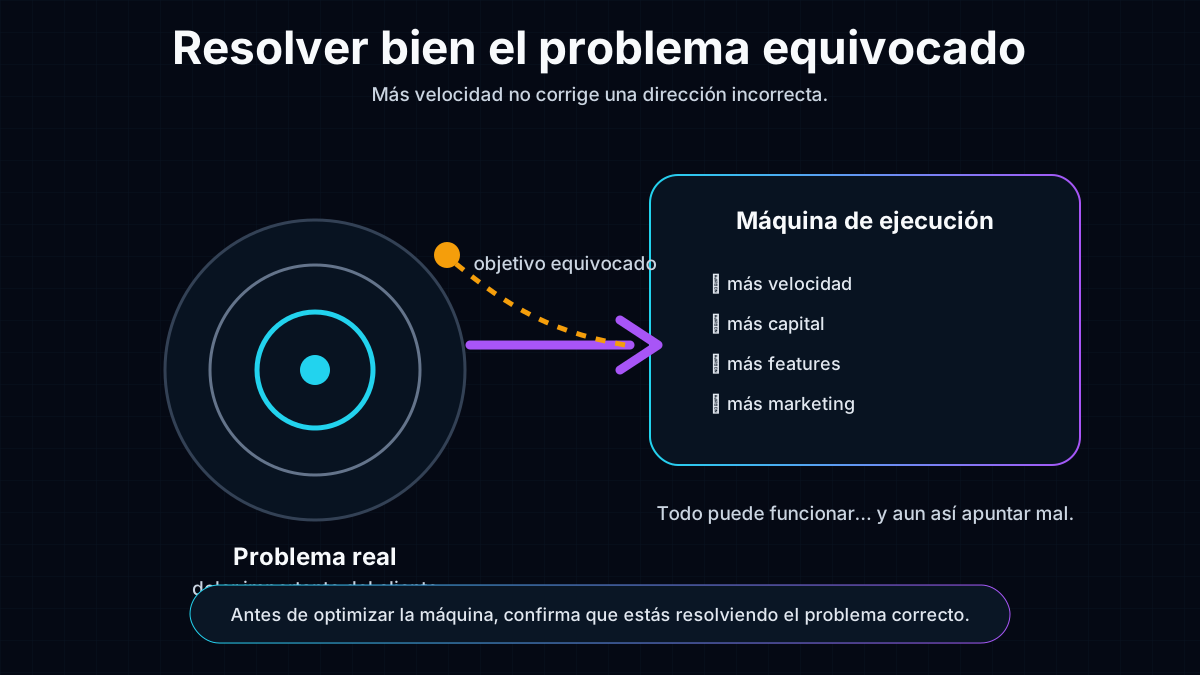
The first job is not optimization: it is diagnosis
In technology, we are trained to optimize systems.
We reduce latency. Increase test coverage. Automate deployments. Add observability. Improve prompts. Parallelize agents. Reduce inference costs. Accelerate the development cycle.
All of that makes sense when the system is trying to produce the right outcome.
The problem begins when we confuse a symptom with a cause.
For example:
Symptom: few sales
Automatic response: more marketing

Symptom: low usage
Automatic response: more features

Symptom: slow growth
Automatic response: more team + more capital
The earlier question should be:
Why is this happening?Low sales can mean weak distribution, but also that the product solves an unimportant problem. Low usage can mean a poor interface, but also that the user simply has no reason to return. Slow growth can mean lack of capacity, but also lack of product-market fit.
The difference matters because each diagnosis leads to a completely different investment.
1. Trying to fix retention with acquisition
The first case Davis describes is especially dangerous because it looks logical from inside the company.
A SaaS company had slow sales and high customer churn. The founder’s reaction was to raise more capital and increase marketing.
The reasoning was:
more money
   ↓
more marketing
   ↓
more customers
   ↓
more growth
But the real problem occurred earlier in the chain.
Customers had bought an initial version expecting future capabilities that, according to the engineering team itself, could not be built as promised.
That completely changes the diagnosis.
The company did not primarily have an acquisition problem. It had a problem between promise, product capability, and customer need.
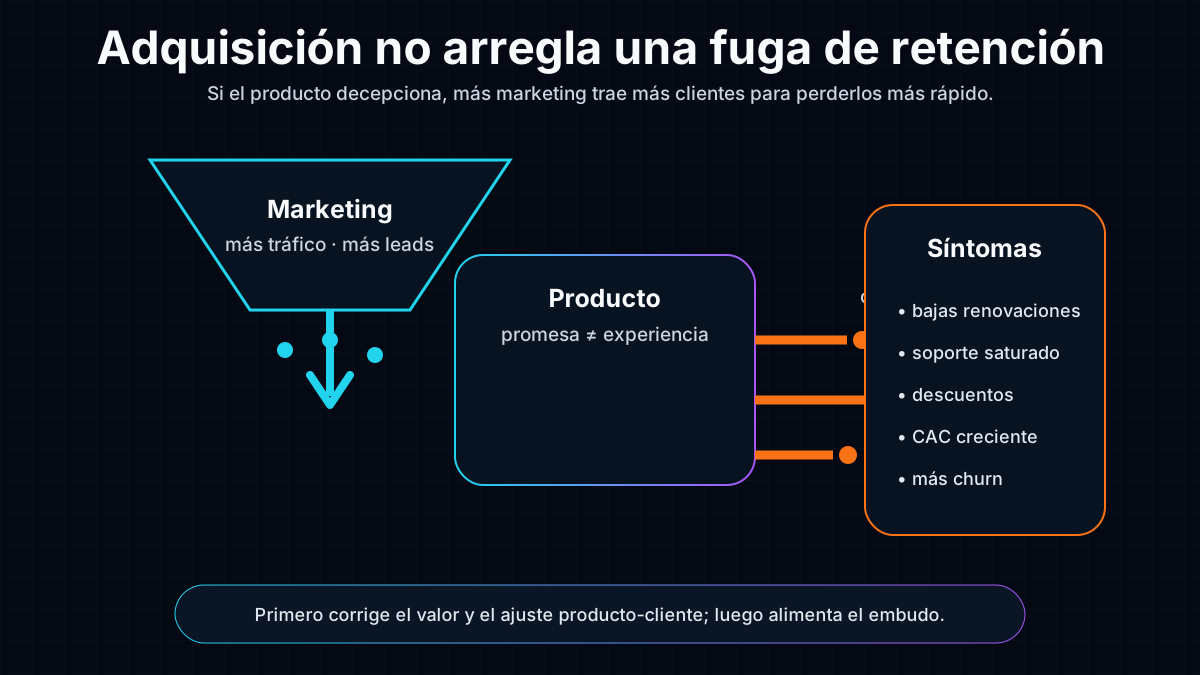
If we fill a leaking container faster, we do not fix the leak.
In fact, we can make things worse:
- increase acquisition cost;
- onboard more customers who will become dissatisfied;
- overload support;
- accumulate a bad reputation;
- confuse activity volume with real growth.
The case was resolved by changing the target market toward customers whose needs could actually be met by the existing product.
That was not a marketing optimization. It was a strategic correction.
The uncomfortable question
Before increasing acquisition, it is worth looking at something more basic:
Do the customers we already acquired receive enough value to stay?
If the answer is no, the funnel probably is not the first thing we should optimize.
2. Building features the customer does not want
The second mistake is almost the mirror image of the first.
Here the engineering team really was extremely productive. It shipped features constantly and eventually built a product far more sophisticated than its competitors.
From inside the company, that looked like an obvious advantage.
More capabilities seemingly meant more value.
But customers saw something else: complexity around a task they wanted to keep simple.
That contrast is fundamental in product work.
What the team sees:
“We have 20 advanced capabilities.”

What the user may see:
“Now I need to learn 20 things to solve a small problem.”
A feature is an advantage only when it improves an outcome the customer values.
Otherwise, it can become cognitive cost, maintenance, documentation, support, and error surface.
The company in the example first tried lowering the price and explaining its value proposition better. That did not work well enough because the problem was not that consumers failed to understand the value: the advanced value was not important to them.
The solution was to move the product from B2C to B2B, where organizations actually had problems complex enough to value those capabilities.
Again, the solution was not executing more intensely on the existing strategy. It was finding a market where the product made sense.
A lesson especially relevant to AI products
This trap is extremely easy to fall into in 2026.
We can add:
- autonomous agents;
- long-term memory;
- multimodality;
- multi-tool workflows;
- RAG;
- code execution;
- web browsing;
- multiple models;
- hierarchical planning;
- agent swarms.
Technically, the product improves.
Commercially, not necessarily.
A user may prefer one button that solves a concrete task in 20 seconds over a fascinating architecture capable of doing 40 things.
The question is not:
What else can we build with AI?
The useful question is:
What important outcome does this customer need, and how much better are we making it?
Technology is the mechanism. Value is in the result.
3. Scaling before proving something works
The third mistake is the most expensive because it turns small problems into big ones.
Scaling can mean:
hiring more people
buying more traffic
opening new markets
increasing infrastructure
raising more capital
automating operations
multiplying sales channels
All of those actions share one property: they are multipliers.
And a multiplier does not distinguish between a healthy signal and a broken one.
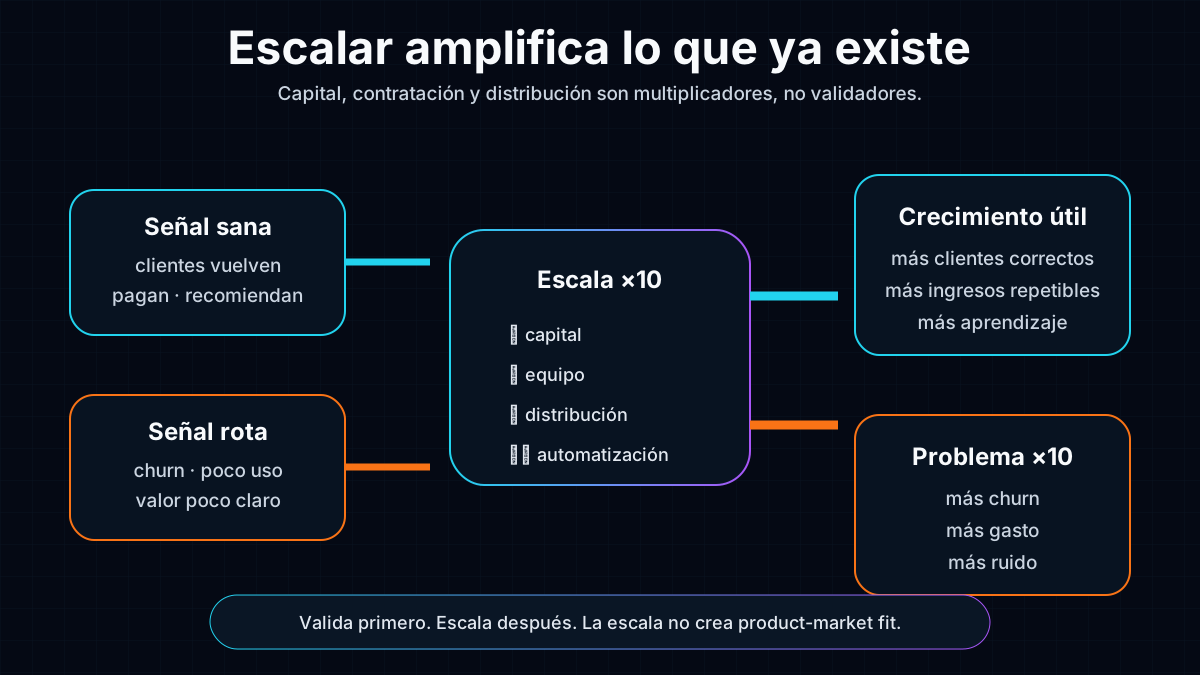
If there is a repeatable value-creation model, scaling can multiply revenue and learning.
If there is churn, confusion, or a proposition customers do not value, scaling can multiply churn, spending, and noise.
Davis cites a well-known Startup Genome estimate that roughly 70% of startups scale prematurely. She also uses Quibi as an extreme example: the company raised approximately $1.75 billion and shut down only months after launch.
Quibi did not lack capital, talent, production, or distribution.
The problem was more fundamental: it had not sufficiently validated that a mass audience wanted to pay for that premium short-form video format in a market already full of free video.
Capital allowed the company to execute a hypothesis at enormous scale. It did not turn the hypothesis into truth.
Strategy or execution: the fork that changes everything
A practical way to think about these cases is to separate two families of problems.
Execution problems
We reasonably know what should work, but we are doing it badly.
Examples:
- too many bugs;
- slow deployments;
- confusing onboarding;
- poor support;
- high infrastructure costs;
- disorganized sales cycle;
- low quality in a feature customers actually use and value.
These problems respond well to better processes, better tools, automation, hiring, or operational discipline.
Strategy problems
It is not clear that we are trying to solve the right problem for the right customer with the right proposition.
Examples:
- customers do not consider the problem important;
- the product promises something it cannot deliver;
- the selected segment does not need the advanced capabilities;
- there is initial use but no repetition;
- the product sells only with heavy discounts;
- more exposure does not improve conversion or retention;
- people praise the demo but do not pay for the product.
These problems are not solved by simply doing the same thing faster.
They require revisiting assumptions.
A small diagnostic machine
Before investing more time or money in a solution, it can be useful to run this sequence:
1. What is the observable symptom?
             ↓
2. What evidence do we have for the cause?
             ↓
3. Does the customer consider the problem important?
             ↓
4. Does our product produce the promised outcome?
             ↓
5. Do the right customers return, pay, or recommend?
             ↓
6. Are we facing strategy or execution?
             ↓
7. Only then: optimize or scale
The important word here is evidence.
It is not enough for an explanation to sound plausible.
“We need more marketing” is a hypothesis.
“We need a new feature” is a hypothesis.
“We need to hire three developers” is a hypothesis.
“We need a more powerful model” is also a hypothesis.
Each one should compete against alternative explanations.
The danger of speed in the agent era
AI tools are radically reducing the cost of producing software.
A small team can generate code, tests, documentation, designs, research, campaigns, and prototypes at a speed that only a few years ago required a much larger organization.
That is a huge advantage.
But it introduces a new risk: we can now build the wrong thing much faster too.
As implementation cost falls, diagnostic quality becomes more important.
In an environment with agents capable of working continuously, the bottleneck stops being only “can we build it?” and shifts toward questions such as:
should we build it?
for whom?
what evidence would change our mind?
what metric would demonstrate real value?
what part should we validate before automating the rest?
Engineering efficiency does not replace product learning.
It can amplify it, but it needs direction.
Do not confuse activity with evidence
A startup can show a lot of activity:
- commits;
- releases;
- dashboards;
- campaigns;
- new models;
- automations;
- hiring;
- meetings;
- experiments;
- infrastructure.
None of that proves by itself that the business is solving an important problem.
A more valuable signal is real behavior:
do they return?
do they pay?
do they renew?
do they use it without us pushing them?
do they recommend it?
do they complain when it stops working?
Those signals get much closer to value than the number of things the team produces.
The rule before spending the next dollar
The lesson can be reduced to one rule:
Before investing more in a solution, confirm that you have correctly identified the problem.
If the problem is execution, improve the machine.
If the problem is strategy, stop the machine long enough to change direction.
Because a startup does not only need to move fast.
It needs to learn quickly what deserves to be accelerated.
And perhaps the most expensive business mistake is not failing while trying to solve a difficult problem.
It may be dedicating a brilliant team, a lot of money, and excellent infrastructure to perfectly solving a problem that was never the important one.