 Capital de Tokens
A telecommunications company is putting tens of millions of dollars toward teaching people to use artificial intelligence. Not toward training another frontier model, but toward helping workers use the models and tools already available.
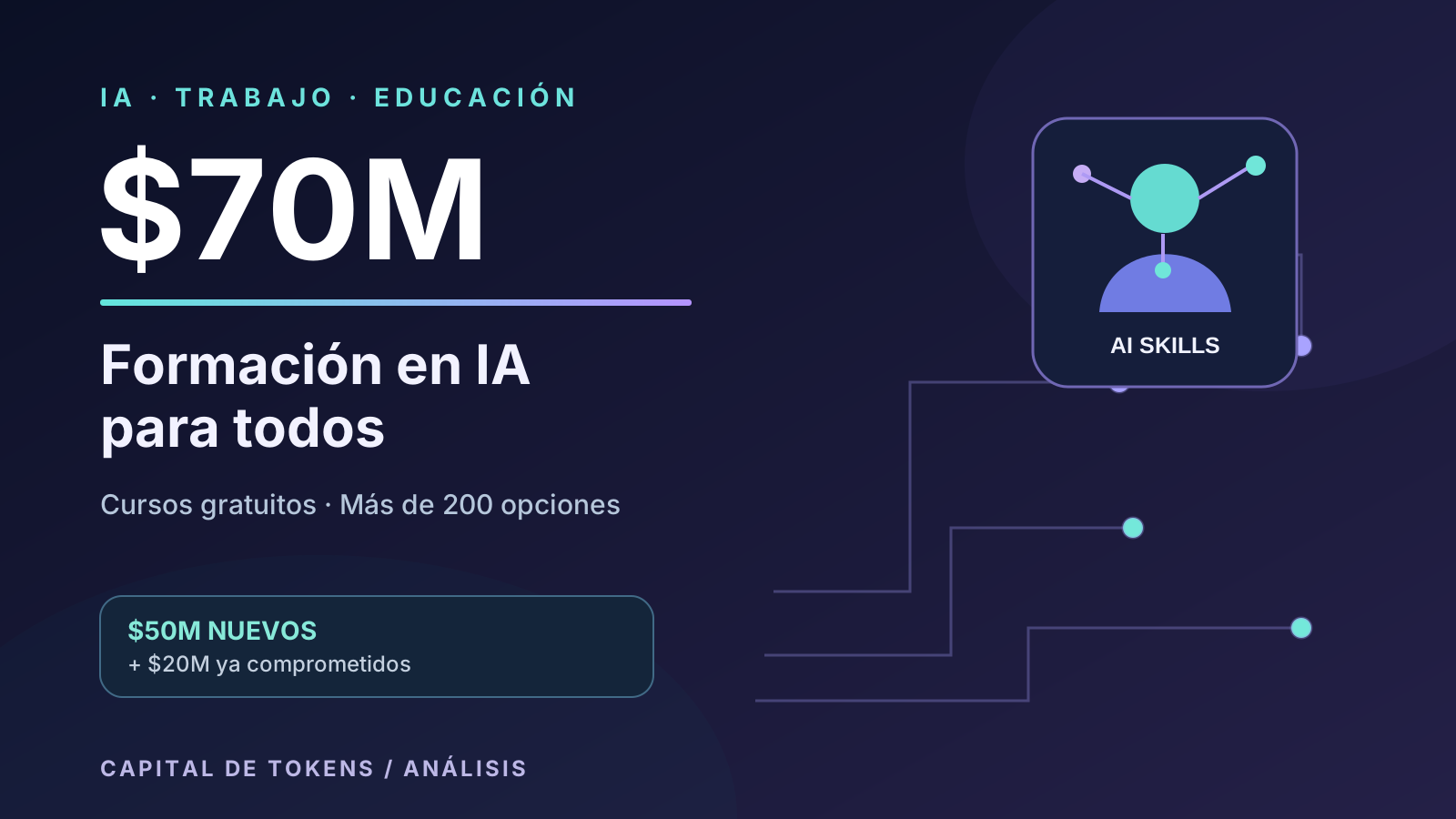
On September 23, 2026, Verizon announced a total $70 million commitment for Verizon AI Skills for America, a workforce initiative aimed at job seekers, early-career professionals, displaced workers, educators and small businesses.
The deeper point: AI’s economic gains will depend not only on who builds the strongest models but also on how many people learn to apply them productively.
That makes it worth examining the funding, the actual courses and the gap between education and employment outcomes.
$70 million does not mean $70 million in new funding
The announced total combines:
- $50 million in new funding to broaden AI training access.
- $20 million already committed through Verizon’s Reskilling and Career Transition Fund for departing employees.
It is therefore a combined commitment, not $70 million of entirely new spending, and not money distributed directly to individual learners.
Training content comes from organizations including IBM, Google, Microsoft, Anthropic, Coursera and OpenAI. Verizon is also partnering with Goodwill Industries International, LISC and NACCE to offer local coaching and other forms of guidance. The online initiative is nationwide, while more intensive local support is initially available only in select regional markets.
That difference matters. Hosting a course catalog at scale is one thing; helping people develop dependable skills is another.
What you can learn at no charge
Verizon’s official AI Skills for America portal features more than 200 courses and programs covering fundamentals and practical applications. It states that enrollment is free, no Verizon subscription is required, and the offering is open to adults 18 and older in the United States and its territories.
Among its featured courses are:
| Course | Provider | Listed duration | What it covers |
|---|---|---|---|
| AI for Productivity | Duke University | 5 hours | ChatGPT, Copilot and Gemini for workflows and analysis |
| AI for Brainstorming & Planning | 1 hour | Project planning with Gemini and NotebookLM | |
| AI for Research and Insights | 1 hour | Deep research and source synthesis | |
| AI for Writing and Communicating | 1 hour | Workplace communication using AI | |
| Google Workspace with Gemini Specialization | Google Cloud | 12+ hours | Gemini across Gmail, Docs, Sheets and Slides |
| The Evolving World of AI: Emerging Technologies and Applications | IBM SkillsBuild | 3 h 35 min | Emerging AI trends and applications |
These course names and lengths reflect the catalog as viewed in October 2026 and may change. Credentials vary by course.
The portal also lists data analytics, software development, cybersecurity, marketing, content creation and AI ethics. There is no single path that fits every profession.
A practical learning path beats collecting certificates
For someone starting from scratch, two extremes are unhelpful: focusing only on theory, or trying to automate everything before understanding the risks.
A more useful progression is:
- AI literacy. Learn what assistants can and cannot do, how to write instructions and how to check outputs.
- Personal productivity. Choose one recurring activity: summarize documents, organize information, draft correspondence or outline a project.
- Source-based research. Compare claims with original documents and identify unsupported inferences.
- Job-specific application. Build a modest workflow for education, administration, retail, data or development.
- Measurement. Track time saved, error rates, privacy exposure and human review requirements.
Consider a small business handling customer inquiries. An AI-assisted workflow could extract requirements, prepare responses and leave the final decision with an employee. Success is not the number of prompts generated. It is whether response times improve without increasing mistakes.
What courses cannot guarantee
Training may be a sensible response to technological change, but three questions remain unresolved.
Will training improve employment outcomes? Completing a course or earning a badge does not automatically lead to a better job, higher pay or job security.
Can all workers make time to learn? Free tuition removes one barrier, but time, internet access, language, digital literacy and personal coaching remain relevant.
How will impact be measured? Useful indicators would include enrollments, completions, demonstrated skills, job transitions and longer-term employment outcomes. The launch announcement describes funding and partners, not an independent assessment of those future results.
There is also an important tension: part of the headline funding is associated with a transition fund for employees leaving Verizon. That does not diminish the value of training, but it reminds us that learning new technology and facing job displacement can happen simultaneously.
The bigger shift: AI literacy is becoming economic infrastructure
We usually describe AI infrastructure in terms of chips, data centers and network capacity. Another layer is becoming critical: people who know how to use AI tools responsibly in real workflows.
An organization can buy access to powerful models without improving its operations. Improvements come when workers can define tasks, provide context, verify results and integrate systems into repeatable processes.
Verizon is betting that broad-based AI literacy should be supported by companies and community institutions. The initiative has potential, but success must be assessed rather than assumed.
For learners, the practical step is simple: visit the free catalog, choose one course, use it on a real task and measure what changed. AI for Productivity and AI for Research and Insights offer useful starting points.
AI may reshape employment. Learning to use it will help many workers; proving that such training creates lasting opportunities will be the real test.