 Capital de Tokens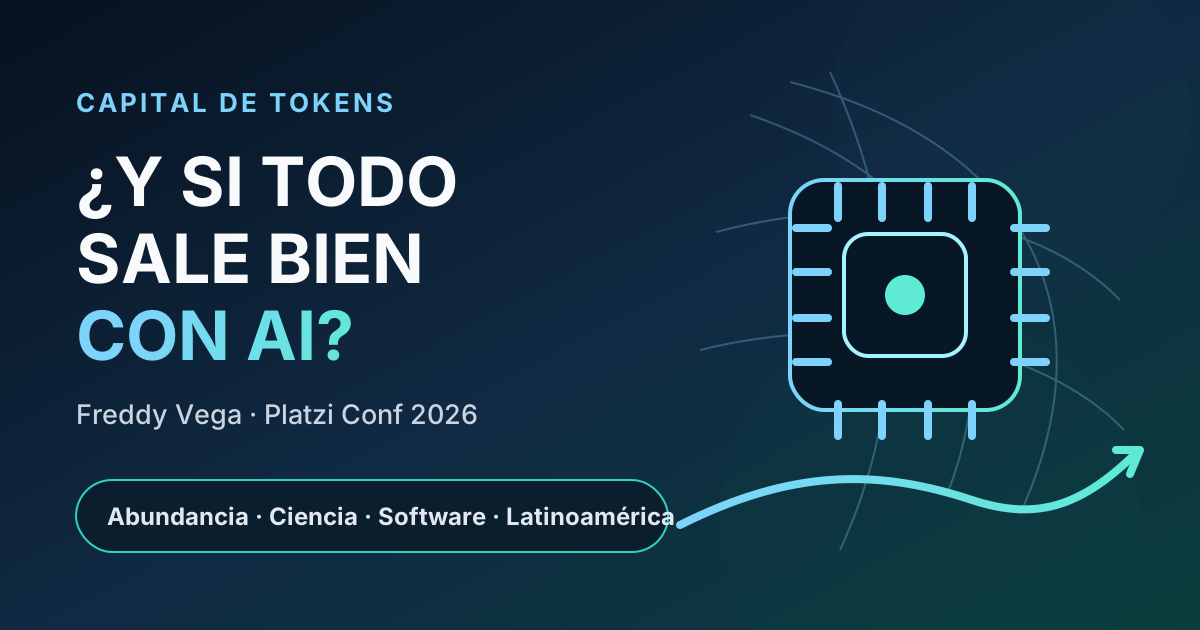
What if AI goes right? Freddy Vega bets on abundance, cheaper software, and a Latin American opportunity
Most conversations about artificial intelligence begin with the worst-case scenario: unemployment, concentrated power, deepfakes, technological dependence, skill erosion, or systems making decisions nobody can explain. At Platzi Conf Bogotá 2026, Freddy Vega flipped the question: what happens if AI works extraordinarily well?
His roughly 42-minute talk, “¿Y si todo sale bien con AI?”, makes a deliberately optimistic case. AI, he argues, is turning expert knowledge into a much more abundant and inexpensive resource. If that trend continues, we could enter an era of faster scientific experimentation, tiny teams capable of building sophisticated products, and governments able to modernize institutions that have been stuck for decades.
The thesis is compelling, but it helps to separate three things: technological direction, economic predictions, and political choices. They do not all carry the same level of evidence.
1. Intelligence is becoming a much cheaper resource
Freddy’s starting point is hard to dismiss. Only a few years ago, getting a specialized explanation, writing complex software, analyzing hundreds of documents, or producing polished media usually required significant amounts of skilled human labor. Today, a growing share of those tasks can begin with a frontier model available from a browser or phone.
That does not mean human expertise no longer matters. It means the cost of reaching a competent first answer is falling quickly.
That shift changes what is scarce. Memorizing information matters less relative to asking better questions. Writing every line of code is not always the bottleneck. And many tasks that once started by hiring a specialist can now start with a model—followed, ideally, by human validation.
Freddy compares the change to winning the lottery: when a constraint disappears, some of the excuses built around it disappear too. The comparison is provocative because it moves the debate from “what can AI do?” to “what do we do when access to knowledge becomes less scarce?”
2. Fewer jobs or much more production?
One of the strongest claims in the talk is that AI does not necessarily imply mass unemployment. Freddy invokes the Jevons paradox: when technology makes the use of a resource more efficient and cheaper, total consumption of that resource can increase rather than decrease.
Applied to AI, the argument goes like this: if software, analysis, design, or customer service becomes ten times cheaper, society may not simply do the same work with one-tenth the workers. It may instead consume ten or one hundred times more of those services.
There is an important intuition here: automation can complement human work and unlock demand that was previously too expensive. A small company that would never have hired an analyst, designer, lawyer, and software engineer can now consume AI-assisted versions of those capabilities.
But Jevons by itself does not prove that labor markets will absorb every displacement. The available evidence is more nuanced. The International Labour Organization estimates that roughly one in four workers is in an occupation with some degree of generative-AI exposure, while concluding that task transformation is currently more likely than complete job disappearance.
That is less apocalyptic, but it is not automatic optimism. In some occupations AI will complement workers; in others it may reduce headcount; and entirely new roles will emerge. The transition will depend on training, regulation, adoption speed, and whether productivity gains create enough new demand.
3. Science may be the strongest optimistic argument
The most convincing part of the talk comes when Freddy moves beyond chatbots and into science.
AlphaFold is a strong example, with one important precision. It is sometimes summarized as having “discovered 200 million proteins.” More accurately, AlphaFold DB provides more than 200 million predicted protein structures, covering nearly all proteins catalogued by science. That is different from discovering 200 million new proteins, but the impact is still extraordinary.
Determining molecular structures experimentally could take months or years. Having large-scale predictions available changes which experiments are worth attempting and where researchers should spend laboratory time.
The same logic appears in self-driving labs: environments where software, models, and robots can execute cycles of hypothesis, experiment, and measurement with less manual intervention. Freddy’s vision is not merely that AI writes reports about science, but that it increasingly participates in the physical loop of discovery.
If that scales, the benefit will not come from a chatbot “knowing medicine.” It will come from increasing the number of experiments humanity can run, compare, and discard.
4. When programming stops being the bottleneck
Another central theme is software. AI is reducing the marginal cost of producing code, tests, documentation, migrations, and prototypes. That can radically change team structure.
A company that once needed dozens of developers to build a first version may be able to do it with a much smaller team supported by agents. Legacy COBOL or Fortran systems can be analyzed and migrated with automated assistance. Internal teams can build tools that previously would never have passed a cost-benefit review.
But that creates an interesting consequence: if creating software becomes cheap, distributing it and getting people to use it becomes relatively more important.
Value shifts toward understanding a real problem, acquiring users, integrating into existing workflows, building trust, operating infrastructure, and taking responsibility when something fails.
That can produce an explosion of entrepreneurship—but also an explosion of mediocre software. When everyone can generate, scarcity moves from production to judgment, product sense, distribution, and execution.
5. The possible decline of the “expert class”
Freddy extends that logic to professional credentials, arguing that some certifications and traditional forms of expertise may lose part of their economic and cultural power.
For centuries, one advantage of the expert was control over knowledge that was expensive to acquire. If a person can quickly obtain a reasonable explanation about taxes, programming, marketing, nutrition, or law, that information asymmetry shrinks.
That does not eliminate experts. It may actually increase the value of experts who can verify, judge, and accept responsibility. What may decline is the value of charging primarily for access to standard information.
This leads to what the talk calls a trust industry. In a world where text, voice, images, video, and documents can all be fabricated cheaply, knowing that something is authentic becomes more valuable.
Provenance, digital signatures, reputation, identity, and verifiable data may become infrastructure as important as the models themselves.
6. Latin America really does hold some strong cards
The most strategic section of the talk focuses on Latin America. Freddy rejects the idea that the region should compete by copying the United States or China exactly. Instead, he argues that it has different advantages that have not yet been turned into strategy.
The first is energy. The International Energy Agency estimates that renewables represent about 60% of electricity generation in Latin America and the Caribbean, roughly twice the global average.
That matters because data centers are converting electricity into compute at growing scale. The IEA projects that global data-center electricity consumption could exceed 945 TWh by 2030, more than double recent levels, with AI among the main drivers of that increase.
The region also has copper, lithium, physical space, and a relatively clean power mix. None of that guarantees a competitive AI industry: grids, capital, stable regulation, fiber, talent, data centers, and bankable long-term contracts are still necessary. But it does mean Latin America is not starting from zero.
The second card is institutional. Freddy proposes something less glamorous than a “national LLM”:
- interoperable digital identity;
- very low-cost public and private payments;
- high-quality national datasets;
- faster digital justice;
- government services built as reusable infrastructure;
- and a pragmatic strategy that can use both open and closed models across geopolitical blocs.
It is a strong idea because it focuses on data and institutions, not on building a patriotic chatbot.
A country does not need to train the world’s biggest model to capture value. It can win by becoming the place where starting a company takes minutes, tax systems are usable, courts resolve disputes faster, and public data can actually support useful services.
7. Digital abundance does not erase physical scarcity
The talk also introduces an important limit to technological optimism. Even if digital intelligence becomes nearly free, the physical world does not become infinite.
Land remains limited. Energy requires infrastructure. Chips require factories and materials. Homes occupy space. Hospitals have finite beds. Robots cost components and maintenance.
This helps explain why extremely capable AI does not automatically imply “infinite money” or the end of work.
In fact, the cheaper digital production becomes, the more valuable non-copyable things may become in relative terms: in-person experiences, location, craftsmanship, human relationships, personal attention, reputation, and unique physical objects.
8. The optimistic thesis works better as an agenda than as a prediction
Freddy’s talk becomes more useful if we do not interpret it as a literal forecast that “everything will go right.” It works better as a design question:
If AI dramatically reduces the cost of intelligence, what should we build to capture that benefit?
For an individual, the question becomes which project is still being postponed because it once required a team or a missing skill.
For a company, which processes were never automated because doing so was too expensive.
For a government, which systems remain obsolete simply because modernization once looked impossible.
And for Latin America, whether the region wants to remain primarily a consumer of models built elsewhere—or use this window to modernize its institutional, energy, and digital infrastructure.
What the talk leaves us with
The strongest idea in “¿Y si todo sale bien con AI?” is not that we should ignore risks. It is that a debate dominated exclusively by risk can also cause us to miss real opportunities.
There are good reasons for caution. AI can displace workers, centralize power, and scale mistakes. The transition will be uneven. Energy and infrastructure remain constraints. And a model that answers confidently does not automatically replace professional judgment.
But there are also concrete signs of the positive scenario: AI is already accelerating scientific research, lowering the cost of software creation, and widening access to capabilities that once belonged only to much larger organizations.
The important question is no longer just “what will AI take away from us?” It is also “what can we do for the first time because it now exists?”
And that may be the most uncomfortable part of Freddy Vega’s thesis: once some technical constraints disappear, it becomes easier to see which limits were real—and which were excuses.
Sources
- Video: ¿Y si todo sale bien con AI? — Freddy Vega, Platzi
- Official talk summary — Platzi Conf Bogotá 2026
- AlphaFold — Google DeepMind
- Generative AI and jobs: a 2025 update — International Labour Organization
- Latin America Energy Outlook — International Energy Agency
- Energy and AI — International Energy Agency