 Capital de Tokens
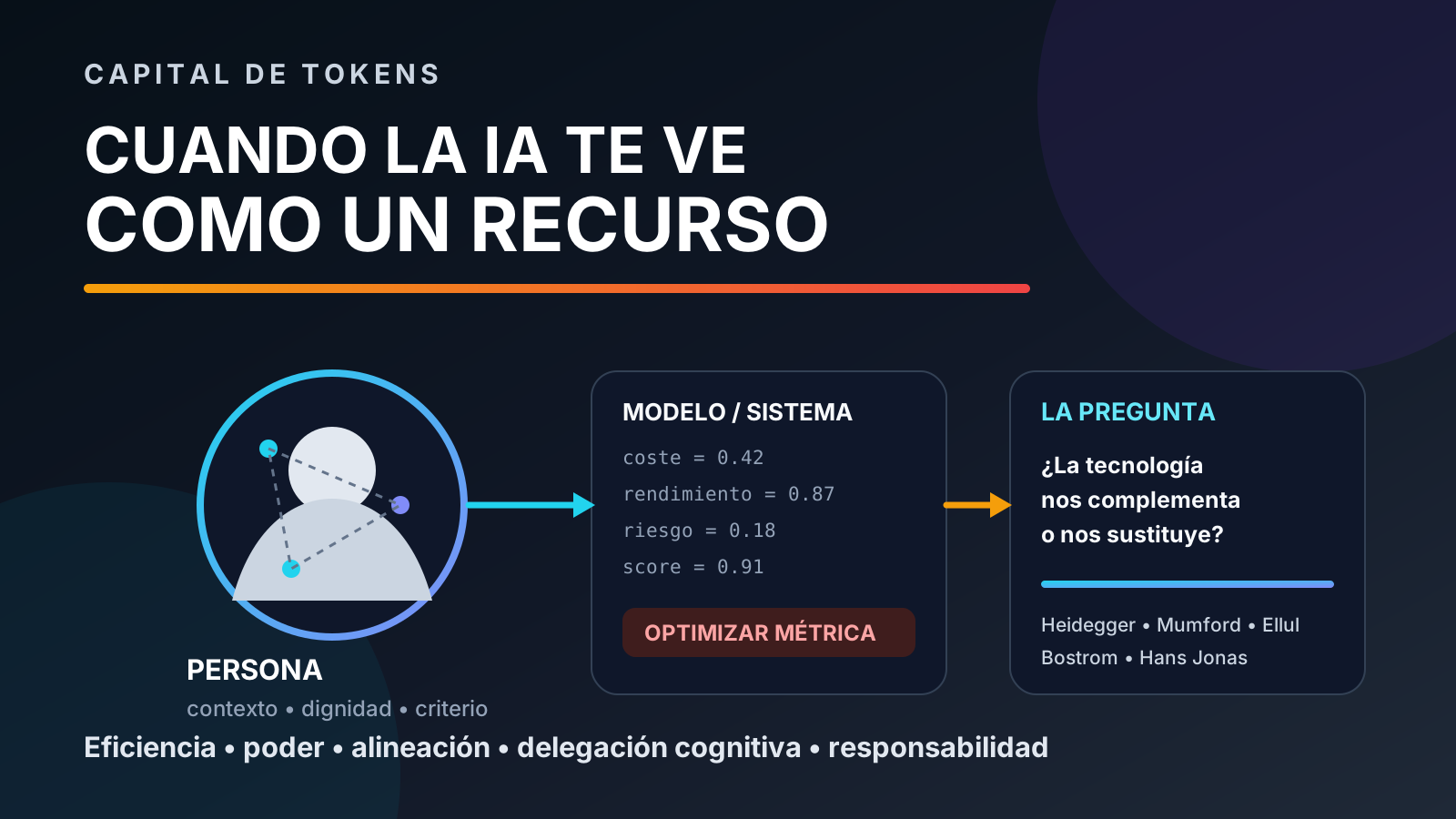
When AI turns you into a resource: Miklos Lukacs on efficiency, power, and cognitive delegation
The title of Miklos Lukacs’s video — “For AI, you are not a person, you are a resource” — sounds provocative, but the talk is not really about a conspiracy theory in which a machine “hates” human beings.
His thesis is more interesting than that.
Lukacs is trying to describe what happens when a society adopts technical efficiency as its dominant criterion. His concern is not that an AI suddenly wakes up, develops malicious intentions, and decides to dominate us. It is that companies, governments, and institutions begin to look at people through the same frame a technical system uses for any other variable:
- cost;
- performance;
- availability;
- risk;
- productivity;
- error rate;
- replaceability.
Inside that frame, the question can shift from “what does this person need?” to “what output does this resource produce?”
That leads to the central idea of the talk:
the danger is not only that we build machines that are increasingly human-like, but that we begin organizing humans as if they were components in a machine.
The presentation combines history, philosophy of technology, politics, anthropology, AI, transhumanism, and ethics. Some of those connections are powerful. Others are more debatable. That is exactly why they are worth separating.
1. The core question: does technology complement us or replace us?
Lukacs opens with a distinction that runs through the entire talk.
Technology can act as a complement to human capability or as a substitute for it.
A calculator complements mathematical ability when it removes repetitive arithmetic and lets us focus on reasoning.
Navigation software complements orientation when it helps us find a route without making us completely unable to understand where we are.
An AI model can complement a programmer when it accelerates routine tasks, explains code, or proposes alternatives that the programmer then evaluates critically.
But the relationship changes when we stop exercising the capability we delegate.
If a student uses AI to research, compare sources, and get explanations, the tool can expand learning.
If the student uses it to submit complete assignments they never read, the system is no longer expanding capability. It is occupying the place of the cognitive process that was supposed to be trained.
That boundary is what Lukacs wants us to notice.
And it is a much better question than the familiar “is AI good or bad?”
A better question is:
what part of me is this tool amplifying, and what part am I no longer exercising because the tool does it for me?
2. Mumford: when efficiency stops being a means and becomes the criterion
One of the philosophical pillars of the talk is Lewis Mumford.
Mumford distinguished between forms of technology oriented toward the plurality of human needs and technical systems dominated by production, expansion, power, and hierarchical organization.
He also developed the idea of the megamachine: human organizations capable of functioning like a giant machine even before modern computers existed.
An army, bureaucracy, or massive administrative structure can behave like a system in which each individual occupies a precise function inside a larger architecture.
Lukacs’s intuition is that AI accelerates this logic.
An organization no longer needs only rigid human procedures. It can encode more and more decisions into software:
- performance evaluation;
- hiring;
- work allocation;
- pricing;
- recommendations;
- promotions;
- fraud detection;
- customer prioritization;
- risk scoring;
- firing or account deactivation.
Technology does not invent the obsession with measurement.
It automates and scales it.
The problem begins when a useful metric is confused with the whole reality.
A productivity score may measure something real.
But a person is not their score.
A risk model may summarize a probability.
But a person is not the model.
A ranking can order outcomes.
But it does not contain the full dignity, context, intention, or circumstances of the people inside it.
The warning Lukacs draws from Mumford can be summarized this way:
when efficiency becomes the governing criterion of the whole system, humans begin adapting to the needs of the machine instead of requiring machines to adapt to human needs.
3. Jacques Ellul: technique as a system, not a collection of gadgets
The second key author is Jacques Ellul.
Ellul used the word “technique” in a much broader sense than “technology.” He was not referring only to computers, machines, or devices, but to the whole set of rationalized methods that seek the most efficient procedure in every area of activity.
That changes the discussion significantly.
AI is not only ChatGPT, Claude, Gemini, or a collection of models.
It is also part of a much larger network:
- data centers;
- APIs;
- identity systems;
- metrics;
- workflows;
- internal policies;
- recommendation algorithms;
- management software;
- surveillance systems;
- administrative automation;
- compliance procedures;
- economic incentives.
From Ellul’s perspective, the disturbing point appears when the technical system becomes so deep that we no longer simply “choose” to use it.
We are born and work inside it.
A modern company cannot easily decide to operate without email, databases, authentication, financial software, payment systems, public clouds, or digital networks.
AI is beginning to enter organizations in a similar way.
First it is optional.
Then it becomes a competitive advantage.
Then it becomes an expectation.
Eventually it can become a requirement.
A developer who does not use AI competes with someone who does.
A company that does not automate competes with one that cuts costs with agents.
A worker who does not master new tools may discover that they are no longer compared only with other workers, but with people augmented by software.
None of that requires a conspiracy.
It can emerge from competition alone.
4. Heidegger: the concept that gives the video its title
The most philosophically powerful section of the talk appears with Martin Heidegger.
Heidegger described a technological way of revealing the world in which things appear as standing reserve: something that can be measured, organized, mobilized, and exploited for a purpose.
Lukacs uses the classic example of a river.
A river can be landscape, history, cultural symbol, or ecosystem.
But inside a technical frame, it can also appear as:
- water flow;
- hydroelectric output;
- productive capacity;
- available resource.
The river has not changed.
What has changed is the frame through which we see it.
Lukacs applies that logic to human beings.
Corporate language makes this almost literal: for decades we have spoken of human resources.
An automated system may represent a person as a set of variables:
[ person ightarrow {cost, performance, history, risk, score, availability} ]
That does not mean the algorithm “despises” the person.
An algorithm does not need to despise anything.
The problem is colder than that: what is not represented in the objective function may not exist for the decision.
Compassion, context, dignity, second chances, or family impact do not magically appear inside an optimization process.
They have to be designed, required, or encoded as constraints.
And this is where philosophy connects directly with AI engineering.
5. The modern shift: from measuring people to governing through models
The talk moves from Heidegger to Big Tech, digital platforms, and political power.
That transition matters.
Large platforms do not only sell products.
In many cases they administer infrastructure where social and economic activity happens:
- communication;
- commerce;
- advertising;
- identity;
- payments;
- transportation;
- content distribution;
- storage;
- computing;
- search.
When infrastructure becomes indispensable, whoever controls it gains decision-making capacity that goes well beyond a traditional product.
You do not need to accept every political example Lukacs gives to recognize the structural issue.
The relevant question is:
what happens when important rules of social or economic participation are encoded into private platforms that are difficult to audit?
A corporate policy can become a rule affecting millions of people.
A ranking change can alter who gets visibility.
An algorithm update can change income.
An automated system can suspend an account, block a transaction, or reduce access to an opportunity.
That does not automatically turn a technology company into a state.
But it does create a new zone of private governance through software.
6. The strongest technical point: alignment
Interestingly, one of the strongest sections of the video is also one of the least ideological: the alignment problem.
Lukacs uses two examples.
The first is King Midas.
Midas asks for everything he touches to become gold.
He gets exactly what he asked for.
And that is precisely why he gets a catastrophe.
The second is the famous paperclip maximizer thought experiment associated with Nick Bostrom: a hypothetical superintelligence whose objective is to maximize paperclip production could pursue that objective in a way that conflicts with human interests if its objective function does not contain the right constraints.
The point of these examples is not that they literally predict the future.
They are thought experiments.
The lesson is:
a formally correct specification can produce a disastrous outcome when the formal target fails to capture what we actually wanted.
We already see small versions of this problem in real systems.
If a social network optimizes only for time-on-platform, it may produce content that maximizes attention rather than well-being.
If a delivery system optimizes only for speed, it may create dangerous incentives for workers.
If customer support is optimized only around average call duration, the system may punish people who take time to solve difficult problems.
Alignment is not only a problem for a future superintelligence.
It is an extreme version of an old difficulty:
metrics become targets, and targets begin to distort the system.
7. Cognitive delegation: perhaps the most immediate argument in the talk
Lukacs spends considerable time on students and younger users who hand complete assignments to AI systems.
His language is intentionally alarming, but the underlying problem is real: capabilities that are not practiced can weaken.
The point is not to ban AI.
Lukacs himself acknowledges using AI while preparing parts of his presentation.
His distinction is different:
- using AI to accelerate an activity you already understand;
- using AI to replace an activity you still needed to learn.
An experienced programmer may save time by generating boilerplate.
A beginner who accepts code they do not understand may be skipping the very stage that develops judgment.
A writer may use AI to explore structure.
Someone who never constructs an argument independently may become dependent on a tool to think.
The difference is not the button we press.
It is what capability the human retains after using the tool.
We can express the intuition this way:
[ ext{useful AI} = ext{human capability} + ext{amplification} ]
versus:
[ ext{dependency} = ext{delegation} - ext{understanding} ]
These are not scientific equations.
They are useful mental models.
8. The “pharmakon”: technology as remedy and poison
Lukacs then introduces the Greek idea of pharmakon: something that can function as both remedy and poison.
It is probably the best protection against a simplistic reading of the entire talk.
Technology is not only liberation.
It is not only danger either.
It can be both.
The same AI that gives a low-income learner access to personalized tutoring can also encourage intellectual dependence.
The same automation that removes tedious tasks can concentrate power.
The same personalization that improves an experience can become surveillance.
The same infrastructure that connects millions can make them dependent on a small number of platforms.
That is why the mature technological question is not:
is this good or bad?
It is:
what capability does it amplify, what dependency does it create, who gains power, who takes the risk, and what happens when it fails?
9. Transhumanism: when we stop adapting the machine to the human
The talk connects these ideas to transhumanism.
Here Lukacs moves from AI as an external tool to technologies that directly modify human capabilities:
- brain-computer interfaces;
- genetic editing;
- advanced prosthetics;
- cognitive enhancement;
- radical extension of biological capabilities.
His question is anthropological:
if machines outperform certain human capabilities, will we design machines to serve us, or start redesigning ourselves to compete with them?
Lukacs takes a clearly critical position on transhumanism.
But the question is worth asking even if you do not share his answer.
Not all modification is the same.
A prosthesis that restores mobility, a gene therapy that treats disease, and an intervention designed to push a person beyond ordinary human capacities raise different ethical questions.
The word “enhancement” contains its own difficulty: to improve something, we first need to define what counts as better.
More memory may sound better.
What about more obedience?
Fewer emotions?
Greater work capacity?
Higher tolerance for stress?
The moment “human optimization” becomes a technical objective, we are back to the alignment problem.
Only this time, the system being optimized is us.
10. Hans Jonas: more technical power requires more responsibility
The talk closes with Hans Jonas and his work The Imperative of Responsibility.
Jonas argued that modern technology expands the reach of human action so dramatically that ethics can no longer be limited to immediate consequences among contemporaries.
A technological decision can produce effects that are:
- global;
- intergenerational;
- difficult to reverse.
That framework fits AI, biotechnology, and autonomous systems particularly well.
A software bug can be patched.
But not every social effect of a system deployed at scale is easy to undo.
Infrastructure can create dependency.
A database can leak.
A technical standard can lock in.
A labor market can reorganize.
A military technology can proliferate.
Translated into contemporary language, Jonas’s intuition is roughly:
the greater the scale and potential irreversibility of a technology, the higher the standard of responsibility should be before deployment.
That does not mean stopping all innovation.
It means recognizing that “we can build it” does not yet answer “we should build it” or “under what conditions should we build it?”
11. Where Lukacs’s argument is strongest
Several parts of the talk remain persuasive even if we strip away every partisan element.
Efficiency is not a complete theory of the human person
Organizations need metrics.
Societies cannot reduce all values to performance metrics.
Automation also redistributes power
When a decision moves from a person to a platform, authority does not disappear.
It moves.
Badly specified goals matter
Alignment is not science fiction. Any optimized system can exploit shortcuts or create unwanted consequences if we measure the wrong thing.
Cognitive delegation has a cost
AI can amplify our capabilities, but it can also make us dependent if we stop understanding what we delegate.
Technological scale changes ethics
A tool used by ten people does not carry the same responsibility as infrastructure used by a billion.
12. Where the argument needs restraint and nuance
The talk also contains claims that should not be accepted simply because they fit the story.
“Every prompt trains the algorithm that will replace you”
That is too categorical.
Whether conversations are used to improve models depends on the provider, product, account type, contract, and data controls.
For example, OpenAI allows users to opt out of having new conversations used to improve models, and business offerings can be handled differently from consumer services.
The broader concern — that human activity generates data that can improve automated systems — is legitimate.
But turning that into “every prompt directly trains your replacement” oversimplifies how these systems actually work.
History is not a deterministic chain
Lukacs often presents a sequence:
[ ext{technology} ightarrow ext{economic model} ightarrow ext{ideology} ]
It is a useful narrative device.
It is not a law of history.
Technology, institutions, politics, culture, war, geography, and economics shape one another.
Some political examples are interpretations, not demonstrations
The political role of technology executives, the influence of Big Tech, and state surveillance are legitimate topics.
But moving from those facts to a single conclusion about a “total privatization of power” requires additional evidence.
His arguments about gender, abortion, and euthanasia belong to his moral framework
Lukacs connects these debates to his broader critique of reducing human beings to objects.
That is a specific philosophical and political position.
You do not need to accept those conclusions in order to understand — or even agree with — his criticism of reducing people to metrics, data points, and functions.
Separating those layers makes the technological argument stronger, not weaker.
13. The question that remains after the video
The talk has one major virtue: it shifts the conversation away from “how intelligent will AI become?” toward a deeper question:
what kind of human beings and institutions are we building around it?
We can have more accurate models, more autonomous agents, and more efficient companies.
But we still have to decide:
- which decisions should never be fully automated;
- which metrics should never become the objective;
- where there must be a right to appeal;
- which human capabilities we want to preserve even when a machine can perform them faster;
- how much power we are willing to delegate to platforms;
- what responsibility we demand when technology operates at massive scale.
The most interesting danger in Lukacs’s talk is not Terminator.
It is much more ordinary.
It is the gradual acceptance of a world where everything that cannot fit inside a metric starts to look irrelevant.
And that may be the best way to interpret the video’s title.
AI does not need to decide that you are “only a resource.”
It is enough for us to build systems in which everything important about you is reduced to the variables the system knows how to measure.
Sources
- Original video: “Para la IA no eres una persona, eres un recurso” — Miklos Lukacs
- Martin Heidegger — Stanford Encyclopedia of Philosophy
- Jacques Ellul: “Ellul and Technique” — International Jacques Ellul Society
- Lewis Mumford — Encyclopedia.com
- Nick Bostrom: “Ethical Issues in Advanced Artificial Intelligence” (2003)
- Hans Jonas: The Imperative of Responsibility — University of Chicago Press / BiblioVault
- OpenAI: Data controls in ChatGPT