 Capital de Tokens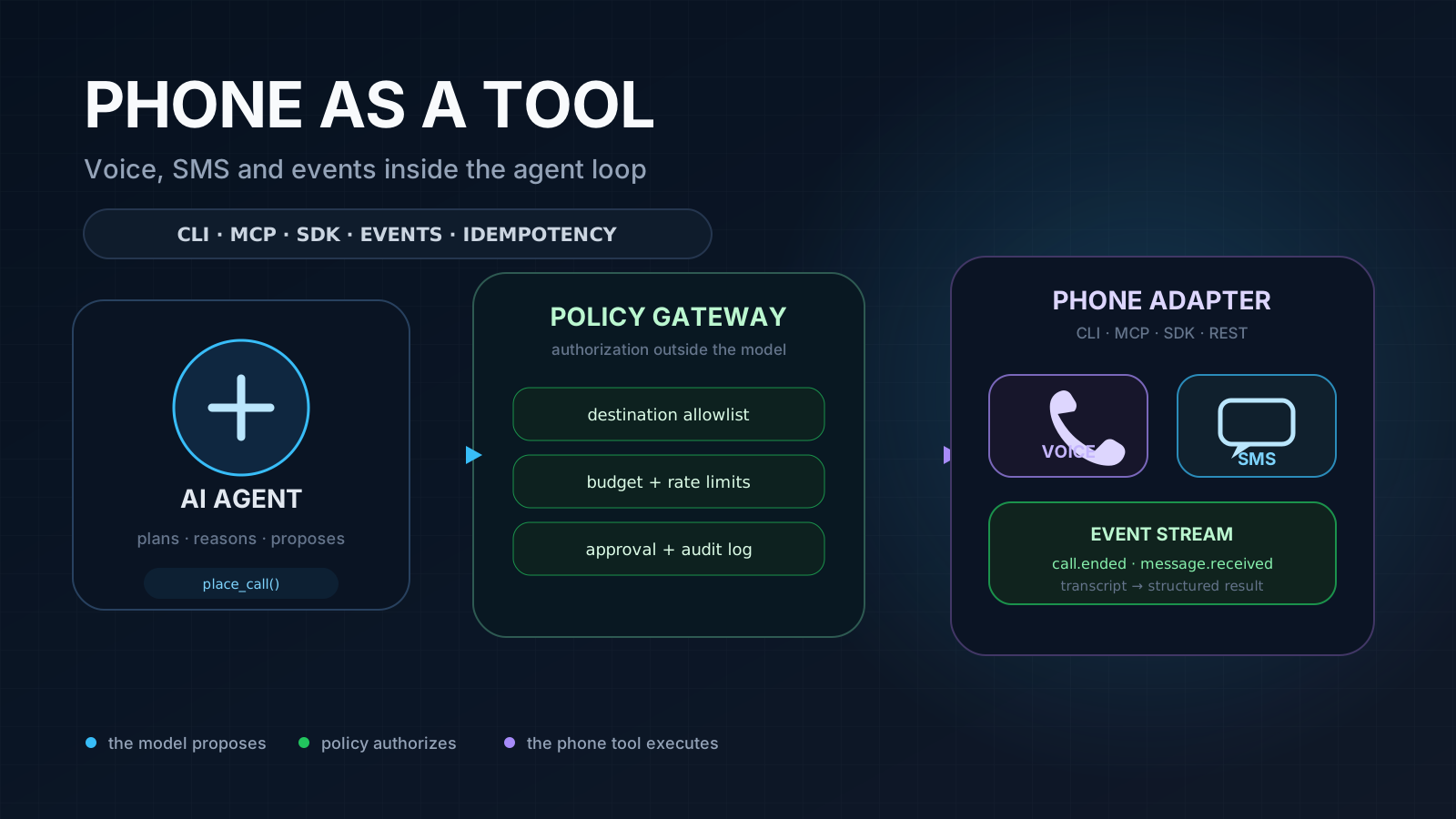
A recent demonstration showed an idea that looks small but changes agent architecture substantially: give an AI agent a phone number and let it place calls, receive them, send SMS messages, and react to telephony events like any other tool.
The interesting part is not that a model can “talk.” Speech recognition, language models, and text-to-speech have enabled that for years. The architectural jump happens when telephony enters the same tool loop as the shell, GitHub, a database, or a browser.
user
  ↓
agent
  ↓
policy / planner
  ↓
phone tool
  ├── outbound call
  ├── inbound call
  ├── SMS
  └── events
  ↓
phone network
  ↓
person or external system
At that point the phone stops being a separate interface. It becomes another operational capability of the agent.
The pattern: phone-as-a-tool
A modern agent usually works with structured tools:
read_file(path)
run_command(cmd)
create_issue(title, body)
query_database(sql)
Telephony can be modeled the same way:
place_call(to, instruction, idempotency_key)
get_call(call_id)
send_message(to, body)
wait_for(event_type)
The model does not need to implement SIP, RTP, carriers, WebRTC, or telephony signaling. An external gateway can encapsulate that complexity and expose a simple surface through a CLI, SDK, REST API, or MCP.
One current public implementation documents exactly this model: its CLI emits JSON, uses conventional exit codes, and lets an agent wait for call or message events. The same platform also exposes SDK and MCP interfaces so models do not need to scrape human-oriented output. (documentation)
That detail matters: a tool for agents should behave like an API, not like a terminal designed only for humans.
CLI vs. MCP vs. SDK
There are three reasonable ways to integrate telephony into an agent.
1. CLI
This is probably the simplest option for coding agents or operators that already have shell access:
phone call \
  --to "$DESTINATION" \
  --instruction "Confirm the appointment time and ask whether any documents are required" \
  --idempotency-key "$REQUEST_ID" \
  --json
Advantages:
- works with any agent that can execute commands;
- easy to audit;
- exit codes enable deterministic branching;
- JSON avoids fragile natural-language parsing;
- easy to wrap with scripts and operating-system policies.
A real implementation follows this pattern and adds --json to commands intended for agents. (CLI reference)
2. MCP
With Model Context Protocol, telephony becomes a native tool surface:
phone.place_call
phone.get_call
phone.send_message
phone.wait_for_event
This removes a shell-parsing layer and gives the runtime typed arguments from the start.
For a persistent agent, MCP adds another advantage: the runtime can apply permissions per tool.
phone.get_call        ALLOW
phone.send_message    REQUIRE_APPROVAL
phone.place_call      REQUIRE_APPROVAL
phone.buy_number      DENY
The policy stays outside the model.
3. SDK / REST
This is the better option when telephony is part of a larger application.
result = phone.place_call(
    to=destination,
    instruction=task,
    idempotency_key=request_id,
)
Here the model can be only one component in the workflow. The backend retains control over authentication, rate limits, auditing, retries, and storage.
A call should be an asynchronous job
A phone call is not a 50 ms function. It may take seconds to connect and minutes to finish.
The correct pattern therefore looks more like a job queue:
POST /calls
   ↓
202 Accepted
   ↓
call_id
   ↓
conversation running
   ↓
call.ended event
   ↓
GET /calls/{id}
   ↓
status + duration + transcript
An agent-oriented telephony platform documents this exact lifecycle: starting a call returns an initial status immediately, and once the call finishes a terminal event is emitted while duration and transcript become available. (voice-call lifecycle)
This fits agentic architectures naturally.
An agent can do other work while a call is in progress:
1. start a call to a supplier
2. persist call_id
3. continue processing other suppliers
4. wait for call.ended
5. retrieve transcript
6. extract price, date, and terms
7. compare results
8. decide the next action
Idempotency: do not call twice by accident
This looks like a small implementation detail until an agent retries a request.
Suppose:
agent → place_call()
             ↓
       network timeout
The agent cannot know whether the call was actually created. Blindly retrying may place a second real call.
The solution is an idempotency key:
request_id = sha256(task_id + destination + purpose)Then:
place_call(
  to=destination,
  instruction=instruction,
  idempotency_key=request_id
)
If the runtime repeats the operation, the provider should return the already-created call instead of originating another one.
At least one current agent CLI explicitly supports idempotency keys for outbound calls and warns that other operations may duplicate if retried blindly. (documentation)
For autonomous agents, this property is not optional. It is part of the tool contract.
Events turn the phone into an input bus
The second important shift appears with inbound calls and messages.
We normally think of an agent as something started by a prompt:
user → agentBut a phone number introduces external events:
incoming.call
incoming.message
call.started
call.ended
message.received
That turns the system into a reactive architecture:
phone
   ↓
event stream
   ↓
router
   ↓
agent runtime
   ↓
policy
   ↓
action
A message can wake up the agent just like a GitHub webhook or a queue event.
For example:
message.received
   ↓
classify intent
   ↓
query CRM
   ↓
generate response
   ↓
policy check
   ↓
send_message
Or for voice:
incoming.call
   ↓
voice agent
   ↓
resolve request
   ↓
if confidence < threshold
      → escalate to human
The main agent should not talk directly to the carrier
A robust architecture separates responsibilities.
                 ┌─────────────────────┐
                 │      AI agent       │
                 │ planning/reasoning  │
                 └──────────┬──────────┘
                            │ tool call
                            ▼
                 ┌─────────────────────┐
                 │    policy gateway   │
                 │ approvals / limits  │
                 └──────────┬──────────┘
                            │
                            ▼
                 ┌─────────────────────┐
                 │    phone adapter    │
                 │ CLI / MCP / SDK     │
                 └──────────┬──────────┘
                            │
                            ▼
                 ┌─────────────────────┐
                 │ telephony provider  │
                 └──────────┬──────────┘
                            │
                            ▼
                         PSTN/SMS
The policy layer should be able to decide things the model cannot modify:
- allowed destinations;
- allowed countries;
- maximum calls per hour;
- daily budget;
- operating hours;
- whether an action requires human approval;
- which prompts may be used;
- whether conversations may be recorded;
- how long a transcript is retained.
The general rule is the same as for any agent with real-world actions:
the model proposes; an external layer authorizes and executes.
Credentials should never live in the prompt
A poor integration would look like this:
Here is my API key: ...
Use it to make calls.
A better integration keeps the secret outside the model context.
agent
  ↓
phone tool
  ↓
credential store
  ↓
provider
The tool can read credentials from:
- a secret manager;
- runtime-injected environment variables;
- a local file with restrictive permissions;
- workload identity;
- an ephemeral token broker.
The model receives only the output it needs.
{
  "ok": true,
  "status": "initiated",
  "call_id": "<opaque-id>"
}
It should never need to see the secret that authorized the operation.
Transcripts become structured data
The real value of an agentic phone call appears after the voice interaction.
Audio can become:
{
  "objective": "confirm appointment",
  "outcome": "confirmed",
  "date": "2026-09-15",
  "time": "14:30",
  "requirements": ["photo ID"],
  "follow_up_required": false
}
The transcript is evidence; the JSON is the operational result.
A useful pipeline is:
audio
  ↓
transcript
  ↓
structured extraction
  ↓
validation
  ↓
domain action
For example:
call transcript
  ↓
extract_quote()
  ↓
validate currency + total
  ↓
store quote
  ↓
compare vendors
The agent does not merely “talk.” It turns a human conversation into computable state.
Observability: every call should be reconstructable
If a call produces a real decision, you should be able to answer:
- what task originated the call?
- which agent requested it?
- which policy authorized it?
- what instruction did the voice agent receive?
- which logical number was used?
- when did the call start and end?
- what was the outcome?
- what follow-up action was executed?
A useful trace can look like:
trace_id
 ├── task.created
 ├── policy.approved
 ├── phone.call.requested
 ├── phone.call.started
 ├── phone.call.ended
 ├── transcript.received
 ├── extraction.completed
 └── workflow.updated
You do not need to retain everything forever. With voice and SMS, data minimization and short retention are often better defaults.
Useful ideas
1. Quote-gathering agent
supplier list
   ↓
controlled parallel calls
   ↓
transcripts
   ↓
structured extraction
   ↓
price / availability / terms table
The human receives a comparison instead of five conversations.
2. After-hours receptionist
The agent handles simple questions and creates a task whenever human intervention is required.
incoming.call
  ↓
FAQ / knowledge base
  ↓
confidence gate
  ├── high → resolve
  └── low → ticket + callback
3. Appointment coordination
The agent can call to confirm, reschedule, or cancel an appointment, with clear limits on what changes it is authorized to make.
4. Operations and incidents
An observability system detects a critical incident and the agent:
alert
  ↓
consult runbook
  ↓
identify on-call owner
  ↓
place call
  ↓
confirm receipt
  ↓
update incident
Here the phone is an escalation channel, not a chatbot.
5. Dispatch and field work
For technicians, deliveries, or maintenance:
job delayed
  ↓
agent calls contact
  ↓
confirms new ETA
  ↓
updates system
  ↓
notifies next actor
6. Status follow-up when no API exists
Instead of a person manually checking whether a request has progressed, an agent can call an authorized contact, ask for the status, and persist the structured result.
7. A phone interface for a local agent
An agent running on a private machine can expose a phone number as a remote interface:
person calls
  ↓
identity + policy
  ↓
local agent
  ↓
read status
  ↓
respond by voice
The key is to tightly constrain what operations can be triggered from an inbound call.
What should not be automated blindly
Technical feasibility does not mean every conversation should be delegated.
Important boundaries include:
- do not hide automation when law or context requires disclosure;
- respect consent, automated-calling, and recording rules in the relevant jurisdiction;
- do not use calls or SMS to bypass controls protecting someone else’s account;
- treat OTPs, PII, and transcripts as sensitive data;
- avoid unsupervised medical, legal, financial, or emergency decisions;
- include human escalation when outcomes have meaningful consequences.
The architecture should assume a phone conversation can contain private information even when the original task looked harmless.
A reasonable minimum design
For an initial implementation:
agent runtime
   ↓
phone skill / MCP
   ↓
policy gateway
   ├── destination allowlist
   ├── call-rate limit
   ├── budget
   ├── approval threshold
   └── audit log
   ↓
telephony provider
   ↓
event queue
   ↓
transcript processor
   ↓
structured result
And keep the tool contract small:
class PhoneTool:
    def call(self, destination, instruction, idempotency_key): ...
    def get_call(self, call_id): ...
    def send_message(self, destination, body): ...
    def wait_for(self, event_type, timeout): ...
I would not start by letting the same agent purchase numbers, edit billing, or change account security. Separate communication operations from infrastructure administration.
The deeper idea
Giving an agent a phone is not primarily a voice feature.
It is another step in the transition:
model that answers
      ↓
model that uses tools
      ↓
agent that operates systems
      ↓
agent that interacts with people
      ↓
agent that participates in real-world processes
When a call becomes a tool, an old boundary between software and human coordination starts to disappear.
A system can query an API when one exists and make a phone call when one does not.
That creates powerful workflows, but it also raises the bar for engineering. Evaluating whether the model produces good text is no longer enough. You need to think about idempotency, budget, consent, permissions, auditing, privacy, escalation, and blast radius.
The useful question is no longer “can AI talk on the phone?”
It becomes:
Which processes that still depend on a human conversation can become a safe, observable, and reversible tool for an agent?