 Capital de Tokens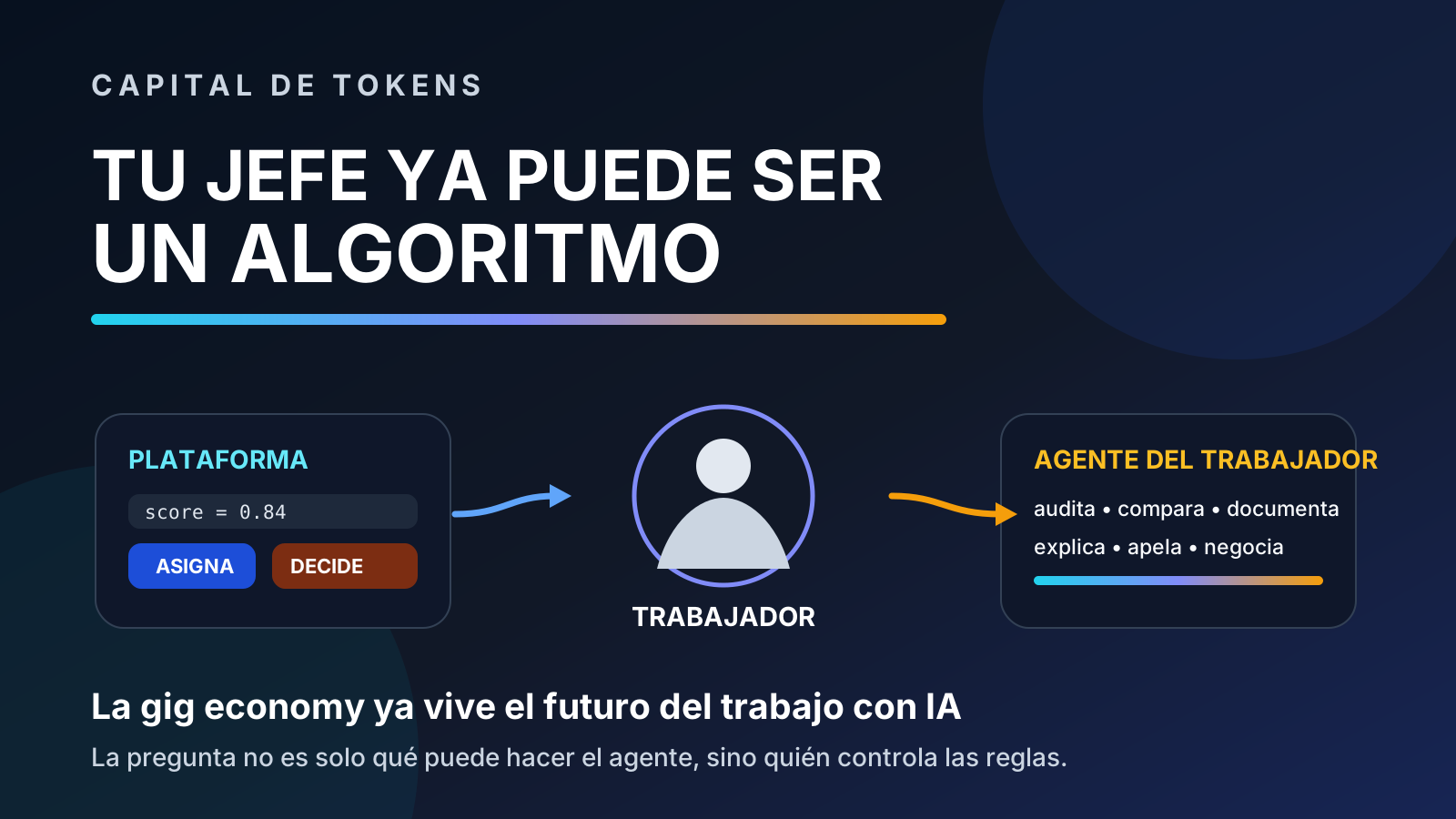
Your boss can already be an algorithm: what the gig economy reveals about the future of work with AI
When we talk about artificial intelligence and employment, we usually imagine a future scene: agents capable of completing entire tasks, companies operating with fewer employees, and professionals competing with increasingly autonomous software.
There is another way to look at the problem.
Part of that future already exists.
Millions of people already work inside systems where an algorithm decides which task appears, what price is offered, which incentive becomes available, how performance is evaluated, and, in some cases, whether a worker keeps access to the platform they depend on for income.
That is already happening across Uber, Lyft, DoorDash, and other gig-economy platforms.
Princeton researcher Andrés Monroy-Hernández has spent years studying this intersection of technology, labor, and power. In a recent interview, he offered a particularly useful idea for thinking about the agent era: while we debate whether AI will replace jobs in the future, there are already workers whose “boss” is an algorithm.
That line is more than a metaphor.
It is a clue to how work changes when the relationship between a person and a company is no longer mediated mainly by other people and is instead mediated by a computational platform.
The problem is not only that AI can do more work
Public discussion about AI and jobs often collapses into one question:
How many jobs will disappear?
That question matters, but it is incomplete.
There is another, more immediate question:
Who controls the rules when work is organized by algorithms?
In a traditional company, an employee may have a manager, coworkers, a human-resources department, internal procedures, and relatively visible channels for challenging a decision.
On a digital platform, many of those relationships can become software.
The system can:
- assign tasks;
- calculate prices;
- decide which offers each worker sees;
- activate promotions;
- evaluate performance;
- detect suspected fraud;
- suspend or deactivate accounts;
- change operating rules without giving workers a full view of the model behind a decision.
That shift is profound because it automates not only work, but also part of the power relationship surrounding work.
The gig economy is an early laboratory
Monroy-Hernández leads research in human-computer interaction and public-interest technology at Princeton. His projects include the Workers’ Algorithm Observatory (WAO), an initiative that develops tools for worker-led audits in the platform economy.
The core idea is simple: platforms have access to enormous amounts of data about prices, task allocation, promotions, and worker performance. Workers usually see only a small slice of the system.
That asymmetry matters.
A Princeton study on rideshare transparency found concrete gaps between what platforms disclose and what drivers need to understand, especially around fares, promotions, routes, and task allocation. The research combined worker interviews with a large-scale analysis of more than one million comments posted in online worker communities.
This makes the debate about “AI at work” much more concrete.
We are not talking only about a generative model writing emails or code. We are talking about automated systems that organize labor markets.
When the algorithm can also fire you
One of the most sensitive cases is account deactivation.
For a rideshare driver, losing access to the platform can functionally mean losing work overnight. The problem becomes more serious when the decision comes from automated systems, the explanation is limited, and the appeals process is difficult.
Princeton researchers developed FareShare, a tool designed to help labor organizations estimate lost wages and prepare cases when drivers are deactivated through arbitrary algorithmic or AI-driven decisions.
The project received recognition at CSCW 2026 and, according to Princeton, can dramatically reduce the time required to calculate lost wages and prepare dispute documentation.
This exposes an important lesson for AI agents.
Technical autonomy without appeal mechanisms, traceability, and accountability can become institutional autonomy without enough oversight.
An agent may be able to make a decision quickly. That does not mean it should have the final word.
“Autonomous agent” does not mean truly independent
The interview’s title refers to “the lie of the autonomous agent.” That phrase is worth interpreting carefully.
AI agents can be autonomous in an operational sense: they receive a goal, plan steps, use tools, and execute actions with little direct human intervention.
But that autonomy always exists inside infrastructure:
- a model provider;
- an execution platform;
- APIs;
- permissions;
- policies;
- data;
- accounts;
- identity systems;
- technical and economic limits.
An agent is therefore not an independent entity floating in a vacuum.
It depends on whoever controls that infrastructure.
And that dependency matters when agents become part of real economic processes.
Imagine a company where 20% or 30% of internal work depends on agents connected to a single provider. The risk is not only that the model might fail. There are also risks involving price, availability, policies, product changes, data access, and concentration of technological power.
It is an enterprise version of the same structural issue already visible in the gig economy: when the entire relationship depends on a platform, the platform accumulates decision-making power.
The alternative does not have to be “reject the technology”
What makes Monroy-Hernández’s work interesting is that it is not anti-technology.
His research also tries to build alternatives.
Princeton’s official profile lists OpenCourier, an open-source federated protocol intended to enable locally owned alternatives to mainstream food-delivery platforms. The goal is to make it possible for restaurants, workers, and communities to operate networks without necessarily placing one intermediary in control of the whole market.
That changes the question.
Instead of asking:
Should algorithms organize work?
we can ask:
Who owns the system, who can see the data, who sets the rules, and who can challenge a decision?
The underlying technology can be similar while the power structure is radically different.
Every worker may eventually need an agent of their own
The interview also raises a provocative possibility: if companies use algorithms and agents to manage work, workers may answer with their own agents.
Imagine a driver with an agent that can:
- automatically record every offer received;
- calculate real earnings per hour and per mile;
- compare rates across platforms;
- detect unusual changes in promotions;
- document potentially unfair decisions;
- prepare evidence for an appeal;
- manage availability and preferences;
- recommend when to accept or reject a task.
The relationship would no longer be simply “person versus algorithm.”
It could become platform algorithm versus worker agent.
That does not eliminate the imbalance of power, but it may reshape it.
Tools such as FairFare, built by Princeton researchers in collaboration with driver organizations, already point in that direction by allowing workers to pool and analyze their own data to understand the platform’s take rate and advocate for greater wage transparency.
The future of work may look less like an office and more like an API
For decades, the typical employment relationship was associated with a specific company, a workplace, and a relatively stable hierarchy.
Platform work broke part of that structure.
AI may accelerate the process.
A designer, programmer, accountant, doctor, lawyer, or consultant could increasingly work through multiple platforms that distribute tasks, verify outputs, calculate reputation, and automatically match supply with demand.
In that world, the basic economic unit may shift away from “employee of one company” toward something closer to “professional connected to a network of systems and agents.”
That can increase flexibility and productivity.
It can also fragment rights, professional identity, bargaining power, and stability.
That is why the gig economy is not a side issue in the discussion about AI agents.
It is one of the best places to observe what happens when software stops being merely a tool and becomes management infrastructure.
The better question is who controls the agent
The conversation about autonomous agents usually focuses on capability:
- How well can they reason?
- How many steps can they execute?
- Can they operate a computer?
- Can they replace an entire workflow?
But once those agents participate in economic decisions, we need another layer of questions:
- Who can audit their decisions?
- What data do they use?
- How can an error be corrected?
- Is there a right to appeal?
- Can the user move to another platform?
- Is there interoperability?
- Does the worker retain their own data?
- Can the platform unilaterally change the rules?
Those questions are not futuristic.
Drivers on Uber, Lyft, and other platforms already live versions of them every day.
Conclusion
The key lesson from this research is not that autonomous agents are fake, nor that automation should stop.
It is something more useful:
technical autonomy does not erase power relationships; it can hide them behind an interface.
When an algorithm decides what work you receive, how much you can earn, or whether you keep access to a platform, system design stops being a purely technical issue.
It becomes governance.
And if the economy of the future is filled with agents, platforms, and workers coordinated by software, the most important challenge may not be building agents that are ever more autonomous.
It may be ensuring that the people who depend on them also have data, tools, alternatives, and real power to defend their interests.
Sources
- Original video: “Investigador Princeton: La Mentira del Agente Autónomo”
- Andrés Monroy-Hernández — Princeton Computer Science
- Workers’ Algorithm Observatory
- Rideshare Transparency: Translating Gig Worker Insights on AI Platform Design to Policy — Princeton
- FairFare: A Tool for Crowdsourcing Rideshare Data to Empower Labor Organizers — Princeton
- FareShare and algorithmic deactivations — Princeton CITP