 Capital de Tokens
The mathematical limit of artificial intelligence
 Watch on YouTube
 In 1936, Turing posed a seemingly austere question: what does it mean for a procedure to be computable? To answer it, he described an abstract machine that reads symbols, writes symbols, and follows a finite set of rules step by step. It was not a blueprint for a modern laptop, but it offered a precise definition of mechanical computation
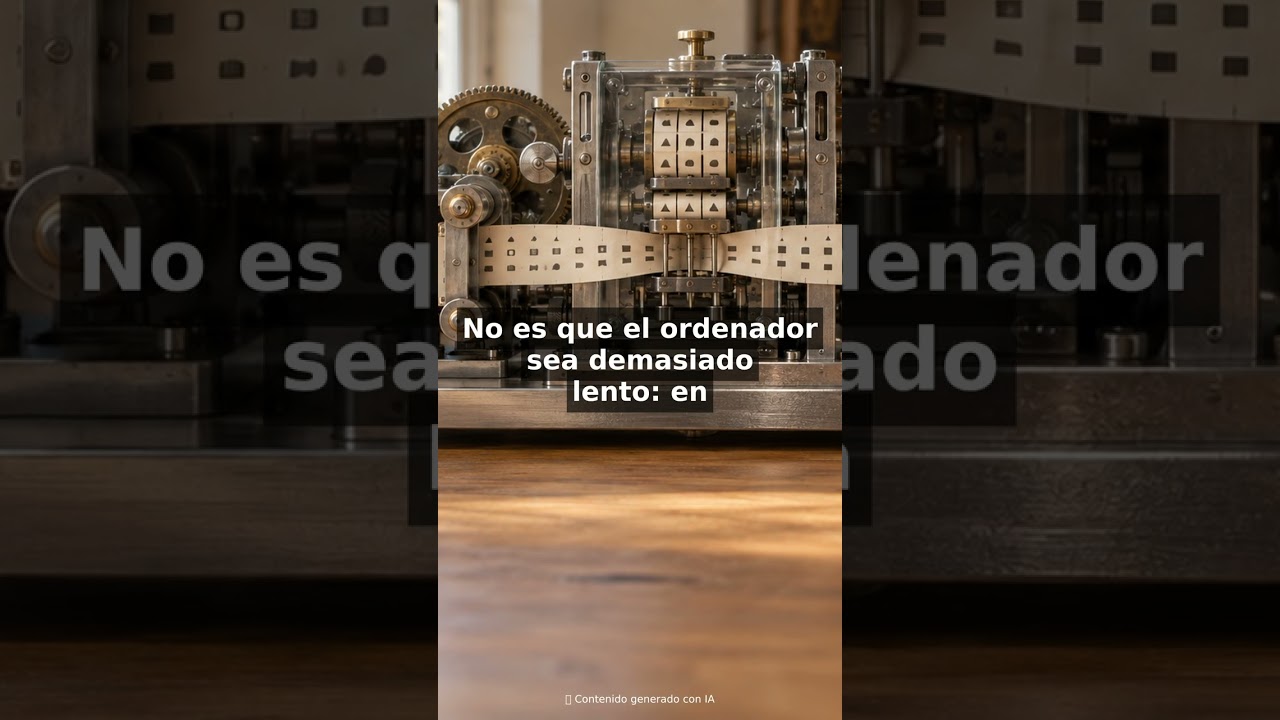
In 1936, Turing posed a seemingly austere question: what does it mean for a procedure to be computable? To answer it, he described an abstract machine that reads symbols, writes symbols, and follows a finite set of rules step by step. It was not a blueprint for a modern laptop, but it offered a precise definition of mechanical computation. And the consequence was enormous. It made it possible to speak rigorously about what a machine can compute, and also about what it cannot compute. That last point is crucial. The popular view of computing is expansive: with enough power, any problem will eventually be solved. But the theory of computation says something more uncomfortable. There are problems for which no general algorithm can always provide an answer. It is not that the computer is too slow: in certain cases, the limit lies in the type of problem. That distinction is liberating. It protects us from promising automated solutions where none can exist. And it should temper the discourse on artificial intelligence. A system can be extraordinary at recognizing patterns and yet offer no mathematical guarantees of accuracy, fairness, or safety in every situation.
Full episode: https://youtu.be/9bXgfg5Il8Q
🤖 AI-generated content: the script, voices, and images for this episode were produced using artificial intelligence tools.
#Shorts