 Capital de Tokens
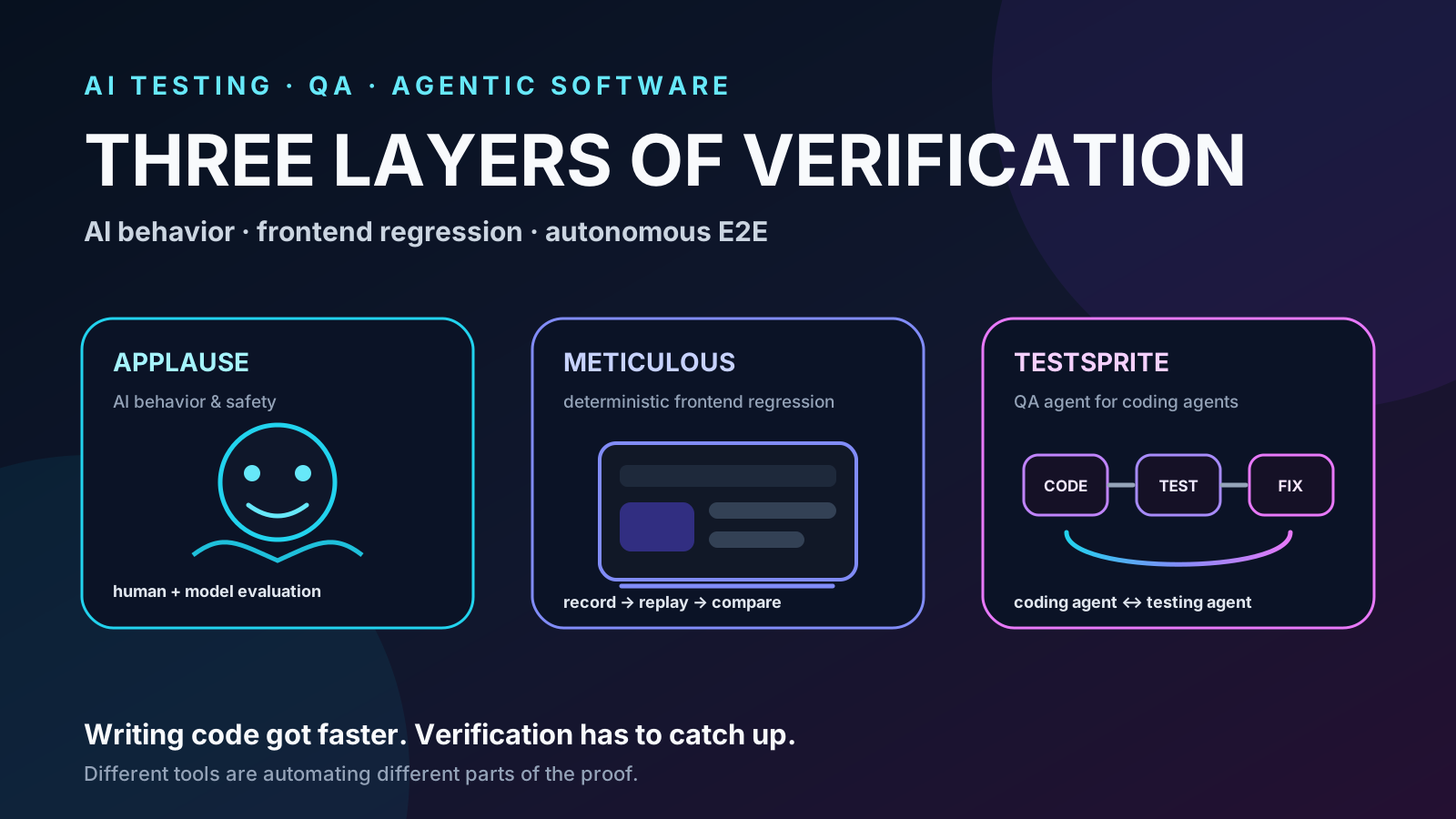
The acceleration of software development with coding agents is creating an unusual problem: writing software can become faster than proving that it works.
A growing set of products is appearing under the broad label of AI testing, but they often solve very different problems.
Three tools illustrate that fragmentation particularly well:
- Applause focuses on evaluating AI applications and agents in real-world conditions by combining automation, model-based evaluators, experts, and users.
- Meticulous primarily automates web UI regression by observing interactions and replaying them deterministically.
- TestSprite aims to act as an autonomous QA agent that generates, executes, and diagnoses end-to-end tests and can work directly with coding agents such as Codex.
The distinction matters because these tools are not perfect substitutes. They represent three different layers of the quality problem.
Information verified on September 29, 2026 from official Applause, Meticulous, and TestSprite documentation and product pages.
The bottleneck is moving
For years, automating testing mostly meant writing and maintaining suites with frameworks such as Playwright, Cypress, Selenium, pytest, and similar tools.
Coding agents change the economics.
If an agent can produce several modifications in minutes, the question is no longer only:
how do we write more code?
It increasingly becomes:
how do we verify, with enough evidence, everything that agent just changed?
A green unit-test suite helps, but it does not necessarily prove that:
- a page still renders;
- a checkout still works end to end;
- an API rejects invalid input;
- an agent selected the right tool;
- a RAG system retrieved the right evidence;
- a generative answer is safe and useful.
This is where Applause, Meticulous, and TestSprite start to diverge.
1. Applause: testing the behavior of the AI system
Applause is the most different of the three.
It is not positioned merely as an automatic test generator. Its AI offering focuses on evaluating generative and agentic systems with a combination of automation and human judgment.
In its Agentic AI Testing services, Applause describes evaluation across areas such as:
- tool-call accuracy;
- retrieval relevance;
- task completion;
- multi-step workflows;
- RAG;
- multi-model or multi-agent coordination;
- safety and red teaming;
- bias, toxicity, and other risks.
It also emphasizes human-in-the-loop review and domain experts for failures that are difficult to reduce to a conventional assertion.
That matters because an AI system does not always produce exactly the same output for the same input.
A traditional test might ask:
expected == actualAn agent often requires questions closer to:
Did it choose the right tool?
Were the arguments correct?
Did it retrieve relevant evidence?
Did it complete the task?
Was the action safe?
Did the final answer satisfy the goal?
Applause says it can inspect these traces step by step while combining automated evaluators with humans.
Its natural territory is therefore AI-system behavior quality, not merely whether a button still works.
Official source: Applause — Agentic AI Testing
Where it fits best
Applause makes the most sense when the product under test is the AI experience itself:
- action-taking agents;
- conversational assistants;
- RAG systems;
- voice systems;
- regulated workflows;
- products where a plausible but incorrect answer can be a serious failure.
Its model is also much closer to a managed enterprise testing service than to simply installing a package in a repository.
2. Meticulous: turning real usage into regression tests
Meticulous attacks a different problem.
Its specialty is the frontend.
The tool adds a recorder to local, staging, or preview environments and observes how the application is used. From those interactions it builds a visual end-to-end suite that evolves as the product changes.
Conceptually:
developers/users interact with the app
        ↓
Meticulous records the flows
        ↓
builds E2E coverage
        ↓
a pull request opens
        ↓
replays the workflows
        ↓
detects regressions before merge
One particularly interesting detail is how it attempts to reduce flakiness.
According to its documentation, Meticulous can save and replay the original backend responses by default. That means a run does not have to depend on remote data remaining identical from one session to the next.
The company also says it uses a deterministic scheduler built at the Chromium level to control sources of nondeterminism.
Official source: Meticulous
What it tries to eliminate
Meticulous is not mainly asking an LLM to invent hundreds of tests from source code.
Its proposal is closer to:
observe how the application is actually used and turn those interactions into a regression network developers do not have to maintain manually.
That can be particularly attractive for complex web applications where large Playwright or Cypress suites consume significant engineering time just to remain healthy.
Meticulous supports stacks such as React, Next.js, Vue, Angular, and SvelteKit, together with GitHub and GitLab integrations.
3. TestSprite: the QA agent working beside the coding agent
TestSprite represents the third direction: making testing itself agentic.
Its idea is that the system should not stop at generating test files. The QA agent should understand what the product is trying to do, execute tests against the running application, collect evidence, diagnose the failure, and return that information to the coding agent.
Its documentation describes a loop roughly like:
Codex implements
      ↓
TestSprite generates / selects tests
      ↓
runs UI + API + workflows
      ↓
collects screenshots, DOM and steps
      ↓
suggests a cause and fix
      ↓
Codex corrects
      ↓
verification runs again
TestSprite can work from a PRD, API documentation, or infer product intent from the project itself.
It also runs cases on cloud infrastructure and keeps failure evidence such as screenshots, DOM snapshots, and replayable sessions.
Official source: TestSprite
The interesting part: Codex as a QA client
TestSprite publishes an integration specifically for OpenAI Codex.
Its command:
testsprite setup --agent codexinstalls a verification skill in the repository so Codex knows the commands, data formats, and exit codes required to drive the testing loop.
The idea matters beyond TestSprite itself.
We are moving from:
developer → test frameworktoward:
coding agent → testing agent → coding agentwith the developer supervising the cycle.
TestSprite also offers MCP integration and references Claude Code, Cursor, VS Code, and other agentic environments.
Official source: TestSprite — Testing Tool for Codex
These are not three direct competitors
Putting all of them in a single “AI testing tools” bucket hides the most important difference.
| Tool | Main question |
|---|---|
| Applause | Does my AI system behave correctly, safely, and usefully in real-world conditions? |
| Meticulous | Did this change break one of my web UI flows? |
| TestSprite | Can a QA agent automatically verify what my coding agent just built? |
In a sufficiently large system they could even coexist.
For example:
                    SOFTWARE
                       │
          ┌────────────┼────────────┐
          │            │            │
          ▼            ▼            ▼
     Meticulous    TestSprite    Applause
     frontend      E2E + API     AI behavior
     regression    agent loop    evals / safety
That does not mean a team should use all three. It illustrates that each one observes a different class of failure.
The common direction: reducing manual verification work
Despite starting from different places, they share a broader trend.
Testing is moving from manually writing every test toward systems that attempt to discover what should be tested, execute the verification, and maintain coverage themselves.
Meticulous learns from interactions.
TestSprite learns from the product and its requirements.
Applause combines automated evaluators with people and domain experts capable of judging behavior that cannot easily be reduced to an assert.
That suggests a future QA stack with multiple layers:
unit tests
    ↓
integration tests
    ↓
agent-generated E2E
    ↓
deterministic regression replay
    ↓
AI evals
    ↓
human / domain expert evaluation
    ↓
red teaming
AI does not necessarily eliminate the earlier layers. It may increase the amount of software that needs verification and therefore make those layers even more important.
The decisive question for teams using coding agents
There is one particularly important consequence for Codex, Claude Code, and similar systems.
Until now, an agent could say:
implementation complete, tests pass.
But that sentence is only as valuable as the tests that already exist.
If the changed behavior had no coverage, the agent could be extremely confident and still ship a regression.
Tools such as TestSprite and Meticulous attempt to expand that evidence automatically. Applause targets an even harder layer: determining whether an AI system actually did the right thing.
That turns testing into a core part of the agent harness.
Giving a model repository access, a terminal, and documentation is not enough. It also needs a reliable way to answer:
how do I know what I just did actually works?
Conclusion
The label AI testing is too broad.
Applause, Meticulous, and TestSprite show three possible futures for QA:
- evaluating AI systems with automation and human judgment;
- converting real frontend behavior into deterministic regression coverage;
- building testing agents that can close the loop with the agents writing the code.
The most important trend is not that AI will “replace tests.”
It is that as agents produce changes faster, verification needs to become an automatic, continuous capability that is as agentic as code generation itself.