 Capital de Tokens
If you open Chat Jimmy and ask it a question, the first impression is not that the model is smarter than the large frontier models.
The impression is something else:
it responds at an absurd speed.
Behind that experience is a hardware demonstration called Taalas HC1, designed to run Llama 3.1 8B in a very different way from a conventional GPU.
Taalas summarizes its philosophy with a provocative phrase:
The Model is The Computer.
The idea is to push specialization so far that the model stops behaving simply like a set of weights that a machine loads from memory and instead becomes part of the structure of the hardware that executes it.
That makes Chat Jimmy more interesting than another chatbot.
It is a window into a much deeper question:
what happens if we sacrifice much of a GPU’s flexibility to build silicon around a specific model?
What exactly is Chat Jimmy?
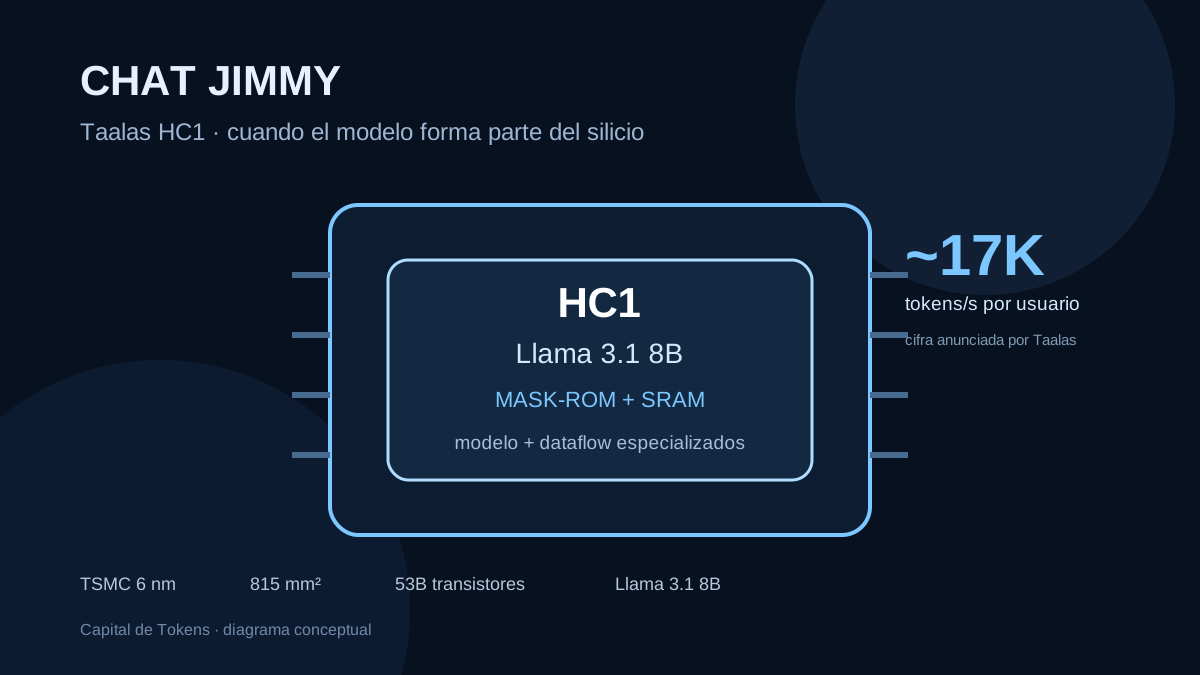
Chat Jimmy is the public chatbot Taalas uses to demonstrate its first accelerator, the HC1 Technology Demonstrator.
According to Taalas’s official specification, HC1 runs Llama 3.1 8B and is manufactured on TSMC 6 nm, with an 815 mm² die and roughly 53 billion transistors. The company also presents a 2.5 kW server configuration.
The figure that has attracted the most attention is the announced performance:
approximately 17,000 tokens per second per user.
Taalas publishes that number for Llama 3.1 8B under a 1k/1k sequence test. It should therefore not be interpreted as a guarantee of 17,000 tokens/s for every prompt, context length, or concurrent workload.
Even so, the magnitude does not appear to be only a marketing chart. EE Times tested the chatbot and reported more than 15,000 tokens/s in its own experience, while Taalas said it approaches 17,000 tokens/s internally under certain conditions.
That same coverage also points out an important detail: the model version being used is aggressively quantized.
The speed is real, but so are the trade-offs that make it possible.
The problem Taalas is trying to attack: moving the weights
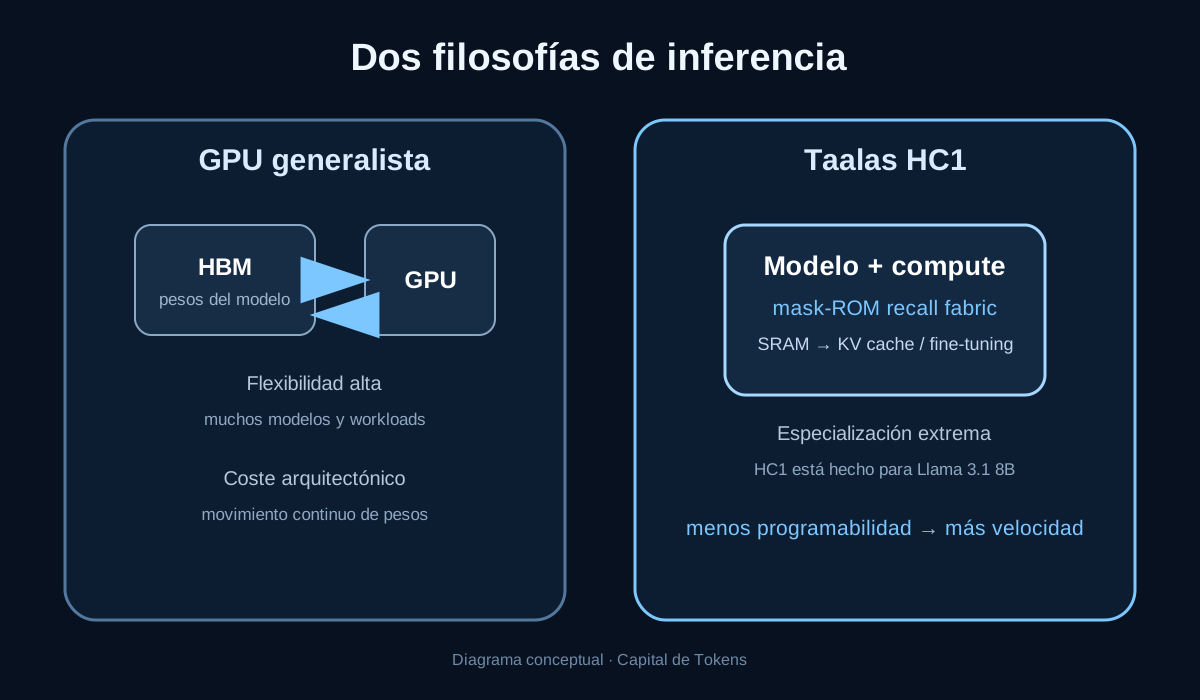
On a modern GPU, running an LLM is not only about doing matrix multiplications.
A huge part of the problem is continuously feeding the model’s weights to the compute units.
Conceptually, a conventional architecture looks like this:
HBM / memory
      │
      │ weights
      ▼
     GPU
      │
      ▼
operations
      │
      ▼
    token
Modern accelerators invest enormous amounts of engineering into solving that problem: high-bandwidth HBM, fast interconnects, caches, batching, optimized kernels, and techniques for extracting as much utilization as possible from the hardware.
Taalas takes another path.
Instead of asking:
how do we move the weights even faster into a programmable processor?
the question becomes:
what if the weights and the model’s dataflow are part of the chip design itself?
Mask-ROM + SRAM: the heart of HC1
EE Times describes HC1 as an architecture that uses a mask-ROM-based recall fabric alongside programmable SRAM.
The ROM portion allows the primary model weights to be embedded in the chip.
SRAM keeps space for information that does need to remain dynamic, such as:
- the KV cache;
- fine-tuning weights;
- model adaptations.
The architectural consequence is important.
A GPU tries to be an extremely powerful and programmable machine capable of running many different models and workloads.
HC1 deliberately gives up much of that generality.
Its goal is not to be a better GPU.
Its goal is to be an extraordinarily good machine for executing the model it was specialized for.
The big trade-off: programmability versus speed
This is the part that prevents Chat Jimmy from becoming a simplistic “new chip destroys GPUs” story.
HC1 has an enormous limitation:
that chip is made for Llama 3.1 8B.
You cannot treat it like a GPU and decide tomorrow that you want to load any arbitrary model from another family.
The conceptual comparison is:
GPU

many models
many workloads
high programmability
        │
        ▼
higher cost of generality
versus:
HC1

specific model
specific flow
very little generality
        │
        ▼
extreme optimization
That echoes a constant throughout computing history: specialization can produce enormous improvements when we are willing to constrain the problem.
The difference is that Taalas is trying to make that specialization avoid the development cycles traditionally associated with designing an entirely new ASIC for each workload.
How can it change models without starting from scratch?
According to Taalas and the technical explanation published by EE Times, the company borrows ideas from structured ASICs.
Instead of redesigning every transistor from scratch, it can modify a limited part of the masks —including interconnects that determine weights and dataflow— to specialize the hardware.
EE Times reports that Taalas changes two masks to adapt the chip.
This point is critical to the strategy’s viability.
An accelerator that took several years to become ready would risk being obsolete at birth in an industry where models change constantly.
Taalas is betting that it can dramatically shorten that cycle and make specialized hardware follow software much faster than a conventional ASIC can.
17,000 tokens/s does not automatically mean “better AI”
Inference speed and cognitive capability are different dimensions.
Chat Jimmy runs Llama 3.1 8B, a small model compared with large frontier systems.
That is why the right comparison is not:
Jimmy is better than frontier models because it generates more tokens per second.
The interesting comparison is:
what new software architectures become possible when generating tokens with a small model stops being a slow operation?
That is a much more useful question.
Imagine tasks such as:
- classification;
- structured extraction;
- routing;
- text normalization;
- fast evaluation;
- variant generation;
- semantic parsing;
- content filtering;
- repetitive transformations;
- small verification steps inside an agent.
Many of those operations do not always need the smartest model available.
They need a model that is capable enough, cheap, and extremely fast.
Why this could matter especially for agents
A traditional chatbot usually has a simple pattern:
user
   ↓
model
   ↓
response
An agentic system may perform many more inferences to complete a single task:
plan
   ↓
select tool
   ↓
interpret result
   ↓
classify
   ↓
verify
   ↓
replan
   ↓
evaluate
   ↓
respond
The latency of each call starts to multiply.
If an agent needs twenty sequential steps and each inference takes one second, the experience can quickly become frustrating.
But if a class of worker can return results in milliseconds, the design space changes.
A hybrid architecture could use a frontier model for difficult decisions and small ultrafast models for repetitive work.
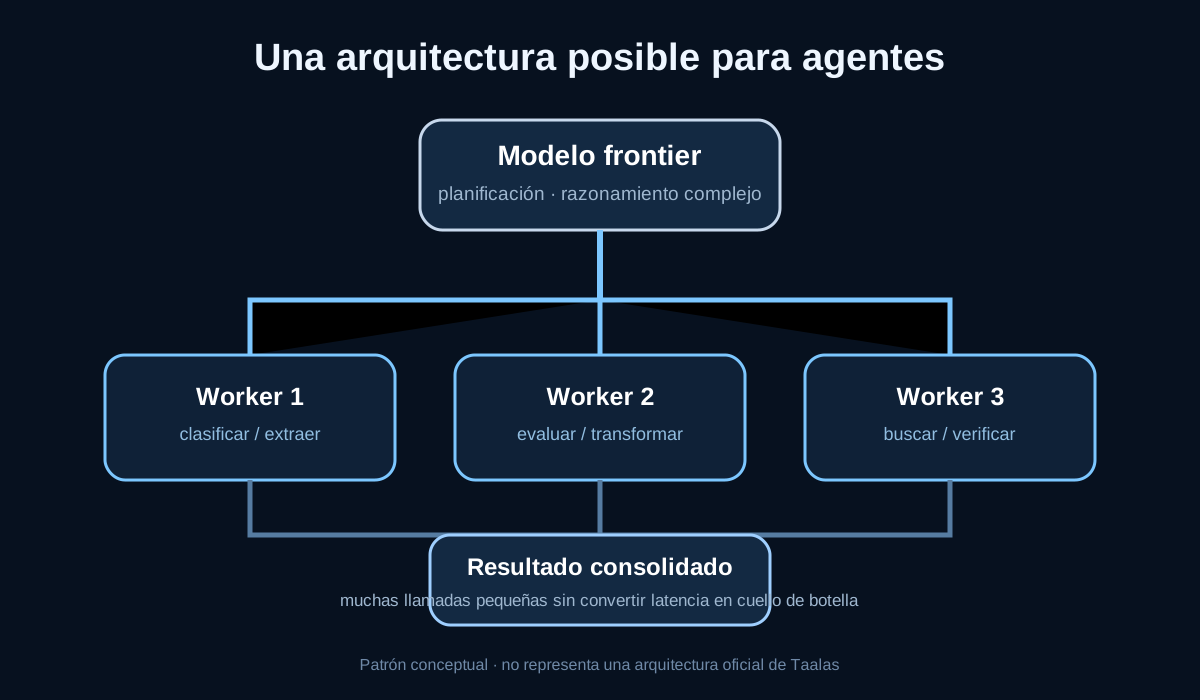
Conceptually:
             frontier model
                  │
               planner
                  │
        ┌─────────┼─────────┐
        ▼         ▼         ▼
     worker     worker     worker
   classify    evaluate    extract
        │         │         │
        └─────────┼─────────┘
                  ▼
               result
This diagram does not represent an official Taalas architecture. It is an engineering consequence worth exploring if specialized inference reaches extremely low latency.
In agent systems, performance does not depend only on how many tokens the main model generates.
It also depends on how expensive every small coordination step is.
A surprisingly familiar API
Taalas does not limit the demonstration to the Chat Jimmy page.
It has a documented public API for HC1 and offers endpoints compatible with the OpenAI format:
POST /v1/chat/completions
POST /v1/completions
GET  /v1/models
The API also supports streaming through Server-Sent Events.
That means that, from an integration perspective, trying HC1 can look very much like changing the base_url of a client that already understands the Chat Completions schema.
A conceptual example would be:
from openai import OpenAI

client = OpenAI(
    api_key="YOUR_TAALAS_API_KEY",
    base_url="https://api.taalas.com/v1",
)

response = client.chat.completions.create(
    model="three_bit_numerics",
    messages=[
        {"role": "user", "content": "Explain what a circuit breaker is."}
    ],
)
The available model name should be checked through the API because it can change. The current documentation shows three_bit_numerics in its examples.
The architectural point matters more than the snippet: Taalas is trying to hide a radical silicon architecture behind a familiar software interface.
That greatly reduces the friction of experimentation.
What Taalas says about privacy
Taalas’s privacy policy includes a statement relevant to people trying Chat Jimmy or its API.
The company says that it and its providers do not use prompts and outputs to create, train, fine-tune, or improve AI models.
At the same time, Taalas does collect technical and service-usage data to operate, measure, and improve its platform.
The practical recommendation remains the same as with any cloud service:
do not enter secrets, credentials, confidential code, or sensitive personal information unless the policy and security context are compatible with that use.
AMD saw enough value to make a move
The Taalas story gained a much larger dimension in August 2026.
On August 6, 2026, AMD announced that it had reached a definitive agreement to acquire Taalas.
The distinction matters: the announcement says the transaction is subject to closing conditions and regulatory approvals. It is not accurate to describe it yet as a fully completed integration.
AMD says it plans to incorporate Taalas technology into its accelerator roadmap and develop system-level solutions alongside AMD Instinct GPUs.
That suggests something interesting.
The future of inference will probably not be a war in which only one architecture survives.
It could be a heterogeneous system where different workloads end up on different kinds of compute:
frontier workload
      ↓
GPU / general accelerator

stable, repetitive workload
      ↓
highly specialized silicon

CPU / control
      ↓
orchestration and system logic
The proposed acquisition fits precisely with that view: use the right kind of compute for each problem.
The number that really matters is not 17K
It is easy to focus on the large number.
17,000 tokens/s is a spectacular demonstration because it makes performance visible to anyone who opens the chatbot.
But the most important part of Chat Jimmy is not the exact figure.
It is the demonstration of three ideas:
- Memory remains one of the major bottlenecks in inference.
- Extreme specialization can trade programmability for radical performance gains.
- If the manufacturing cycle can move closer to the pace of model evolution, model-specific hardware can occupy a real space alongside GPUs and other accelerators.
The third point is the hardest.
An AI model can change in months.
A traditional silicon architecture can take much longer.
Taalas technology will only be transformative at scale if it can keep the path between these stages short enough:
selected model
      ↓
specialization
      ↓
tape-out
      ↓
manufacturing
      ↓
deployable board
That is one of the questions worth continuing to watch.
Extreme specialization also has risks
The same characteristic that produces HC1’s performance produces its risks.
If the model changes too quickly, the silicon may lose relevance.
If an architecture requires new operations that the chip does not support, lack of programmability can become a major limitation.
If the market fragments into hundreds of models, deciding which one deserves to become specialized hardware becomes a difficult economic decision.
And if small models improve while frontier models keep changing, a natural split could emerge:
- highly dynamic models → general-purpose hardware;
- mature, high-volume models → specialized hardware.
That is probably a more useful way to think about HC1 than imagining it as a universal GPU replacement.
A new optimization layer for AI
For years, AI application development has focused mainly on the model and software layers:
prompt
RAG
agents
fine-tuning
tools
orchestration
Chat Jimmy forces us to look one layer lower.
What happens when we can also aggressively optimize the relationship between model and silicon?
The stack begins to look like this:
Application
   ↓
Agent / orchestrator
   ↓
Model
   ↓
Runtime
   ↓
Inference architecture
   ↓
Silicon
The more inference volume there is, the more important each layer becomes.
In that context, Taalas is not simply trying to build “another GPU.”
It is challenging a more basic assumption:
why do the model and the computer have to remain two such separate things?
For now, Chat Jimmy is an extremely specialized demonstration of that idea.
But the speed at which it generates text makes the experiment difficult to ignore.
Sources and recommended reading
- Chat Jimmy
- Taalas — HC1 Technology Demonstrator
- Taalas API — documentation and OpenAI-compatible endpoints
- Taalas — Privacy Policy
- EE Times — Taalas Specializes to Extremes for Extraordinary Token Speed
- AMD — definitive agreement to acquire Taalas, August 6, 2026
The ~17,000 tokens/s figure, 6 nm process, 815 mm² die, 53B transistor count, and 2.5 kW server specification come from Taalas. The independent description of the mask-ROM recall fabric, SRAM, aggressive quantization, and a test exceeding 15,000 tokens/s comes from EE Times. The status of the AMD transaction is based on the official corporate announcement from August 6, 2026.