 Capital de Tokens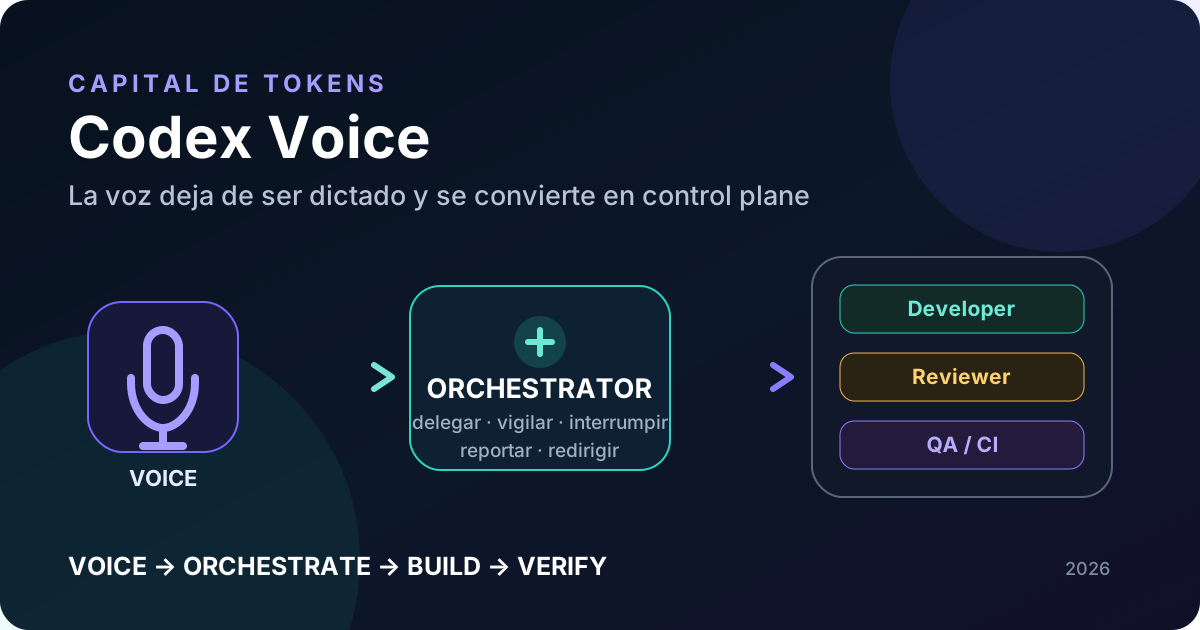
When we think about using voice for programming, the first mental model is usually fairly limited:
I speak
  ↓
speech-to-text
  ↓
prompt
  ↓
agent writes code
That is already useful. Dictating a long instruction can be faster than typing it, and speaking often makes us add context, constraints, and examples we might omit at the keyboard.
But Voice in Codex points to something else.
On July 23, 2026, OpenAI introduced a desktop voice experience for Work and Codex designed not only for conversation, but to start tasks, check progress, ask questions about agents, and coordinate multiple agents from one conversation.
That detail changes the mental model entirely.
Voice stops being just another way to enter text.
It starts becoming a control interface for agentic work.
And the first weeks of public use are already showing how that pattern could evolve.
What OpenAI actually launched
It helps to separate two experiences that are often mixed together in public discussion.
First there is dictation: you speak, your voice is transcribed, and you get text you can review before sending.
Then there is Live Voice: a bidirectional real-time conversation where the system can listen and respond and, in Work or Codex, coordinate work while agents continue executing tasks.
The official documentation describes capabilities such as:
- starting tasks;
- checking progress;
- asking about agent status;
- coordinating multiple agents;
- interrupting or redirecting work through the conversation.
That suggests an architecture very different from a “microphone inside the editor.”
voice
  ↓
orchestrator
  ↓
┌────────────┬────────────┬────────────┐
│ developer  │ reviewer   │ QA / CI    │
└────────────┴────────────┴────────────┘
  ↓
state + results
  ↓
voice
The conversation becomes the control plane.
Workers execute the work.
What the community is actually doing
There is not yet broad statistical evidence that would justify calling any of this a quantitative consensus. What does repeatedly appear across Reddit, GitHub, and user discussions are concrete usage patterns.
1. A voice manager for multiple agents
One of the most interesting use cases appeared immediately after launch.
Users found that a Voice conversation could look across active projects, launch workers, and send messages to other Codex threads.
Instead of maintaining a separate conversation with every agent, the user talks to a coordinator:
"Review my active projects."
"Send an agent to fix that CI failure."
"Open another worker to review the change."
"How is the first one doing?"
"Cancel the second one."
That pattern matters because it shifts the interface away from the executing agent and toward an orchestrator.
The human no longer needs to remember which thread owns each task.
They only need to express intent and receive state.
2. Talk through architecture, then delegate implementation
Another natural pattern is to use voice for the most ambiguous part of the work: design, requirements, trade-offs, and decisions.
The conversation can last several minutes.
Once the direction is clear, implementation is delegated to a worker.
human + voice
      ↓
explore problem
      ↓
agree on architecture
      ↓
create task capsule
      ↓
worker implements
This makes sense because speaking is especially efficient for transmitting high-level context, while the execution agent can work from a structured, bounded instruction.
3. Hands-free coding during long tasks
On Reddit, some users describe multi-hour Voice sessions while Codex coordinated real work; one example involved a cloud migration.
We should not turn one person’s experience into universal evidence, but it does reveal a possible workflow:
"Do X."
      ↓
agent works
      ↓
"How is it going?"
      ↓
status
      ↓
"Don't do that; use Y."
      ↓
redirect
The important capability here is not speech transcription.
It is being able to intervene while the work is still live.
4. Voice as a status interface
This may become one of the most valuable use cases.
Today, to see how a task is progressing, we usually open GitHub, a dashboard, a terminal, or the specific agent conversation.
A voice layer could make that much more direct:
"How is the PR going?"

"Developer finished. Reviewer found two issues.
CI has 18 of 19 checks green."

"Tell Developer to fix the failure."
Voice then becomes an operational console expressed in natural language.
It does not replace GitHub Actions or an observability system.
It abstracts them.
5. More context with less friction
Developers have been using dictation for a simple reason: speaking can produce richer prompts.
When we type, we tend to compress.
When we speak, we explain.
That often introduces naturally:
- background;
- examples;
- constraints;
- edge cases;
- priorities;
- the reasoning behind a decision.
That is why Dictation and Live Voice should not be treated as competitors.
They solve different problems.
Dictation works well when we want to speak, review, and then send.
Live Voice works better when we want an ongoing conversation with a system that is also coordinating work.
But it still feels like a v1
The other half of the story shows up in GitHub Issues and user discussions.
The idea is compelling, but the UX still has rough edges.
Visibility is weak while the agent works
A voice conversation constantly needs to answer one question:
What is happening right now?
If the agent is executing a long task without clear milestones, the user may end up talking to a system whose internal state is opaque.
A voice-first agentic interface needs something equivalent to:
Developer started.
↓
Implementation finished.
↓
Reviewer is reviewing.
↓
Reviewer found 2 issues.
↓
Developer is fixing them.
↓
CI is running.
↓
All checks are green.
Without those checkpoints, the experience can feel unclear.
Usage can become expensive
Some users also report that Live Voice burns through their Codex usage budget faster than expected.
One Reddit post described roughly 12% usage after about 30 minutes of casual testing.
Another user explained that they were reducing cost by using Voice mostly as an orchestration layer while offloading implementation to other agents.
Those are anecdotal reports and commercial limits can change, but the architectural principle is interesting:
the orchestrator should keep little operational context; workers should own the heavy work.
The same idea appears in agentic workflows designed to reduce the cost of repeatedly replaying huge contexts on every turn.
Long dictation and lost audio
This is where the issues become more serious.
Several issues in the Codex repository describe recordings or transcriptions that can be lost:
- a permission prompt can interrupt an active recording;
- failed transcription can disappear after switching threads;
- very long dictated messages can end up with no recoverable draft, transcript, or audio;
- some versions have introduced regressions in dictation hotkeys.
For a two-second instruction, this is annoying.
For a ten- or thirty-minute technical explanation, it is a reliability problem.
A voice-first tool should treat audio as important user data: persist it temporarily, allow retries, and never silently discard a long input.
Push-to-talk, shortcuts, and ergonomics
The community has also asked for better controls:
- start recording;
- stop recording;
- cancel recording;
- send transcript;
- global hotkeys;
- a choice between toggle-to-record and push-to-talk.
That sounds minor, but it is not.
A hands-free experience stops being hands-free if every interaction requires hunting for a button with the mouse.
The architecture that is starting to emerge
When we combine the official capabilities with community workflows, a fairly clear pattern appears.
The primary agent does not need to be the one writing code.
It can be the agent that:
- listens;
- understands intent;
- decides where to delegate;
- maintains a state ledger;
- watches progress;
- receives compact results;
- interrupts when necessary;
- reports milestones back to the human.
Workers, by contrast, own the operational context.
                    HUMAN
                      │
                   Voice
                      │
                      ▼
             ┌────────────────┐
             │  Orchestrator  │
             └───────┬────────┘
                     │
       ┌─────────────┼─────────────┐
       ▼             ▼             ▼
   Developer      Reviewer        QA
       │             │             │
       └─────────────┼─────────────┘
                     ▼
              State / Ledger
                     │
                     ▼
            GitHub / CI / Hosts
That architecture has several advantages.
The main context grows more slowly
The orchestrator does not need to read every log, diff, and output generated by every worker.
It only receives materially important changes.
Handoffs become explicit
Developer finishes.
Reviewer receives a defined package.
QA validates.
The orchestrator knows the state of each transition.
Voice can become truly operational
Commands like these then stop being demos:
"Which agents are working?"
"How is issue 17 going?"
"Cancel that workflow."
"Pause the task."
"Send it to review."
"Fix what the reviewer found."
"When everything is green, merge it."
The interface stops being “talking to the model.”
It becomes operating a system of agents.
What a real voice-first experience should have
These use cases suggest five foundational properties.
1. Persistent state
The conversation cannot be the only source of truth.
There should be an independent ledger containing tasks, agents, checkpoints, results, and relationships.
2. Spoken milestones
The system should report meaningful state transitions without forcing the user to watch a screen.
3. First-class interruption
“Stop,” “cancel,” “pause,” and “redirect” should be real task operations, not merely messages appended to the end of a queue.
4. Small handoffs
The orchestrator should transfer relevant instructions and knowledge, not entire conversations containing hundreds of thousands of tokens.
5. Voice recovery
If ASR fails or a permission prompt appears, the audio should not disappear.
An interface that accepts minutes of human thinking needs to treat that input with the same seriousness as an unsaved file.
So does voice replace the keyboard?
Probably not.
For code, JSON, exact names, paths, regular expressions, dangerous commands, or changes we want to inspect word by word, text still has major advantages.
The opportunity for Voice appears to sit at a different layer:
text   → precision
voice  → intent + coordination + interruption
The combination may be more powerful than either modality alone.
The important idea
Codex Voice still has issues around ergonomics, usage, visibility, and dictation reliability.
But it would be a mistake to evaluate it only by asking:
“Is speaking faster than typing a prompt?”
The more interesting question is:
Can voice become the control plane for a fleet of software agents?
The first community workflows suggest that it can.
And if that direction continues, the future of voice coding probably will not be a developer speaking every line of code out loud.
It will look more like an engineering supervisor:
speak
  ↓
delegate
  ↓
observe
  ↓
interrupt
  ↓
validate
  ↓
deliver
Voice would not replace the coding agent.
It would become the interface from which we coordinate many of them.
Sources
- OpenAI Developer Community — ChatGPT Voice is now in the desktop app
- OpenAI Help Center — ChatGPT Business release notes: Voice in Work and Codex
- Reddit r/codex — Does Codex voice mode work with existing projects?
- Reddit r/codex — Voice mode usage
- Reddit r/codex — MacOS Desktop app forces Voice live mode to eat up weekly Usage
- Reddit r/codex — What should I expect out of voice mode usage on the $100 plan?
- Reddit r/codex — How I effectively got 3× more Codex usage by changing the orchestration workflow
- GitHub openai/codex — Permission prompt interrupts active voice dictation and discards audio #21445
- GitHub openai/codex — Codex Desktop loses pending dictation after ASR failure and window/thread switch #28765
- GitHub openai/codex — Voice input can silently lose long dictated message #18223
- GitHub openai/codex — Dictation keyboard shortcut now requires being held instead of toggling recording #30208