 Capital de Tokens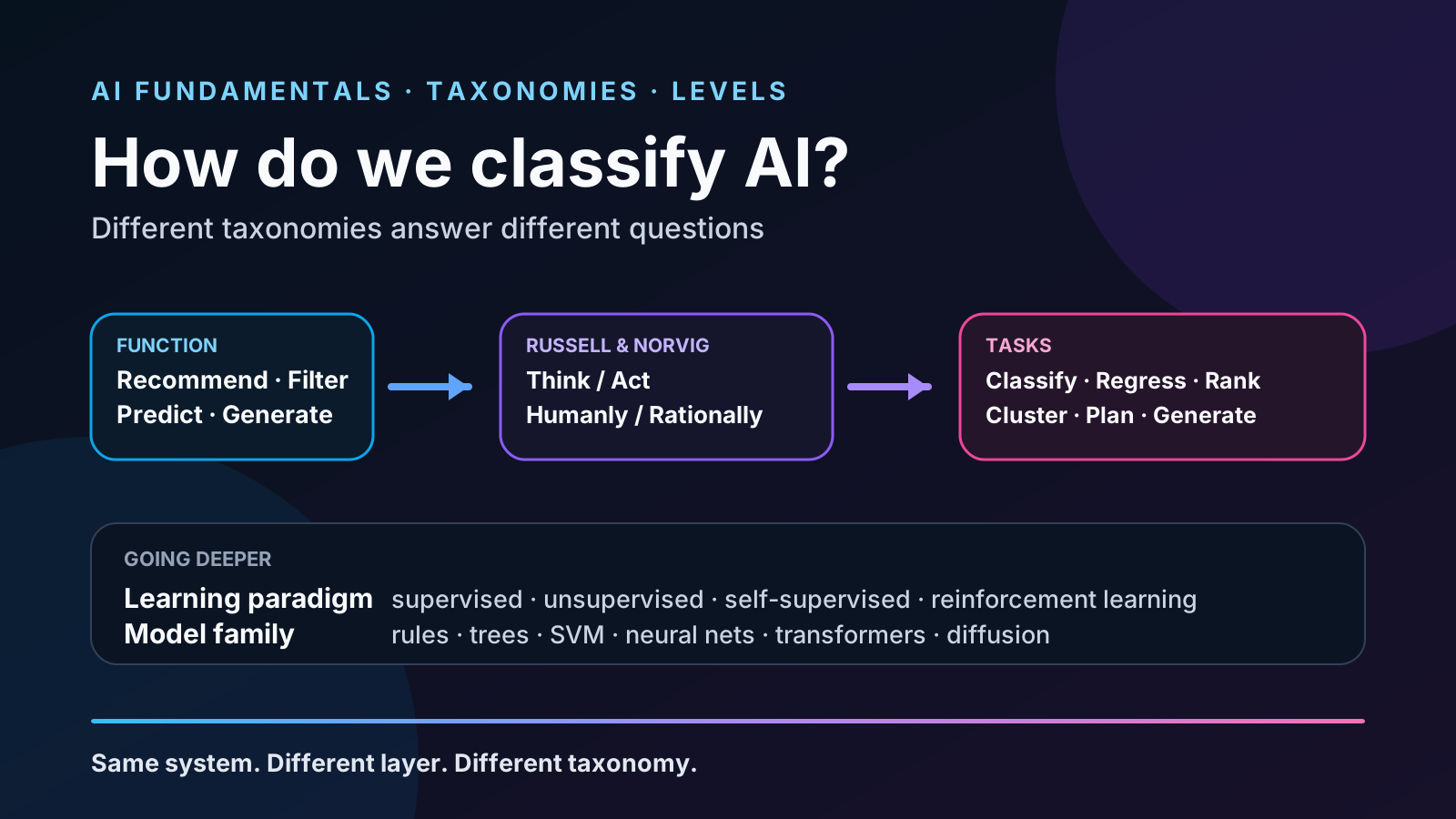
When we start learning artificial intelligence, it is easy to encounter classifications that seem to contradict one another.
A course might say AI does four things:
- recommend;
- filter;
- predict;
- generate.
A classic textbook such as Artificial Intelligence: A Modern Approach, by Stuart Russell and Peter Norvig, organizes the field differently:
- thinking humanly;
- acting humanly;
- thinking rationally;
- acting rationally.
Then, one level deeper into machine learning, even more categories appear:
- classification;
- regression;
- ranking;
- clustering;
- anomaly detection;
- forecasting;
- generation;
- reinforcement learning.
There is no contradiction. What changes is the level of abstraction and the question being asked.
The most useful way to organize these ideas is as layers.
AI
│
├── What do we use it for?
│     recommend · filter · predict · generate
│
├── What does intelligence mean?
│     think/act · humanly/rationally
│
├── What mathematical task does it solve?
│     classification · regression · ranking · clustering...
│
├── How does it learn?
│     supervised · unsupervised · self-supervised · RL
│
└── What technique implements it?
      rules · trees · SVM · neural networks · transformers...
Each taxonomy describes a different dimension.
Recommend, filter, predict, and generate: a functional taxonomy
This first classification is especially useful when explaining AI from a product perspective.
It does not attempt to define intelligence. It describes the job the system performs for the user.
1. Recommend
The system selects or prioritizes options that are likely to be relevant.
Examples include:
- movies;
- music;
- products;
- news;
- people to follow;
- search results.
Real recommendation systems often split the problem into multiple stages. Google describes a common architecture based on candidate generation, scoring, and re-ranking.
millions of options
        ↓
candidate generation
        ↓
hundreds of options
        ↓
scoring
        ↓
ranking
        ↓
re-ranking
        ↓
final recommendations
So “recommend” is a product-level function that can internally use ranking, embeddings, classification, similarity models, and other techniques.
2. Filter
Filtering means deciding what information passes through and what is discarded, blocked, or deprioritized.
Examples include:
- spam versus legitimate email;
- fraudulent versus normal transactions;
- allowed versus disallowed content;
- important alerts versus noise;
- relevant versus irrelevant results.
An important point follows: filtering is usually not a single mathematical task.
It can be implemented using:
- classification;
- rules;
- anomaly detection;
- ranking;
- risk models.
A spam filter, for example, can be formulated as binary classification:
email
  ↓
model
  ↓
spam / not spam
Google defines classification as the task of predicting which class an example belongs to.
3. Predict
Prediction means estimating an unknown outcome from available information.
The term is broad.
We can predict a category:
transaction → fraud / legitimateor a continuous value:
house → estimated priceor a variable that evolves over time:
historical sales → next month's salesThat is why the broad idea of “predict” includes more technical tasks such as:
- classification;
- regression;
- forecasting;
- probabilistic estimation.
Scikit-learn, for example, explicitly separates classification and regression within supervised learning.
4. Generate
Generation means producing a new output rather than only selecting among options or estimating a value.
The output can be:
- text;
- code;
- images;
- audio;
- music;
- video;
- molecular structures;
- synthetic data.
prompt
   ↓
generative model
   ↓
new content
Google describes generative AI around models capable of producing complex, coherent, original content.
This category became especially visible with LLMs and diffusion models, but generation did not begin with ChatGPT. Earlier models such as RNNs and LSTMs could already generate sequences.
This first taxonomy is not universal
“Recommend, filter, predict, and generate” is a very useful teaching framework for AI capabilities.
But it is not the single canonical classification of the entire field.
Depending on the course, other functions might be added:
- optimize;
- detect;
- control;
- plan;
- search;
- decide.
That is why other sources use different divisions.
Russell and Norvig ask a different question
Russell and Norvig do not begin with:
What service does AI provide?
Their question is more fundamental:
What does it mean for a machine to be intelligent?
In Artificial Intelligence: A Modern Approach, they present four historical approaches.
Thinking humanly
The goal is to model how people actually think.
The question is:
Can we build a machine whose cognitive process resembles human cognition?
This approach connects AI with cognitive psychology and neuroscience.
Getting the correct answer is not enough. How the system reaches the answer matters.
Acting humanly
Here, replicating the human mental mechanism is not necessary.
What matters is observable human-like behavior.
The classic example is the Turing Test.
human ← conversation → machine

Can we distinguish them by behavior?
This approach evaluates intelligence from the outside.
Thinking rationally
This tradition attempts to formalize correct reasoning.
It is related to the laws of thought: logic, inference, and deduction.
If we have:
A implies B
A is true
-------------
B is true
the system should be able to derive the correct conclusion.
The challenge is that the real world often contains incomplete information, uncertainty, and limited computational resources.
Acting rationally
This is the rational agent approach.
An agent:
- perceives its environment;
- considers possible actions;
- chooses an action oriented toward its objectives.
environment
    ↓
perception
    ↓
  AGENT
    ↓
action
    ↓
environment
Rationality does not mean knowing everything. It means choosing a reasonable action with the information and resources available.
This approach occupies a central role in the modern organization of Russell and Norvig’s textbook.
The two taxonomies do not compete
We can place them side by side:
| Question | Example taxonomy |
|---|---|
| What does the system do for the user? | recommend, filter, predict, generate |
| What counts as intelligent behavior? | think/act, humanly/rationally |
| What mathematical problem does it solve? | classification, regression, clustering, ranking |
| How does it learn? | supervised, unsupervised, self-supervised, reinforcement learning |
| How is it built? | trees, SVMs, neural networks, transformers, rules |
The same system can belong to one category in every row at the same time.
Going one level deeper: taxonomy by task
For machine-learning engineering, it is often more useful to talk about tasks.
Classification
Assign a category.
image → cat
email → spam
transaction → fraud
Regression
Predict a continuous number.
house → $425,000
sensor → 72.4 °C
customer → $183 expected spend
Ranking
Order candidates by relevance.
documents
   ↓
model
   ↓
1. result A
2. result C
3. result B
Ranking is fundamental to search engines and recommendation systems.
Clustering
Group similar examples when labels are not necessarily available.
Google describes clustering as an unsupervised machine-learning technique that groups unlabeled data according to a similarity measure.
unlabeled data
      ↓
clustering
      ↓
group A · group B · group C
Anomaly detection
Find observations that deviate from normal behavior.
Examples:
- fraud;
- industrial failures;
- unusual network traffic;
- abnormal account behavior.
Forecasting
Predict how a variable evolves over time.
Examples:
- demand;
- sales;
- traffic;
- electricity consumption.
Generation
Create new samples or sequences.
With an LLM:
previous tokens
      ↓
model
      ↓
probability of next token
      ↓
new token
The process repeats until a response is constructed.
Planning and control
Choose actions that lead toward an objective.
This category connects directly to the rational-agent perspective.
current state
    ↓
possible actions
    ↓
evaluation
    ↓
action
    ↓
new state
Another level: how the system learns
A task does not necessarily determine the learning method.
We can also classify systems by the training signal they use.
Supervised learning
We have examples paired with known answers.
input + label
     ↓
training
     ↓
model
Classification and regression are typical cases.
Unsupervised learning
There is no explicit target label.
The system tries to discover structure in the data.
Clustering is a classic example.
Self-supervised learning
The data itself supplies the learning signal.
Language models provide an especially important example: a sequence contains the tokens that the model will try to predict.
Reinforcement learning
An agent takes actions and receives reward signals.
state → action → reward → new stateThe objective is to learn a policy that produces good decisions over time.
And one more level down: model families
Finally, we reach concrete techniques.
A classification problem could be solved with:
- logistic regression;
- decision trees;
- random forests;
- gradient boosting;
- SVMs;
- neural networks;
- transformers.
A planning system could use:
- search;
- dynamic programming;
- constraint solving;
- symbolic planning;
- reinforcement learning;
- an LLM inside an agentic harness.
That is why statements such as:
“This is generative AI”
and
“This uses a transformer”
describe different things.
The first describes a function or behavior.
The second describes a possible architecture.
A complete example: a video recommender
We can describe the same system across every layer.
PURPOSE
recommend videos

        ↓

TASKS
candidate generation
ranking
classification

        ↓

LEARNING
supervised + self-supervised

        ↓

REPRESENTATION
embeddings

        ↓

MODELS
neural networks / transformers

        ↓

SYSTEM
candidate generation → scoring → re-ranking
Saying only “it is an AI that recommends” is correct.
It is simply a high-level description.
Another example: ChatGPT
A generative assistant can also be described in layers.
PURPOSE
generate / assist

        ↓

BASE TASK
language modeling

        ↓

TRAINING
self-supervised + post-training

        ↓

ARCHITECTURE
transformer

        ↓

SYSTEM
model + tools + memory/context + policies
And if that system begins perceiving an environment, using tools, and choosing actions to complete objectives, we can also analyze it through the rational-agent lens.
The key idea: before debating a taxonomy, ask what it is classifying
Many discussions about AI sound confusing because two people are using categories from different levels.
One person talks about the product:
“This AI recommends.”
Another talks about the task:
“That is ranking.”
Another talks about training:
“It is trained with supervised learning.”
Another talks about architecture:
“It uses a transformer.”
All four statements can be true at once.
A useful mental hierarchy is:
WHAT FOR?
recommend · filter · predict · generate

        ↓

WHAT TASK?
classification · regression · ranking · clustering · planning...

        ↓

HOW DOES IT LEARN?
supervised · unsupervised · self-supervised · RL

        ↓

WITH WHAT MODEL?
tree · SVM · neural network · transformer · diffusion...

        ↓

HOW IS IT INTEGRATED?
pipeline · service · agent · tools · memory
With this hierarchy, most of the apparent contradiction between AI taxonomies disappears.
There is no single taxonomy that is correct for every purpose.
The better question is:
Which dimension of AI are we trying to describe?
Sources
- Artificial Intelligence: A Modern Approach — Table of Contents
- Artificial Intelligence: A Modern Approach, 4th edition
- Scikit-learn User Guide
- Google Machine Learning: Recommendation systems overview
- Google Machine Learning: Classification
- Google Machine Learning: What is clustering?
- Google Machine Learning Glossary: Generative AI