 Capital de Tokens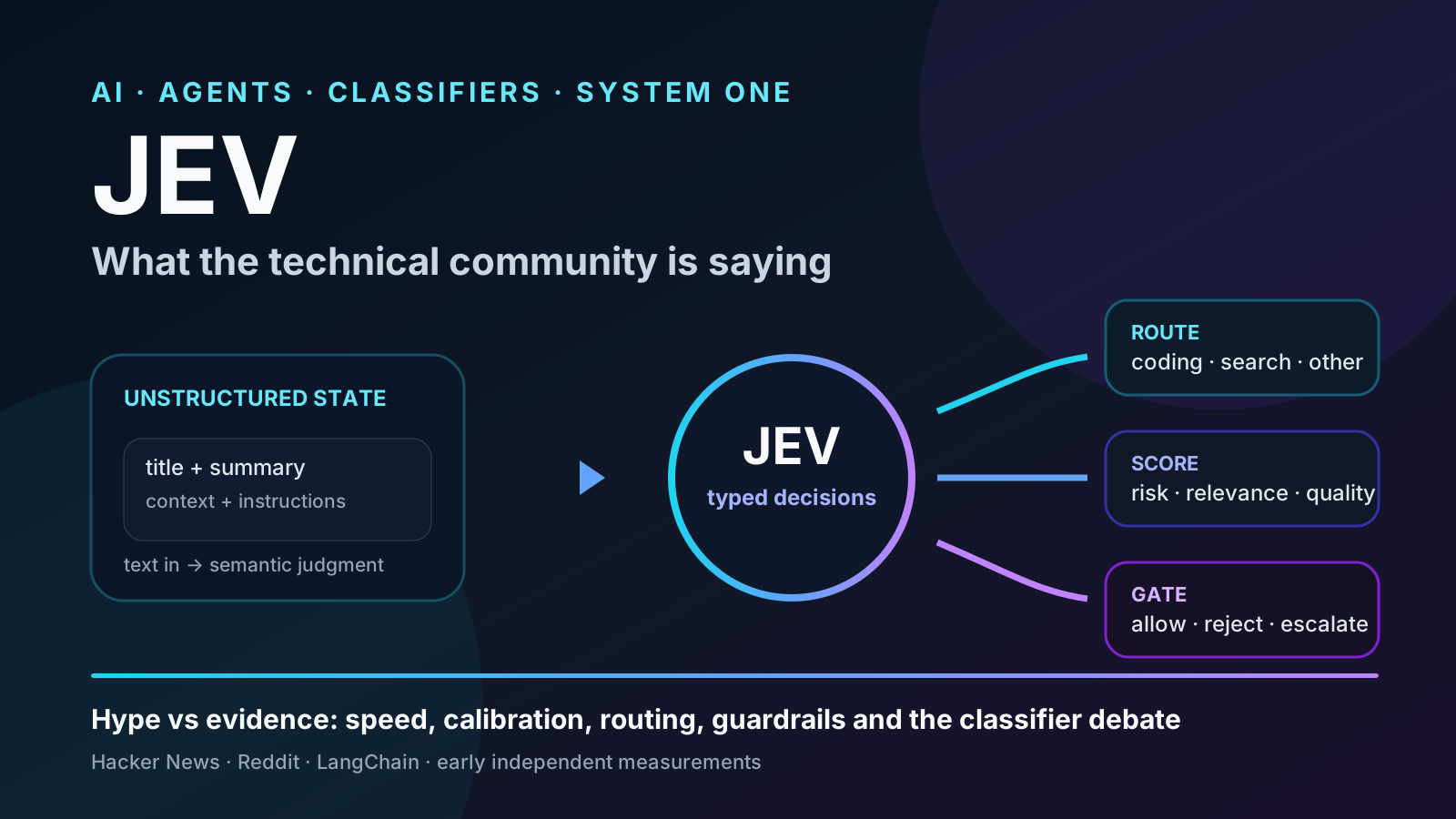
TypeSafe AI launched Jev with an unusual proposition for 2026: an AI model that does not try to chat or write prose.
Instead of returning paragraphs, Jev receives state plus typed questions. It can choose among options, return scores, or estimate the probability that a condition is true. The intended use is to feed those decisions directly into code branches, routers, guardrails, and workflows.
The launch immediately attracted attention. The main Hacker News thread passed 1,800 points and accumulated close to 500 comments in its first few days. Reddit quickly filled with experiments involving agent routing, tool-call security, Minecraft, home automation, and evaluators. LangChain also published a practical exploration of Jev inside an agent harness.
But the enthusiasm came with a fair question:
Is Jev really a new model category, or is it essentially a highly optimized general-purpose classifier?
The most useful answer so far is that both descriptions capture part of what is interesting.
What Jev actually does
TypeSafe describes Jev as its first “System One model”: a model optimized for fast, semantic, structured decisions.
The API accepts a state and multiple questions. For example:
from typesafe_sdk import Choice, Noul, TypeSafeClient

client = TypeSafeClient()

result = client.system_one(
    state={
        "title": "Microsoft launches a new AI coding agent",
        "summary": "The product can autonomously modify code and run tools.",
    },
    questions={
        "topic": Choice(
            instructions="Classify the main topic.",
            criteria={
                "ai": "Artificial intelligence is central.",
                "technology": "Technology is central, but AI is not.",
                "other": "Neither AI nor technology is central.",
            },
        ),
        "publishable": Noul(
            instructions="This story fits an AI and technology publication."
        ),
    },
)
Instead of generating an explanation, the model returns structured decisions and probabilities.
The current documentation lists Jev 1.13 as the stable model, with up to 64k tokens of context per request and a published input price of $0.042 per million tokens. TypeSafe also says the state is processed once while multiple questions are evaluated in parallel.
That explains why the model is getting attention in systems that need to make many small decisions.
Sources: Quick start and Models.
The positive reaction: cheap, fast semantic branching
One of the most interesting themes in the Hacker News discussion is not the “System One” branding itself, but a practical consequence: Jev may enable very fast semantic branching inside control flow.
That looks roughly like this:
if risk_probability > 0.95:
    require_human_approval()

if route == "coding":
    send_to_coding_agent()

if should_escalate:
    use_expensive_model()
The difference is that risk_probability, route, and should_escalate can depend on natural-language understanding instead of brittle hard-coded rules.
That pattern matters because modern agents constantly make these micro-decisions:
- which tool to use;
- whether a tool call looks dangerous;
- whether a result satisfies the goal;
- which subagent should receive a task;
- whether a request deserves escalation to a more expensive model;
- whether an answer needs review;
- whether a document belongs to a category.
Today, many of those decisions are implemented by calling a generative LLM that spends seconds producing an explanation nobody needs before eventually returning a label.
Jev deliberately removes the generative part.
LangChain sees the same niche
LangChain published Building a Harness with Jev only days after launch.
Its framing matters because it does not present Jev as a replacement for the main LLM.
It places Jev inside the agent loop.
A typical agent behaves like this:
LLM
 │
 ▼
decide action
 │
 ▼
tool
 │
 ▼
evaluate result
 │
 └──────────→ next iteration
The issue is that every turn can require another generative-model call.
The alternative LangChain explores is to use a model such as Jev for some fast decisions while reserving the large LLM for steps that really require generation or deeper reasoning.
The architecture becomes closer to:
large model
plan / write / reason
       │
       ▼
      Jev
routing / scoring / gates
       │
       ▼
      code
invariants / execution
That pattern likely explains much of the early builder interest.
”The industry rediscovered classifiers”
The most repeated criticism on Reddit is also the funniest one: after years of LLM hype, the industry appears to have rediscovered classification models.
In a thread on r/singularity, several users described Jev as a general-purpose classifier.
But there is an important difference.
A traditional classifier usually needs:
- a specific domain;
- predefined labels;
- a dataset;
- training or fine-tuning;
- retraining when the problem changes.
Jev’s promise is to retain classifier-like speed and structure while accepting natural-language criteria at runtime.
If that capability stays accurate across many domains, calling it merely a traditional classifier undersells the distinction.
Classification itself is not new. What may be new is the cost of defining a new classifier-like decision.
Early user tests: routing, games and guardrails
Reddit is still full of small experiments, but some are useful for understanding the design space.
A developer in r/LLMDevs tested Jev as a router among several agents in a personal application and reported end-to-end latency of roughly 145 to 271 ms in two routing examples.
Another experiment connected Jev to Mineflayer to control Minecraft. The harness exposed a set of actions and the environment state; Jev repeatedly selected the action with the highest probability. The interesting point is not that “Jev plays Minecraft” on its own, but that a fast decision model can sit inside a real-time interactive loop.
Developers are also trying it as:
- a safety layer over tool calls;
- an automatic model router;
- a prompt/output evaluator;
- a home-automation decision engine;
- a content classifier.
These are still anecdotes, not reproducible benchmarks. But they do show that users found concrete use cases almost immediately.
The most controversial phrase: “can’t hallucinate”
TypeSafe has emphasized that Jev “can’t hallucinate” as one of its distinctions from generative LLMs.
Hacker News pushed back hard on this wording.
The issue is semantic.
If the allowed outputs are:
AI
Technology
Other
Jev will not invent a fourth option such as “Maybe robotics.”
In that sense, the output space is constrained.
But the model can still return:
AI: 99%when the correct answer is “Other.”
One Hacker News commenter summarized the problem with a simple analogy: a model can say “Apple: 99%” while the object is actually an orange.
So a more precise statement is that Jev removes a class of generation and schema failures, but it does not eliminate model error.
TypeSafe’s own documentation acknowledges several limitations in Jev 1.13: overly literal reading, weak numeric precision, difficulty with date comparisons, indirection, large irrelevant state, and adversarial content.
The company explicitly recommends keeping math, date logic, and structural invariants in code.
Source: Jev 1.13 jaggedness.
Benchmarks are where the most caution is needed
The launch promotes figures around 193× faster and 444× cheaper in certain workflows relative to generative models.
The community has not ignored those numbers, but many developers correctly point out that the multiplier depends heavily on the baseline.
Comparing:
Jev → one structured classificationwith:
frontier LLM → reasoning + text generation + classificationcan be a valid comparison if that is the workflow you are actually replacing.
But it does not mean Jev is automatically 193 times faster than every alternative on every classification task.
That distinction matters.
Jev could be extremely valuable even if no universal multiplier exists.
Independent measurements are beginning to appear
A few external evaluations have already appeared, although they are far too new and small to constitute a consensus.
WotAI compared Jev with other models across 150 passages plus additional tasks. Its conclusion was not that Jev had the best absolute accuracy against every model. Some alternatives were more accurate. The interesting result was the combination of sub-second latency, calibration, and willingness to express uncertainty among fast models.
OpenChamber examined thousands of social posts and separated vendor claims from measurements reported by practitioners. Its conclusion is more cautious than the launch marketing: observed speedups vary substantially depending on what is used as the comparison.
These are not peer-reviewed papers and should not be treated as definitive evidence.
But they are an important signal that the discussion is already moving from demos toward measurements.
Calibration may matter more than being right every time
A particularly useful idea in the Hacker News discussion deserves more attention than the “no hallucinations” slogan.
Suppose an automation gate works like this:
if probability >= 0.98:
    execute()
else:
    ask_human()
The model does not have to be correct 100% of the time.
Its probabilities need to be meaningful enough to support a useful policy.
The important question then stops being:
What is the total accuracy?
and becomes:
What fraction of decisions can I automate while maintaining a target accuracy?
That matters in:
- fraud detection;
- moderation;
- security;
- approval gates;
- financial operations;
- tool selection;
- automatic publishing.
A well-calibrated model can be more operationally useful than another model with slightly better aggregate accuracy, because it gives the system a way to know when not to automate.
That is likely to be one of the areas where Jev will need to prove itself most clearly over the coming months.
Jev does not replace the large model
The picture emerging from the community is not:
Jev replaces GPT / Claude / GeminiIt is closer to:
        large LLM
     planning
     generation
     reasoning
          │
          ▼
         Jev
    fast decisions
    routing
    scoring
    guardrails
          │
          ▼
         code
    invariants
    execution
That explains why the product can be interesting even to developers who think the “new class of frontier model” branding is overstated.
Jev does not need to replace the LLM.
It only needs to handle millions of small decisions well enough that we no longer need to use oversized generative models for them.
What still needs to be demonstrated
After the first few days, five major questions remain open.
1. Accuracy outside launch demos
We need public, reproducible eval sets for routing, security, classification, ranking, and agent control.
2. Calibration in production
Probabilities are central to the product. They need to remain useful under distribution shift.
3. Adversarial robustness
A classifier inside an agent loop may receive text controlled by users, web pages, or external tools. Prompt injection and adversarial content therefore become real operational concerns.
4. Comparisons against the right baselines
The baseline should not always be a frontier LLM. Jev should also be measured against:
- small models;
- embeddings plus classifiers;
- rerankers;
- fine-tuned classifiers;
- deterministic rules.
5. Full-system economics
The token price is tiny, but the useful metric is cost per correct decision or cost per completed workflow, not simply token cost.
So: hype or a real shift?
It is too early to call Jev a revolution.
It would also be premature to dismiss it as “just another classifier.”
The community reaction reveals something more important: there is enormous demand for models that do not write, but instead make fast semantic decisions inside software.
For years, we optimized LLMs to become better conversational systems.
Agents expose another requirement: hundreds or thousands of semantic micro-decisions per workflow.
If Jev can occupy that space with useful calibration, low latency, and low cost, its importance will not come from replacing the chatbot.
It will come from becoming an almost invisible part of the runtime.
And that may be the most interesting idea behind the launch: the most useful AI in a system may not be the one talking to the user, but the one executing an intelligent “if” hundreds of times per second.
References
- TypeSafe AI, Introducing System One Models and Jev.
- TypeSafe AI, Quick start.
- TypeSafe AI, Models.
- TypeSafe AI, Jev 1.13 jaggedness.
- Hacker News, Introducing System One Models and Jev.
- LangChain, Building a Harness with Jev.
- Reddit / r/LLMDevs, Jev as an agent router.
- Reddit / r/accelerate, Jev controlling Minecraft through Mineflayer.
- WotAI, Jev vs. 15 other models.
- OpenChamber, Jev: claims vs practitioner measurements.