 Capital de Tokens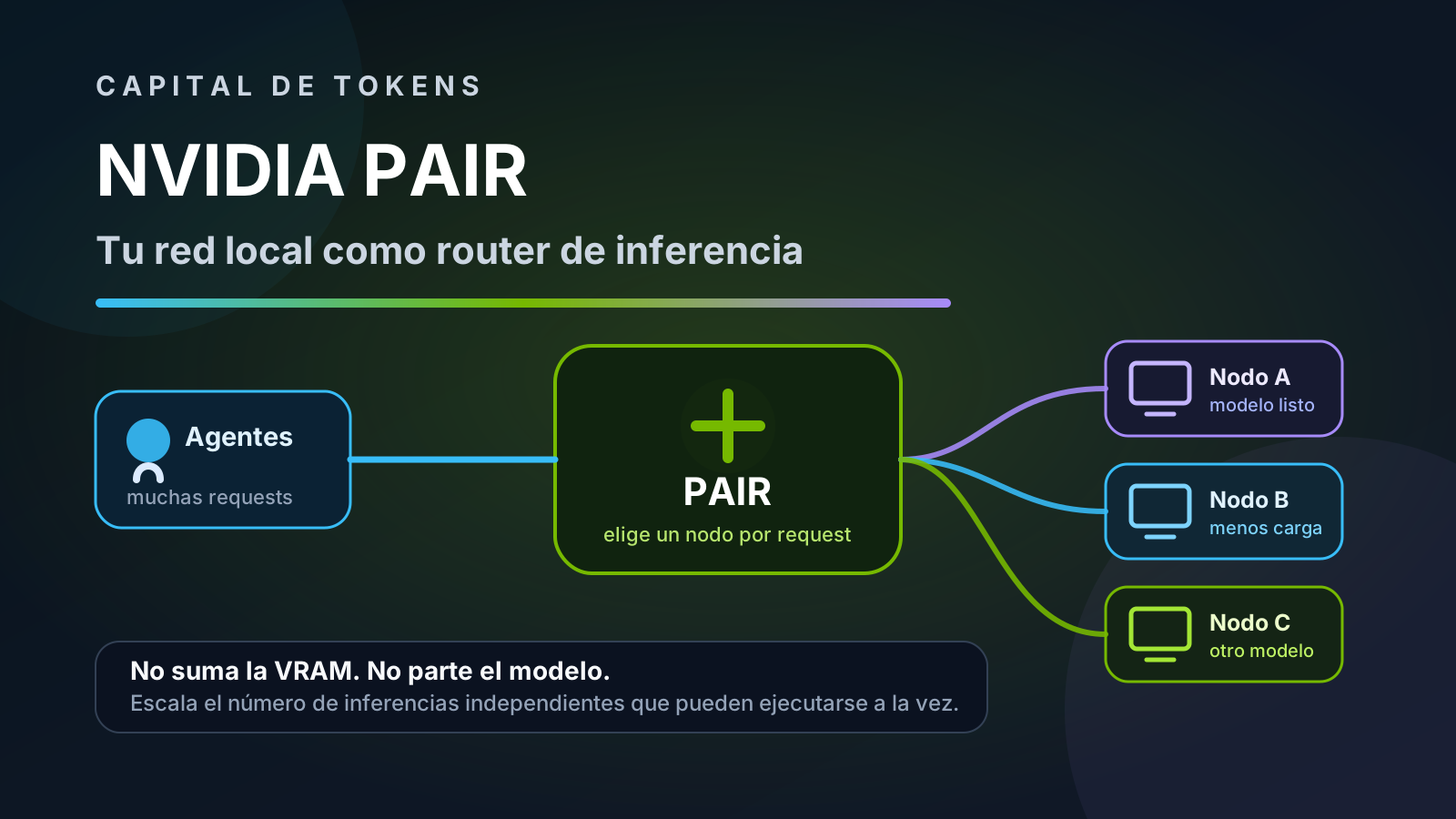
The headline is tempting: NVIDIA wants to turn the idle PCs in your home into a small personal data center.
There is some truth to that idea, but it can also create the wrong mental model. NVIDIA PAIR — Personal AI Router — does not join several GPUs into one giant virtual GPU, and it does not distribute a single model across multiple machines.
What it does is simpler and, for the next generation of agents, potentially more useful: it turns several computers on a local network into a pool of nodes across which independent inference requests can be distributed.
In other words, PAIR does not scale one inference request. It scales how many independent inferences you can run at the same time.
That distinction is exactly what makes the project interesting.
The problem PAIR is trying to solve
Local AI systems often begin with a very simple architecture:
application or agent
        ↓
     Ollama
        ↓
       GPU
As long as there is only one conversation or one task, this architecture works well.
The problem appears when the software becomes multi-agent.
A lead agent can divide one objective into several subproblems:
lead agent
   ├── researcher
   ├── programmer
   ├── verifier
   ├── critic
   └── synthesizer
From the user’s perspective, it is still one task. From the infrastructure’s perspective, it can become dozens of model calls competing for the same GPU.
The queue grows even if another PC, workstation, or laptop on the same network has spare inference capacity.
PAIR is designed to address exactly that bottleneck.
According to NVIDIA’s documentation, the system discovers compatible machines on the local network, knows which engines and models each node has available, and routes each request to an eligible node.
The application still sees a single endpoint.
                    ┌── PC A → Ollama
agents → PAIR ──────┼── PC B → Ollama
                    └── PC C → LM Studio
The agent harness does not need to know which of the three machines actually performed the inference.
PAIR is a router, not a new inference engine
This point matters.
PAIR does not execute models directly.
The models still run inside compatible inference engines such as:
- Ollama
- LM Studio
PAIR sits in front of them as a proxy and scheduler.
NVIDIA exposes endpoints compatible with interfaces those tools already use. In practice, an application that lets you configure its base_url can point to PAIR’s local proxy without learning an entirely new cluster API.
The architecture looks like this:
application
    ↓
local endpoint
    ↓
PAIR proxy
    ↓
router / scheduler
    ↓
eligible node
    ↓
Ollama or LM Studio
    ↓
   model
NVIDIA describes this separation of responsibilities in a particularly useful way:
- the agent decides what work it wants done;
- PAIR decides where that work should run.
That makes it possible to add physical distribution without rewriting the agent’s logic.
How PAIR decides where to send a request
A node does not participate merely because it is powered on.
It must actually be able to satisfy the request.
PAIR maintains information about factors such as:
- whether the node is connected;
- whether a compatible inference engine is active;
- whether that engine has the requested model;
- how much pending work the node has;
- and GPU-utilization signals.
The current implementation is still early. NVIDIA’s own repository notes that the scheduling policy does not yet consider more advanced signals such as the exact GPU model, available memory, model warmness, or an estimate of how expensive a request will be.
That matters because PAIR should be understood as emerging infrastructure, not a mature data-center scheduler.
But the architectural pattern is already clear.
What PAIR does NOT do
This is the limitation that prevents the announcement from being misunderstood.
Suppose you have:
PC A → 12 GB VRAM
PC B → 12 GB VRAM
PC C → 24 GB VRAM
PAIR does not create a virtual 48 GB GPU.
It also cannot take a model that needs 40 GB and automatically distribute its layers across those three machines.
Every complete request runs on one node.
request 1 → PC A
request 2 → PC B
request 3 → PC C
What increases is the amount of independent work that can be processed simultaneously.
That is why PAIR is a much better fit for workloads such as:
- multi-agent systems;
- multiple simultaneous sessions;
- pipelines with several independent model calls;
- coding tools that launch workers in parallel;
- local assistants used by multiple applications.
The unit of scaling is the request, not the GPU.
NVIDIA’s demo: five subagents
NVIDIA demonstrated the concept with Hermes Desktop creating a five-subagent workload while Ollama executed the model.
In the configuration described by the company, the same workload took roughly:
| Configuration | Average time |
|---|---|
| One RTX Spark laptop | 18 minutes |
| Three-device PAIR cluster | 8 min 48 s |
The cluster contained an RTX Spark laptop, a DGX Spark, and an RTX 5090.
That is a large reduction in total completion time, but NVIDIA explicitly says this was a configuration-specific demonstration, not a universal benchmark or a promise of linear scaling.
It also does not mean every inference became twice as fast.
The explanation is different:
one GPU
request A ──────────────┐
request B waits         │
request C waits         ├─ queue
request D waits         │
request E waits ────────┘

multiple nodes
request A → node 1
request B → node 2
request C → node 3
request D → node 1
request E → node 2
The gain comes from workload parallelism.
A local API that hides the physical topology
One of PAIR’s best design choices is that it tries to keep cluster topology invisible to applications.
The program connects to a local endpoint as usual.
Behind that endpoint, PAIR decides which node executes the work.
This resembles a classic distributed-infrastructure abstraction:
client
  ↓
stable endpoint
  ↓
router
  ↓
variable resources
The difference is that the resources are not homogeneous servers in a rack.
They can be household machines that enter and leave the pool:
- a gaming PC that becomes unavailable while someone is playing;
- a laptop that goes to sleep;
- a workstation that has a model other nodes do not;
- a machine that powers off completely.
PAIR is designed around that kind of household elasticity.
NVIDIA uses local discovery through mDNS and also allows nodes to be added by IP address.
Security: local does not automatically mean secure
PAIR is designed to keep inference traffic on the local network when all the components being used are local too.
The pairing process requires explicit approval and a six-digit PIN. After pairing, node-to-node traffic uses mutual TLS (mTLS) with certificates generated for the cluster.
But NVIDIA makes an important warning: the PIN is a convenient bootstrap mechanism, not a high-entropy credential.
The recommendation is to pair nodes only on trusted networks and trusted machines.
That fits a useful rule for any local-AI infrastructure:
“Local” reduces the external attack surface, but it does not remove the need to design trust boundaries.
Supported hardware and operating systems
In its September 2026 announcement, NVIDIA mentions support for compatible systems with:
- GeForce RTX 20 Series or newer;
- RTX PRO based on Turing or newer;
- DGX Spark;
- Apple Silicon M4+.
PAIR has builds for Windows, Linux, and macOS, plus a terminal interface for headless systems.
It is important to separate two ideas here as well: the fact that PAIR can run on a machine does not guarantee that a specific engine and model can run there. Ollama, LM Studio, drivers, and the model itself still have their own hardware and memory requirements.
The most interesting detail: agents and infrastructure begin to decouple
The most important reading of PAIR is not “NVIDIA invented a home data center.”
It is something else.
Agent systems are beginning to need an inference-scheduling layer that is independent of the agent harness.
Until now, many local projects effectively do this:
agent.py
  ↓
http://localhost:11434
The code assumes that one specific machine exists behind that URL.
With a router such as PAIR, the relationship changes:
agent.py
  ↓
stable endpoint
  ↓
available capacity on the network
The agent stops caring about the physical infrastructure.
That decoupling is the same kind of transformation that has happened in other layers of distributed computing: applications stop selecting machines and delegate that decision to a specialized infrastructure layer.
A home Kubernetes for GPUs?
Not exactly.
PAIR does not offer the breadth of a general orchestrator such as Kubernetes. It also does not do distributed training, model sharding, or GPU-memory aggregation.
A more accurate comparison would be:
a model-aware, load-aware load balancer for local inference.
That description sounds less dramatic than “a data center at home,” but it probably explains better why the project matters.
A future with dozens of local agents may not necessarily require one monstrous GPU.
It may require many reasonable GPUs behind a good scheduler.
The home as a small compute layer
PAIR also points toward a broader trend.
For years, personal devices were treated as isolated clients:
PC
laptop
workstation
Local AI creates an incentive to treat them collectively:
             available capacity
                     ↓
PC ───────────────┐
laptop ───────────┼──► local inference pool
workstation ──────┘
That does not literally turn a home into a data center.
But it does introduce one data-center idea: separating compute demand from the specific machine that ultimately executes it.
For agentic workloads, that abstraction may be far more important than trying to add VRAM together.
Conclusion
NVIDIA PAIR is interesting precisely because of what it does not try to do.
It does not turn three small GPUs into one large one.
It does not magically accelerate an individual request.
It does not replace Ollama or LM Studio.
What it introduces is a routing layer that lets several machines on a LAN share independent inference workloads behind a stable endpoint.
For a traditional chatbot, that may be a minor optimization.
For a system with five, ten, or fifty agents launching work in parallel, it could become a fundamental piece of infrastructure.
The “home AI data center” revolution may not begin by pooling GPUs.
It may begin with something much more mundane:
a good router.