 Capital de Tokens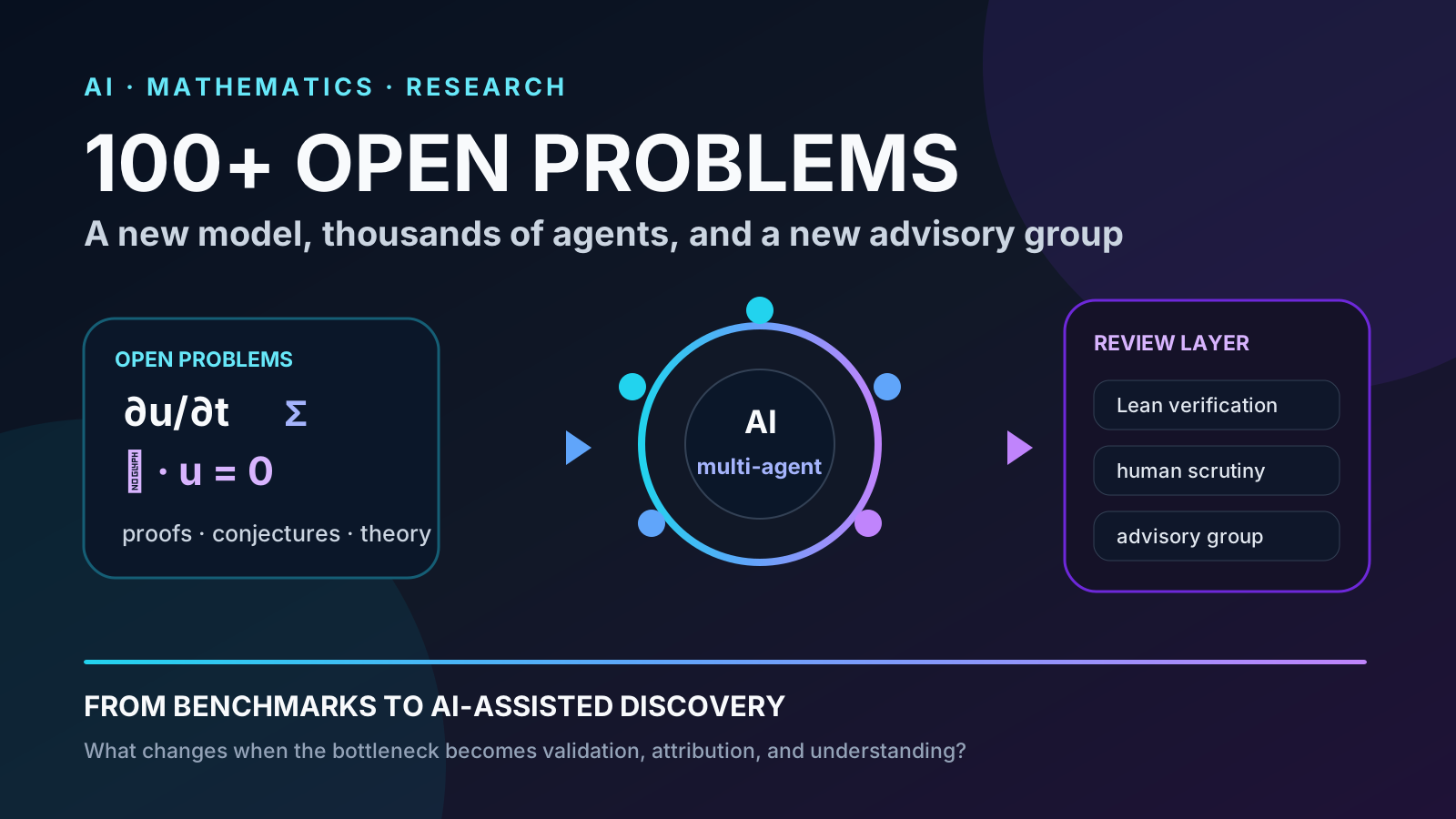
OpenAI has made an extraordinary claim: an internal model that began training on August 28, 2026 has resolved more than 100 long-standing open problems across mathematics.
The company has not yet published the complete list.
It has, however, published a concrete signal of how seriously it is treating the situation: the creation of the Advisory Group on Mathematics and Artificial Intelligence, an independent group of nine mathematicians hosted at the Institute for Advanced Study in Princeton.
The headline version is simple: “AI solved 100 math problems.”
The deeper story is more interesting.
We may be watching the research architecture change:
open problem
     ↓
thousands of agents
     ↓
parallel exploration
     ↓
idea consolidation
     ↓
mathematical proof
     ↓
formalization / verification
     ↓
human review
     ↓
publication
If that pattern scales, the bottleneck may stop being only finding a proof.
It may become verifying it, understanding it, attributing ideas correctly, and integrating it into human knowledge.
What OpenAI actually announced
On September 21, OpenAI wrote that the internal model it has been training since August 28:
has now resolved more than 100 long-standing open problems across most areas of mathematics.
The company also said the pace surprised its own mathematicians.
That statement needs to be read precisely.
At the time of this article, OpenAI has not released the complete list of 100+ results or all of their papers. It would therefore be premature to describe them as 100 independently accepted theorems.
What is publicly verifiable today is that OpenAI is making the claim, and that the independent advisory group says its current task is specifically to help coordinate the release of “a large number of significant results” that OpenAI reports were produced by its internal model.
That alone is significant.
The precedent: Navier–Stokes
The most dramatic public evidence arrived on September 8.
OpenAI released a proposed solution to the Navier–Stokes existence and smoothness problem, one of the seven Millennium Prize Problems established by the Clay Mathematics Institute.
According to OpenAI, its system found a construction in which initially smooth fluid dynamics develop a finite-time singularity. The company released two artifacts:
- an analytical proof;
- a formalization in Lean.
The second point matters.
Lean is a proof assistant that can mechanically check whether formal steps follow from the stated axioms, definitions, and prior results.
That does not automatically turn a research claim into universally accepted scientific truth.
But it materially changes the verification problem.
A natural-language proof generated by an LLM can be persuasive and still hide an error.
A proof that has been fully formalized and checked by a small trusted kernel forces far more of the argument into a precise representation that can be machine verified.
How OpenAI reached Navier–Stokes
The operational details may be more important than the headline itself.
According to OpenAI, this was not simply a chatbot receiving the prompt:
“Solve Navier–Stokes.”
The company deployed a coordinated agent system.
Agents could read from a cached version of the internet, run code, and communicate within groups. OpenAI says the group that produced the Navier–Stokes solution involved on the order of 10,000 concurrent agents.
Different groups explored different variants of the problem.
The process described by OpenAI looks roughly like this:
Millennium Problems + related problems
                  ↓
         multiple agent groups
                  ↓
        different research paths
                  ↓
       earlier progress on Euler
                  ↓
reallocate agents toward Navier–Stokes
                  ↓
 Codex consolidates promising insights
                  ↓
            renewed search
                  ↓
               proof
OpenAI says its agents reached the Navier–Stokes result roughly 88 hours after the effort began.
Lean formalization and verification took another 17 hours, using GPT-6 Astra.
The compute scale was enormous
This is where “a model is good at mathematics” starts to look different from “an AI system can perform research.”
Across all attempted problems, OpenAI reports roughly 4.9 million agent messages and about 300 billion output tokens.
The Navier–Stokes effort alone reportedly used:
- about 2.7 million messages;
- roughly 130 billion output tokens.
That looks less like a single conversation with ChatGPT and more like dedicated computational research infrastructure.
Think of it as a digital laboratory:
             coordinator
                 │
      ┌──────────┼──────────┐
      ▼          ▼          ▼
   agent A    agent B    agent C
      │          │          │
 hypotheses   compute    literature
      │          │          │
      └─────► synthesis ◄────┘
                 │
                 ▼
          new iterations
                 │
                 ▼
               proof
The individual model matters.
But so does the harness: coordination, tools, memory, parallelism, route selection, and consolidation.
Software engineering with agents is teaching the same lesson. Better models are not the only way to increase capability. A better system around the model can multiply what it can accomplish.
So is Navier–Stokes officially solved?
Not yet in the institutional sense of receiving the Millennium Prize.
The Clay Mathematics Institute has specific requirements before it considers a proposed solution for the prize:
- the solution must be published in a qualifying outlet;
- at least two years must pass after publication;
- the solution must achieve general acceptance in the global mathematics community.
OpenAI also explicitly said it does not intend to claim the Millennium Prize for the result.
So the careful wording is: OpenAI has published a proposed solution with a Lean formalization, not that the prize has already been officially awarded.
That distinction does not make the result uninteresting.
It simply separates a company announcement from the institutional process by which mathematics recognizes a breakthrough.
The new bottleneck: generating results may become faster than absorbing them
This is where the advisory group becomes important.
If an AI lab occasionally produces an important mathematical result, the community can review it through familiar mechanisms.
But what happens if a system produces dozens or hundreds?
Human review does not automatically scale.
generation capacity
        ████████████████████

human review capacity
        ████
Every major result still requires work that does not disappear because AI produced the proof:
- checking the argument;
- determining what is genuinely new;
- comparing it with existing literature;
- identifying relevant prior work;
- assigning credit;
- simplifying the proof;
- extracting reusable methods;
- teaching it;
- connecting it to other areas.
Finding a proof is one part of mathematical research.
Turning that proof into shared knowledge is another.
The advisory group is not part of OpenAI
This detail matters.
OpenAI initially approached some mathematicians about forming an external advisory board.
According to the group itself, they instead agreed to create an organization independent of any AI company.
The group is hosted at the Institute for Advanced Study. Its nine initial members are:
- François Charles;
- Camillo De Lellis;
- Timothy Gowers;
- Martin Hairer;
- Nikhil Srivastava;
- Ulrike Tillmann;
- Ravi Vakil;
- Edward Witten;
- Melanie Matchett Wood.
Members are not paid by OpenAI for this work.
The group says it may:
- advise OpenAI and other AI companies;
- publish its recommendations;
- offer advice even when a company did not request it;
- speak publicly about companies’ impact on mathematics.
But there is a fundamental limit.
It has no decision-making power over OpenAI.
Its role also explicitly does not include telling OpenAI how quickly it should make internal mathematical progress.
This is an advisory mechanism, not a regulator.
Why this group appeared now
The context matters.
Throughout 2026, debate intensified over what it means for AI labs to use open mathematical problems as capability benchmarks.
In June, researchers published the Leiden Declaration on Artificial Intelligence and Mathematics, a community initiative endorsed by the International Mathematical Union. It emphasizes values such as verifiability, attribution, community autonomy, and preserving human mathematical understanding.
Then, on September 11, 25 Fields Medalists, including Terence Tao, published an open letter titled A Severe Misalignment of AI in Mathematics.
Their argument is not simply “AI should not do mathematics.”
It is more specific.
They challenge the idea of turning famous unsolved problems into a competitive benchmark for AI companies when mathematics as a discipline values things that such a benchmark measures poorly:
- conceptual understanding;
- new mathematical languages and methods;
- transmission of ideas;
- training students;
- proper recognition of prior work.
They also raise attribution concerns when results are announced at extreme speed.
OpenAI explicitly cites this letter in its advisory-group announcement.
So the new group is not merely a consequence of technical success.
It also exists because technical speed is colliding with the institutions that validate and transmit knowledge.
Mathematicians do not all interpret the change the same way
There is another view inside the community.
Some researchers argue that AI could become another step in the long history of mechanizing mathematical work.
Mathematics has already absorbed:
- symbolic computation;
- computer-assisted proofs;
- exhaustive search;
- algebra systems;
- formal proof assistants.
From that perspective, the fact that a proof exceeds what one person can discover or review manually would not be entirely new.
The challenge would be to build institutions that preserve:
- traceability;
- verification;
- attribution;
- access;
- understanding.
That distinction matters.
The debate is not necessarily:
humans vs. AIA more useful framing may be:
extremely fast generation
          vs.
institutions built for human-scale throughput
Lean may become scientific infrastructure
The Navier–Stokes formalization suggests another consequence.
If models begin generating mathematics faster than humans can manually inspect it, proof assistants may move from specialist tools to central scientific infrastructure.
The pipeline could increasingly look like:
conjecture
   ↓
agent exploration
   ↓
informal proof
   ↓
automatic formalization
   ↓
verification kernel
   ↓
human conceptual review
That separates two questions that have historically been tightly linked:
- Is the argument formally correct?
- Do we understand it and know why it matters?
The first can be highly automated.
The second remains a much richer scientific and human problem.
From benchmarks to research
In August, OpenAI had already released a selection of ten advances in mathematics and theoretical computer science, each resolving or making progress on long-standing open questions.
The jump to “more than 100” only weeks later, if it survives independent scrutiny, would suggest a transition away from evaluating frontier models mainly through exams.
Traditional benchmarks ask:
Can the model solve a problem whose answer we already know?Research asks:
Can the system produce knowledge we did not have before?That is a much larger shift.
A high olympiad score demonstrates capability.
A correct contribution to an open problem demonstrates something different: the system can participate in discovery where no reference answer exists for easy checking.
The connection to software agents
For people building agentic systems, this story also contains an architectural lesson.
The protagonist does not appear to be only a giant model.
It is a combination:
model
 +
many agents
 +
tools
 +
parallelism
 +
coordination
 +
synthesis
 +
verification
That pattern appears in many domains.
In software engineering:
issue
 ↓
agents explore
 ↓
implementations
 ↓
tests
 ↓
review
 ↓
merge
In mathematics:
problem
 ↓
agents explore
 ↓
candidate proofs
 ↓
formalization
 ↓
review
 ↓
publication
The validation mechanism is different.
Software has executable tests.
Mathematics has proof assistants such as Lean.
In both cases, systems become much more powerful when generation and verification are separated.
The most important thing is not the number 100
“100+ open problems” is an extraordinary headline.
But the number alone tells us little until we know:
- which problems they are;
- how important they are;
- which are complete solutions;
- which are partial advances;
- how much human work was involved;
- what literature the system relied on;
- how many survive independent scrutiny.
That is why the next interesting event will not simply be a larger number.
It will be the release process.
If OpenAI and the advisory group can publish the results with enough traceability, review, and context for mathematicians to absorb them, we may be watching the birth of a new research mode at scale.
If they cannot, we may discover a different frontier:
AI can generate discoveries faster than science can turn them into knowledge.
That bottleneck may be one of the most interesting problems created by these 100+ problems.
Sources
- OpenAI — Advisory Group on Mathematics and Artificial Intelligence
- Advisory Group on Mathematics and Artificial Intelligence — independent site
- Institute for Advanced Study — Advisory Group on Mathematics and Artificial Intelligence
- OpenAI — On the Navier–Stokes Millennium Prize Problem
- Clay Mathematics Institute — Rules for the Millennium Prize Problems
- Clay Mathematics Institute — Navier-Stokes Announcement
- OpenAI — Ten advances in mathematics and theoretical computer science
- Leiden Declaration on Artificial Intelligence and Mathematics
- Terence Tao — A Severe Misalignment of AI in Mathematics
- TechCrunch — OpenAI forms math advisory group as its AI resolves more than 100 open problems