 Capital de Tokens
When people discuss AI agents inside the enterprise, the first question is often about the model.
GPT? Claude? Gemini? A proprietary model?
But large organizations quickly encounter a different problem: a model can reason extremely well and still fail to understand how the company actually works.
It may have access to tables, APIs, documents, dashboards, and tickets, yet that does not mean it automatically understands what each piece of data represents, how those pieces relate, or which actions are allowed.
That is the problem Palantir is trying to address with Ontology.
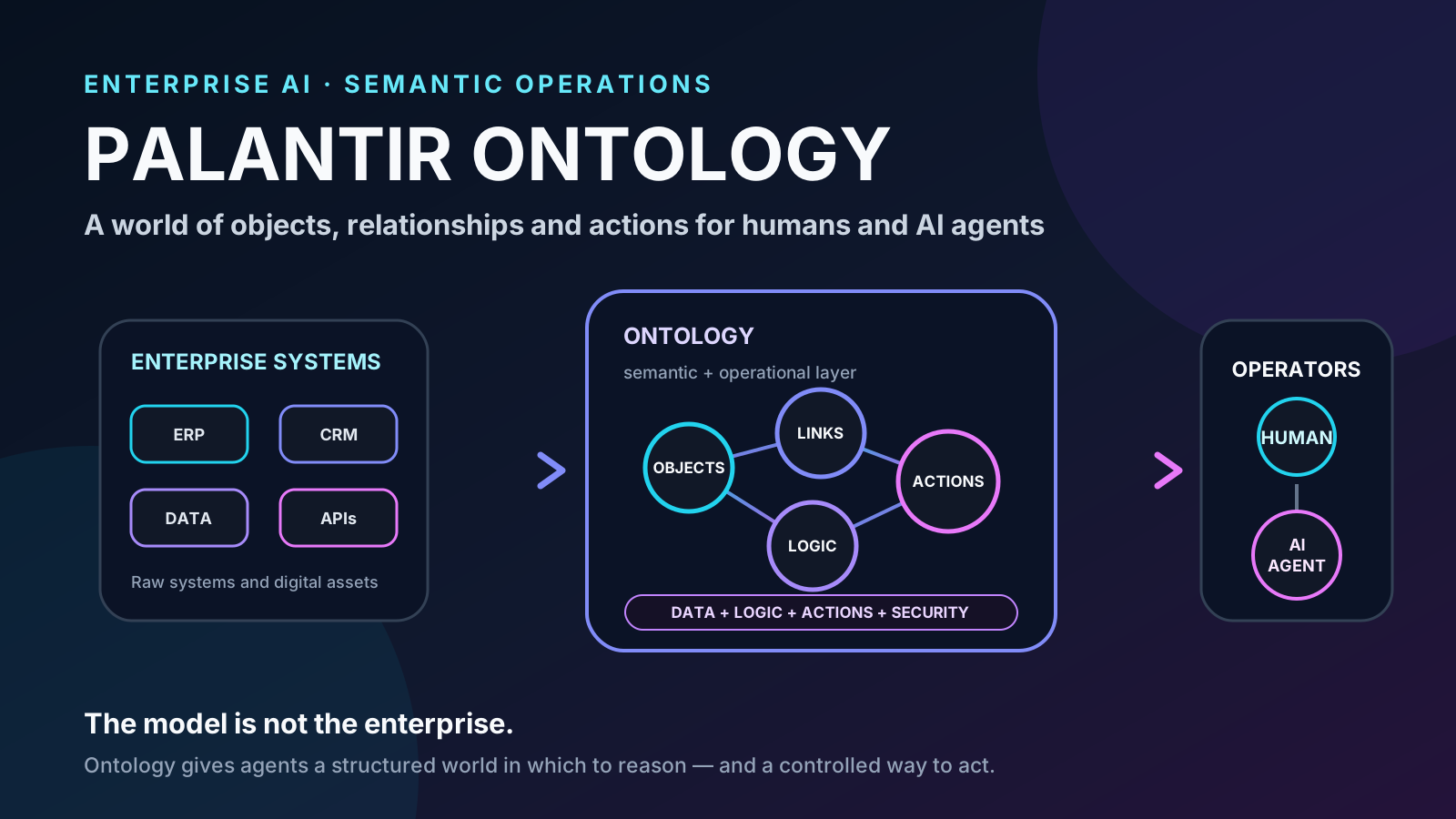
The core idea is to transform an organization’s digital assets into a coherent representation of its operational world: objects, properties, relationships, logic, and actions that can be used by people, applications, and AI agents.
Palantir describes the Ontology as a digital twin of an organization and, in its current architecture material, as a layer integrating data, logic, actions, and security policies into a representation that humans and AI agents can wield.
Official sources:
The problem with giving an agent a database
Imagine a transportation company.
Its systems might contain tables such as:
customers
drivers
vehicles
trips
maintenance_records
incidents
That is enough for a database.
It is not enough to understand the business.
A person naturally understands concepts such as:
Driver
  └── drives → Vehicle
               └── has → Maintenance Record

Trip
  ├── requested_by → Customer
  ├── assigned_to → Driver
  └── uses → Vehicle
And people understand that real operations exist on top of those entities:
AssignDriver()
CancelTrip()
ScheduleMaintenance()
EscalateIncident()
An LLM connected directly to raw enterprise data has to reconstruct much of that meaning.
It must discover which table represents which concept, which columns matter, how joins work, which system contains the current truth, which API changes state, and which permissions apply.
Ontology tries to move that knowledge out of the prompt and turn it into persistent infrastructure.
Objects, properties, links, and actions
Palantir structures the Ontology around several basic concepts.
An Object Type represents a real-world entity or event: an aircraft, factory, order, employee, or transaction.
An Object is a concrete instance of that type.
Properties describe its characteristics.
Links represent relationships between objects.
And Actions describe changes that can be executed on those objects.
Palantir provides a useful analogy with databases:
Dataset      → Object Type
Row          → Object
Column       → Property
Field value  → Property value
Join         → Link
The important difference appears once actions are added.
An Ontology does not only say:
this vehicle belongs to this fleet.
It can also represent an authorized operation that can:
reassign the vehicle, schedule maintenance, or modify a specific state.
At that point it is no longer only a descriptive layer.
It becomes an operational layer.
Source: Palantir — Core concepts
Why this is more than a Knowledge Graph
At first glance, Ontology looks a lot like a Knowledge Graph.
There is an obvious reason: both represent entities and relationships.
But reducing Ontology to a knowledge graph leaves out a major part of Palantir’s design.
A traditional Knowledge Graph might represent:
Factory A
  ├── produces → Product X
  └── located_in → Ohio
That describes knowledge.
Palantir’s Ontology is also intended to represent what can be done with that knowledge.
For example:
Factory
  ├── ChangeProductionPlan()
  ├── ReallocateInventory()
  └── RunSupplySimulation()
Palantir describes this distinction with a simple metaphor: nouns + verbs.
Objects are the nouns of the organization.
Actions are the verbs.
Around them can sit business rules, machine-learning models, optimizers, functions, and security controls.
In simplified form:
Knowledge Graph
≈ entities + relationships

Palantir Ontology
≈ entities + relationships
  + business logic
  + actions
  + permissions
  + operational workflows
This does not mean every Knowledge Graph is passive or that Ontology is the only architecture capable of adding operations. The relevant distinction is that Palantir explicitly designs this combination as the center of its platform.
Source: Palantir — Architecture Center
Why this matters for AI agents
This is where Ontology becomes particularly interesting in 2026.
A common enterprise agent pattern can be represented like this:
LLM
 + prompt
 + tools
 + RAG
The model receives a task, retrieves documents, queries databases, and invokes tools.
But as the number of enterprise systems grows, the agent must understand increasingly large amounts of organizational detail.
Which tool contains orders?
Which service is the source of truth?
What exactly does “active customer” mean?
How is an order connected to a production line?
Which operation can modify a purchase order?
Which user is allowed to perform it?
Without another layer, much of that knowledge becomes scattered across prompts, documentation, tool code, and hand-written rules.
Ontology proposes something different:
Enterprise systems
        ↓
Data + models + business logic
        ↓
────────────────────────────
        ONTOLOGY
────────────────────────────
Objects + Links + Actions + Security
        ↓
Apps + Automations + AI Agents
The agent no longer has to learn the enterprise exclusively through documentation.
It can operate against a representation of the business explicitly designed to reflect how the organization works.
From technical APIs to a semantic API for the business
One useful way to think about Ontology is as a semantic API for the enterprise.
A conventional API might expose:
POST /api/v2/maintenance/work-ordersTo use it correctly, an agent must know:
- which endpoint to call;
- which identifiers to send;
- which fields are mandatory;
- which system contains the vehicle;
- which rules allow creation of the work order;
- which side effects occur.
At the semantic layer, the agent can reason in concepts closer to the business:
Vehicle
  → ScheduleMaintenance()
Underneath, APIs, databases, ERP systems, functions, and workflows can still exist.
The difference is that the agent works against a more stable and understandable abstraction.
That decoupling can be particularly useful for long-lived agents because it reduces the amount of accidental infrastructure knowledge that must live inside prompts and skills.
Data + Logic + Actions
Palantir summarizes much of its architecture around three components:
Data: what relevant facts are true.
Logic: which rules, models, predictions, or optimizers should be applied.
Actions: how a decision produces a real change in production systems.
That last component is critical.
Many enterprise AI systems work well for answering questions:
Which orders are delayed?
An operational system tries to go one level further:
Identify the delayed orders, determine which inventory can be reallocated, and execute the change while following authorized rules.
The distance between those two sentences is enormous.
The first requires access to information.
The second requires state, rules, actions, permissions, and traceability.
That is exactly the territory where Palantir positions Ontology.
Source: Palantir — Platform overview
Security is part of the model
Allowing an agent to query information is one thing.
Allowing it to modify real operations is something else entirely.
That is why the Ontology also includes access controls around resources such as object types, link types, and action types, as well as permissions over the objects and links themselves.
Palantir presents security as an integral part of this layer rather than something bolted on afterward.
This matters because an agent may need to see an object without being authorized to invoke every available action on it.
The target architecture is not simply:
Agent → Toolbut something closer to:
Agent
  ↓
Ontology
  ↓
Objects + Actions
  ↓
Authorization / policy
  ↓
Operational systems
Source: Palantir — Object permissioning
What this has to do with Context Engineering
The idea connects directly to a broader trend: Context Engineering.
We recently looked at Uber’s AI Context Graph, which connects millions of nodes and relationships so agents do not have to explore internal systems blindly.
The underlying principle is similar:
a large part of agent performance depends on how the world available to the agent is structured.
Ontology pushes the idea one step further toward operations.
A Context Graph may help an agent answer:
which service owns this dataset?
An operational Ontology also aims to provide a controlled way to express:
perform this action on this object under these rules.
It is the difference between understanding context and acting inside it.
Ontology does not eliminate data problems
There is an important caveat.
Creating an Ontology does not magically turn bad data into good data.
If sources are stale, relationships are modeled incorrectly, or business definitions are ambiguous, the agent will still operate against a flawed representation.
There is also an organizational cost.
Someone must decide:
- which objects truly represent the business;
- which relationships matter;
- which system is the source of truth;
- which actions should exist;
- which rules and permissions control them;
- how the model evolves as the organization changes.
The value therefore does not come only from the software.
It also comes from doing the hard work of modeling the organization correctly.
Infrastructure may matter as much as the model
During the first phase of generative AI, the dominant question was:
Which model should we use?
In enterprise agent systems, the question is expanding:
What world are we giving the model to reason and act within?
A stronger model can improve reasoning.
But if every execution must rediscover what every table means, who owns each system, which rules exist, and how an operation is executed, a large portion of that intelligence is spent reconstructing context.
Palantir Ontology represents a concrete answer to that problem:
turn the enterprise into a set of objects, relationships, logic, and actions that software and agents can understand and use.
The architecture of enterprise agents may end up looking less like:
LLM + toolsand more like:
LLM
  ↓
semantic / operational layer
  ↓
enterprise systems
If that direction holds, one of the most important competitive advantages will not simply be access to the best model.
It will be having built an accurate representation of the world in which that model must operate.