 Capital de Tokens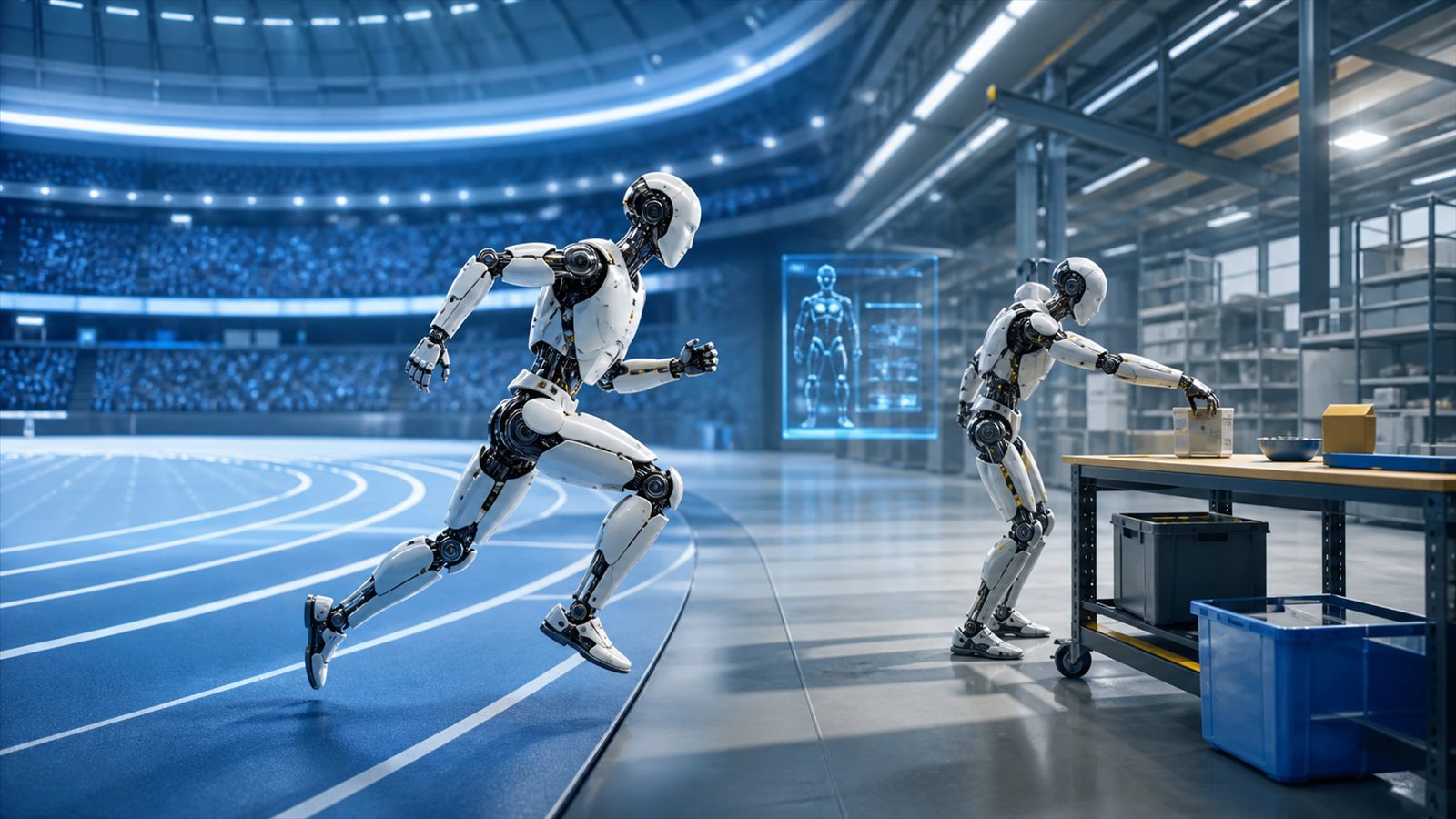
A humanoid robot has just covered 100 meters in 8.64 seconds.
The number is inevitably striking: Usain Bolt’s men’s world record is 9.58 seconds.
But if we focus only on the headline that “a robot is already faster than Bolt,” we miss the truly interesting part of the 2nd World Humanoid Robot Games, held in Beijing from August 22 to 26, 2026.
The event brought together 666 teams from 16 countries and more than 2,000 robots, with 51 events and 1,301 competition sessions at the National Speed Skating Oval, the “Ice Ribbon.” In just one year, some humanoid athletic marks improved dramatically. At the same time, the most important tests began moving away from the track toward factories, homes, services, fine manipulation, and emergency scenarios.
That shift in focus matters much more than any sports record.
Running fast shows that motors, dynamic control, balance, materials, and locomotion software are improving.
But a useful humanoid needs something harder:
perceive a changing environment, decide what to do, manipulate objects, correct errors, and complete a long task without a human rescuing it.
That is embodied AI in earnest.
What happened in Beijing
The second World Humanoid Robot Games took place from August 22 to 26, 2026.
According to Beijing’s official portal, 666 teams and 2,056 robots participated, compared with 280 teams in the first edition. The program grew to 51 events, divided between competitive disciplines and scenarios oriented toward real applications.
Disciplines included:
- 100, 400, and 1,500 meter races;
- jumping;
- football;
- martial arts and boxing;
- weightlifting;
- table tennis;
- dancing;
- household tasks;
- industrial operations;
- services;
- emergency response.
The organizers are not simply trying to build an “Olympics for robots.”
They are creating a public collection of physical benchmarks.
That makes the event a useful snapshot of the current state of humanoid robotics.
Sources: Beijing International Web Portal and the official closing report.
The viral number: 8.64 seconds over 100 meters
The sporting protagonist was Tiangong Ultra, developed by the Beijing Innovation Center of Humanoid Robotics, also known as X-Humanoid.
During the event it progressively lowered its times.
Reuters first reported 9.39 seconds, then 8.86 seconds in the semifinals, and finally 8.64 seconds in the large-robot 100-meter final.
The progression is even more spectacular when compared with 2025.
In the first edition, the winner needed approximately:
2025   21.50 s
2026    8.64 s
In one year, the winning mark fell by almost 13 seconds.
That does not look like an incremental improvement.
It looks like a change in technological regime.
Reuters described it as a combination of advances in lightweight design, optimized motors, and control software, allowing the robot to sustain very fast steps and a high cadence.
Sources: Reuters, August 25 and Reuters analysis, August 28.
Did it really “beat Usain Bolt”?
Numerically, yes:
Tiangong Ultra   8.64 s
Usain Bolt       9.58 s
But technically there is a giant asterisk.
We are not comparing two officially homologated events under the same sporting rules.
Reuters notes, for example, differences in the start: Bolt used starting blocks and had a measured reaction time, while the robot began from a different posture. Mechanics, regulations, timing, and competition conditions are not equivalent to an official World Athletics event.
The comparison is useful for visualizing the magnitude of the speed achieved.
It is not a reason to declare Bolt’s human world record obsolete.
There is another difference that is even more revealing.
After crossing the finish line, several robots had trouble stopping. Some ended up against barriers, and one impact reportedly produced sparks and a small fire.
An elite human does not merely run.
They also perceive remaining distance, adjust stride, decelerate, avoid obstacles, and preserve their own body.
That apparently comic detail shows exactly where the next engineering problem lies.
400 meters: sustained speed
The 100 m measures acceleration and top speed.
The 400 meters demand stability for much longer.
Tiangong recorded 38.15 seconds in the large-robot event.
For reference, Wayde van Niekerk’s men’s human world record is 43.03 seconds.
Again, the competitions are not directly homologous, but the year-over-year progress is remarkable: the winning mark in the previous edition was approximately 1 minute 28 seconds.
Going from 88 seconds to just over 38 in one year means the advance is not simply one robot learning a short sprint.
There are improvements in stability, sustained power, heat dissipation, posture control, and dynamic coordination.
Sources: Xinhua and CCTV/CGTN.
1,500 meters: keeping the body under control
In the 1,500 meters, team Tianzhuo won in approximately 2 minutes 21.64 seconds.
The previous edition had required more than six minutes.
Here the technical problem changes again.
For a biped robot, hundreds or thousands of support cycles mean accumulating small errors in:
- orientation;
- position estimation;
- foot-ground contact;
- joint synchronization;
- actuator temperature;
- energy consumption;
- vibration;
- torso stability.
A fall can happen because a tiny error was amplified over dozens of steps.
That makes distance events an interesting benchmark for locomotion-control robustness.
The 2.88-meter jump: another headline that needs context
One humanoid reached 2.88 meters in a jumping event, compared with approximately 0.95 meters in the previous edition.
AP highlighted that the figure exceeds Javier Sotomayor’s 2.45-meter human high-jump world record.
But these are not equivalent events either.
The robotic format and regulation high jump use different mechanics.
The important point is not declaring a new world sports record.
It is the technological jump between generations.
A biped capable of rapidly converting electrical energy into vertical impulse requires:
high-power actuators
        +
precise center-of-mass control
        +
synchronization across multiple joints
        +
a structure capable of absorbing the landing
Source: Associated Press.
The truly important change: the 100 m became autonomous
Here we find one of the most interesting changes in 2026.
The organizers announced that the 100-meter event would become a competition for fully autonomous robots.
That changes the meaning of the benchmark.
A teleoperated robot can have excellent locomotion and still depend on a human for decisions.
An autonomous robot has to run a loop like this:
sensors
   ↓
perception
   ↓
state estimation
   ↓
planning
   ↓
control
   ↓
actuators
   ↓
physical environment
   ↓
new sensor data
That cycle runs continuously.
In traditional software we can retry a function.
In the physical world, a wrong decision can make a robot weighing dozens of kilograms fall, hit a person, or break an expensive component.
That is why Physical AI and embodied AI are much harder than an agent operating only over APIs.
From the track to the factory
The organizers also designed tests in environments resembling the real world.
Instead of keeping everything in arenas created specifically for competition, some scenarios moved into contexts such as:
- factories;
- hotels;
- model homes;
- retail;
- services;
- emergencies.
Rules published before the event mentioned tasks such as folding clothes, fighting fires, and preparing food.
The official closing report gives even more concrete examples.
In Smart Charging Service, a robot had to remove connectors, charge vehicles, and return the connectors to their positions.
In General Service, several robots completed tasks such as organizing name plates, printing documents, and shredding paper.
This looks far less spectacular than an eight-second sprint.
But from an intelligence perspective it is probably harder.
Sources: Beijing Investment Promotion Service Center and the official closing report.
Why manipulating objects remains so hard
A language model can move a token with perfect precision.
A robot has to move a real object.
Suppose we want to connect a cable.
The problem sounds simple:
pick up cable → find port → insert cableBut it actually contains many subproblems:
locate cable
↓
estimate its 3D pose
↓
identify which end to grasp
↓
calculate a stable grasp point
↓
move the arm without collision
↓
adjust finger force
↓
locate the port
↓
align two geometries
↓
insert with millimeter tolerance
↓
detect whether it worked
↓
correct if it failed
And all of that must work under changing lighting, slightly displaced objects, varying friction, deformable cables, and imperfect sensors.
Locomotion can be optimized on a relatively structured track.
General manipulation has a much larger state space.
The real benchmark: recovering from errors
One characteristic often disappears from promotional videos: what happens when something goes wrong.
A truly autonomous system cannot depend on a technician pressing reset every time it fails.
It needs to detect things such as:
"I dropped the object"
"the drawer did not open"
"the connector is misaligned"
"my foot slipped"
"there is a new obstacle"
and then generate a corrective action.
We can think in three maturity levels:
Level 1
Runs a demo when everything is prepared exactly right.

Level 2
Completes the task with small variations.

Level 3
Detects failures, replans, and recovers autonomously.
Most commercial robots that truly transform factories, warehouses, and services will need to move toward level 3.
That is one of embodied AI’s important frontiers.
The perfect contrast: extraordinary speed, still-limited intelligence
On the same day Reuters analyzed the speed records, Breakingviews published a much colder assessment of China’s humanoid industry.
Its central conclusion was that important problems remain in:
- intelligence;
- reliability;
- dexterity;
- truly profitable commercial applications.
The Games also showed robots unable to complete basic tasks, falls, and manipulation failures.
There is no contradiction.
Both things can be true at the same time:
humanoid locomotion is advancing extremely quickly, while general autonomy remains insufficient to replace human workers at mass scale.
Source: Reuters Breakingviews.
The bottleneck is moving from the body toward the brain
For years, one of the biggest challenges was simply getting a humanoid to walk without falling.
That is still difficult, but the Games show that part of the physical stack is maturing very quickly.
We can simplify the system into layers:
┌───────────────────────────────┐
│ planning / reasoning          │
├───────────────────────────────┤
│ multimodal perception         │
├───────────────────────────────┤
│ movement policy               │
├───────────────────────────────┤
│ dynamic control               │
├───────────────────────────────┤
│ actuators + sensors           │
├───────────────────────────────┤
│ mechanical structure          │
└───────────────────────────────┘
In the first stage of humanoid robotics, the lower layers dominated the problem.
If the robot could not stay upright, having an excellent vision or planning model barely mattered.
Now machines are beginning to appear with locomotion good enough for the bottleneck to move upward.
The question stops being:
“Can it walk?”
And starts becoming:
“Does it understand what is happening and can it complete a mission without supervision?”
That is a huge change.
What do LLMs and VLMs have to do with this?
Modern humanoids are beginning to combine several families of models.
A conceptual architecture can look like this:
cameras + audio + proprioceptive sensors
                 ↓
        perception / VLM
                 ↓
        high-level model
                 ↓
         action plan
                 ↓
   locomotion/manipulation policy
                 ↓
       local controllers
                 ↓
          actuators
A VLM can interpret a scene.
A high-level model can turn an instruction such as:
"pick up the boxes and clear the hallway"into a sequence:
1. locate boxes
2. detect storage area
3. walk to the first one
4. grasp it
5. transport it
6. check stability
7. repeat
Then much faster movement policies translate those intentions into joint movements.
That resembles the architecture of a software agent:
LLM
 ↓
plan
 ↓
tool call
 ↓
result
 ↓
replan
The difference is that here the tools are arms and legs.
And the result is not JSON.
It is the physical world.
The Games function as a public benchmark
There is another valuable aspect of the event: competition creates comparative pressure.
When hundreds of teams perform similar tasks under shared rules, we can observe:
- times;
- stability;
- success rate;
- autonomy;
- recovery ability;
- precision;
- manipulation speed.
That lets us compare generations and detect progress that would be difficult to quantify in a corporate demo.
The evolution of the 100 meters is a good example:
21.50 s → 9.39 s → 8.86 s → 8.64 sA competition repeated every year turns progress into a time series.
And as factory and service tasks mature, those metrics may become much more interesting than the athletics results.
The question we should ask in 2027
At the next edition, looking only at who runs fastest will probably be less interesting.
The useful question will be:
how many tasks can a humanoid complete from beginning to end without human intervention?
For example:
Can it work for 2 hours without a reset?
Can it recover after a fall?
Can it manipulate objects it never saw during training?
Can it detect an unsafe situation and stop?
Can it switch tasks through natural-language instructions?
Can it do so at an economically reasonable cost?
Those metrics will tell us much more about the arrival of humanoids in productive environments.
Conclusion
The World Humanoid Robot Games 2026 produced images that would have looked like science fiction only a few years ago.
A humanoid covering 100 meters in 8.64 seconds is technically impressive.
But it is probably not the number that best predicts the future of robotics.
The more important signal is that benchmarks are beginning to move from:
walk
run
jump
toward:
perceive
manipulate
plan
work
recover
That is the point where humanoid robotics truly begins to meet agentic artificial intelligence.
A robot that runs faster than a human is a spectacular engineering demonstration.
A robot that understands a task, works for hours in an unpredictable environment, and resolves its own errors would be something much more important:
a machine capable of turning artificial intelligence into autonomous physical work.
And that race is only beginning.
Sources
- Reuters — Chinese robot Tiangong clocks sub-9 second 100 metres in Beijing
- Reuters — China’s record robotic strides show the limits of human speed
- Reuters Breakingviews — China’s robots fail early market test
- Associated Press — Chinese humanoid robots smash human records in 100m sprint and high jump
- Beijing International Web Portal — 2nd World Humanoid Robot Games: Highlights & Ticket Info
- Beijing International Web Portal — 2nd World Humanoid Robot Games Conclude
- Beijing Investment Promotion Service Center — 2nd World Humanoid Robot Games to Run in Beijing in August
- Xinhua — Robot Tiangong breaks men’s 400m world record
- CCTV/CGTN — What do humanoid robots actually compete in?