 Capital de Tokens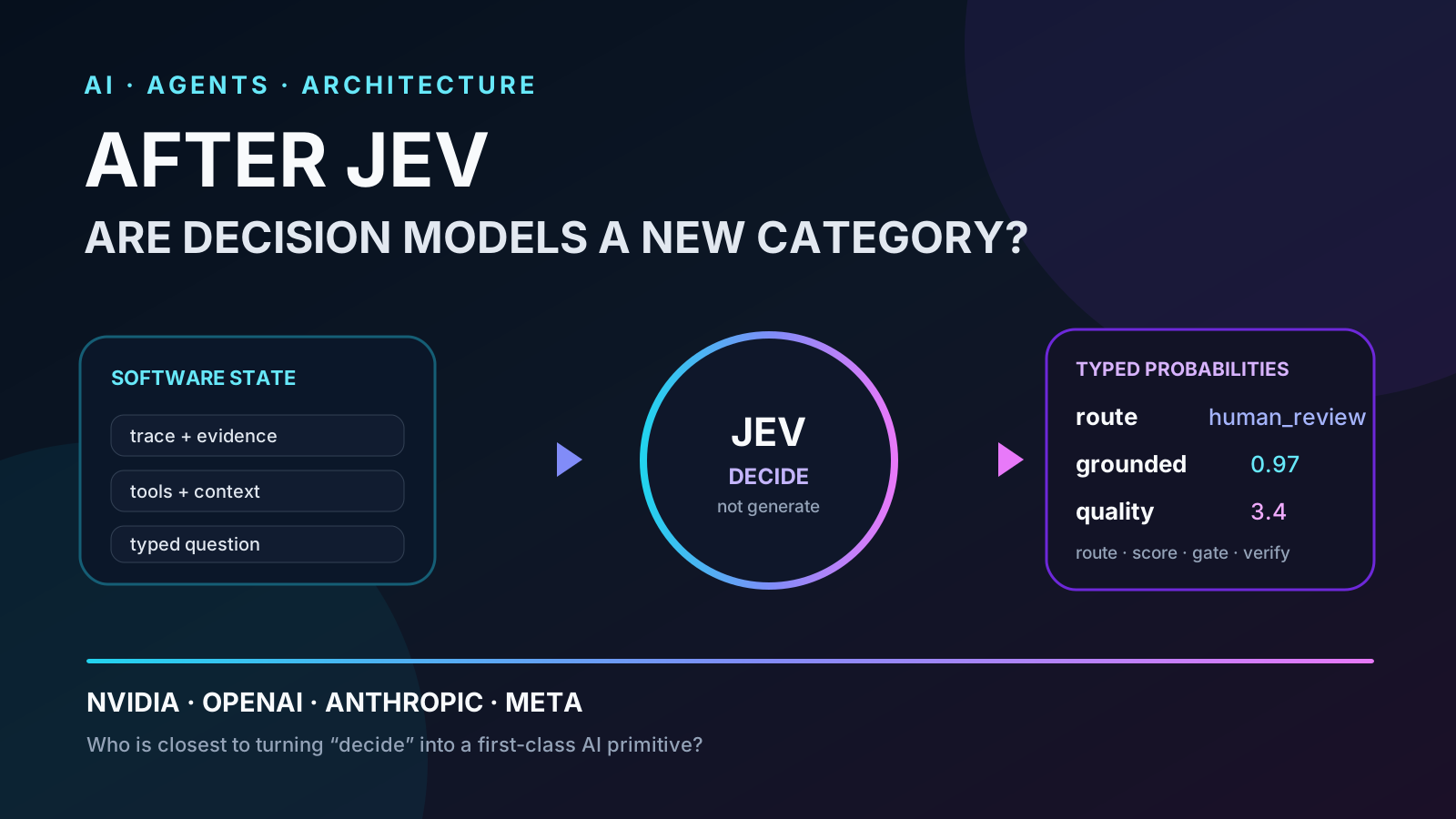
Jev starts from an idea that looks small but has fairly large architectural consequences:
not every AI task needs a model that generates text.
In many systems, software does not need a paragraph. It needs a decision.
Is the answer grounded in the evidence?
Which tool should run?
Should this execution go to human review?
Which workflow branch should run next?
How good is this output?
A conventional LLM can answer all of those questions. But doing so means using an architecture optimized to generate token sequences even when the useful result is ultimately something like:
grounded = 0.97
route = "human_review"
quality = 3.4
TypeSafe AI is trying to turn that pattern into a category of its own.
Its first public model, Jev, belongs to what the company calls System One Models: models designed to consume unstructured state and return structured, typed decisions accompanied by probabilities.
The interesting question is no longer only whether Jev works.
It is this:
If this architecture proves there is a real market, how long will it take the large AI companies to offer something similar?
First: what “decision model” means here
I am not using the term as a synonym for a traditional classifier.
A conventional classifier is usually trained for a relatively fixed task:
spam / not spam
fraud / legitimate
positive / negative
Jev is trying to occupy a more general space.
The application sends arbitrary state and defines at runtime what it wants the model to decide.
For example:
questions = {
    "grounded": {
        "type": "noul",
        "instructions": "Is the answer supported by the evidence?"
    },
    "route": {
        "type": "choice",
        "options": [
            "fast_model",
            "reasoning_model",
            "human_review"
        ]
    },
    "quality": {
        "type": "score",
        "criteria": [
            "poor",
            "acceptable",
            "good",
            "excellent"
        ]
    }
}
The model does not need to write an explanation only for the application to turn it back into JSON.
The contract is defined in advance.
state
  │
  ▼
decision model
  │
  ├── probability
  ├── category
  ├── score
  └── confidence
TypeSafe describes Jev as a model for “decisions, not strings” and says its System One Models use an architecture, sampler, and training method oriented around calibrated decisions.
Two things need to be separated.
The speed, cost, and performance numbers published by TypeSafe are vendor claims, although the company publishes methodology and caveats around its benchmarks. What matters most for this discussion is the product shape: an intelligence API specifically designed for software to make decisions.
We already looked at Jev’s mechanics in Jev after launch: what the technical community is saying and at its use as a judge in What is an agent evaluator?.
Here I want to look at what comes next.
The category that could appear between rules and LLMs
Many systems currently live between two extremes.
deterministic rules
        │
        │ cheap, fast, rigid
        ▼
     software
        ▲
        │ flexible, semantic, more expensive
        │
       LLM
But there is a huge set of decisions where neither extreme is ideal.
For example:
Does this tool call match the user's intent?
Which of five handlers should receive this ticket?
Is this result good enough to continue?
Does the new answer contradict previous state?
Should we escalate to the expensive model?
Does this trace show signs of failure?
A hand-written rule may be too brittle.
A large generative model may be excessive.
That creates room for a third layer:
rules
  ↓
decision model
  ↓
LLM / agent
or:
             ┌──────────────┐
simple case ─► decision model├──► action
             └──────┬───────┘
                    │ low confidence
                    ▼
               large model
                    │
                    ▼
               human review
If that pattern works, it does not replace LLMs.
It makes them the slow path.
Why this resembles embeddings and rerankers
There was a time when many semantic tasks could simply be sent to an LLM.
Over time, specialized categories emerged.
LLMs        → generate and reason
embeddings  → represent meaning
rerankers   → order candidates
moderation  → detect risk
Each category exists because a more specialized architecture or interface can provide a better combination of:
- cost;
- latency;
- consistency;
- capability;
- integration simplicity.
The hypothesis behind Jev is that making decisions inside software deserves another category:
decision models → classify, score, route, verify and decideIt is too early to know whether that name will stick.
But the workload is real.
The four companies I would watch
If Jev gets meaningful adoption, four companies are especially interesting because they already own parts of the required technology.
My estimate, based only on public products and documentation available on September 22, 2026, is:
| Company | Estimated probability of being first with a comparable general alternative |
|---|---|
| NVIDIA | 40% |
| OpenAI | 32% |
| Anthropic | 18% |
| Meta | 10% |
These numbers are not calibrated market probabilities and are not based on private information.
They are a subjective estimate of which company appears to have the shortest technical and product distance to a general decision API.
Here is the reasoning.
NVIDIA: 40%
NVIDIA already has something extremely close in NeMo Evaluator.
The platform can evaluate:
- models;
- RAG pipelines;
- agents;
- final responses;
- trajectories;
- tool calls;
- custom metrics.
It can also use models as judges and produce rubric-based scores.
For agent evaluation, NVIDIA explicitly distinguishes between evaluating only an outcome and evaluating the full trajectory that produced it.
That means the infrastructure already understands exactly the type of state a decision model might consume.
Today, however, many of those metrics still rely on an LLM-as-a-judge.
NVIDIA’s own agentic-metrics documentation says that many agentic metrics require a judge LLM.
That is the gap.
NVIDIA already has:
traces
 + metrics
 + agent evaluation
 + Nemotron
 + inference infrastructure
 + hardware
What would move it substantially closer to Jev is turning part of that stack into something like:
state
  ↓
Nemotron Decision
  ↓
typed probabilities
That is why I put NVIDIA slightly ahead.
Not because the company has announced such a product.
Because the jump from what it already offers to that API shape looks relatively short.
OpenAI: 32%
OpenAI may be the most interesting case from the API perspective.
The platform already exposes Graders.
Current grader types include:
- string checks;
- similarity graders;
- score-model graders;
- label-model graders;
- combinations of multiple graders.
A score-model grader uses a model to assign a score.
A label-model grader uses a model with structured outputs to assign labels.
Conceptually, that is already close to:
input
  ↓
model
  ↓
score / label
The remaining difference is fundamental.
The grader is still a generative model being used as a judge.
Jev’s claim is that the model itself should be optimized for probabilistic decisions rather than for language generation whose output is then constrained.
If OpenAI decided to expose a dedicated primitive, it would fit naturally into the platform:
client.decisions.create(
    state=trace,
    questions={
        "grounded": boolean(),
        "route": choice(["fast", "reasoning", "human"]),
        "quality": score(["bad", "ok", "good", "great"])
    }
)
That would pair naturally with Evals, agents, guardrails, and routing.
I do not put OpenAI first because its public platform strategy still gets enormous leverage from general models across many tasks.
But if the decision-model market proves large, OpenAI could close the distance quickly.
Anthropic: 18%
Anthropic already uses classifiers as an important part of its safety systems.
In July 2026, for example, it published details about classifiers accompanying Claude Fable 5 that detect and block certain dangerous cybersecurity uses.
That demonstrates something important:
Anthropic already treats some critical decisions as a separate workload from the model generating the answer.
Architecturally, the pattern looks like:
request
   ↓
classifier
   ├── allow
   └── block
        ↓
      Claude
The conceptual jump to a programmable general classifier exists.
But Anthropic has publicly focused those components mainly on safety.
It does not currently expose a general primitive equivalent to:
"Here is arbitrary state and a typed question.
Return a probability distribution."
That is why I place it below NVIDIA and OpenAI.
Meta: 10%
Meta may have the clearest example of the value of very small specialized models.
Prompt Guard 2 exists in 86M and 22M parameter variants.
The 22M version is explicitly designed to reduce latency and compute costs while detecting jailbreaks and prompt injection.
Meta also offers Llama Guard for safety classification of inputs and responses.
That demonstrates the architecture:
small specialized model
          ↓
fast decision
          ↓
large model / application
The missing step is turning that philosophy into a general user-defined decision model.
Meta’s public strategy also tends to emphasize open weights and components that developers operate themselves, while Jev is positioned as a specialized hosted API.
A powerful open alternative could absolutely emerge.
It simply looks like the least direct product path among these four right now.
The important question is not who copies Jev
The useful question is not:
Who will launch a Jev clone?
Nobody may copy the exact API.
The stronger signal would be seeing terms such as:
decision model
judge model
router model
verification model
policy model
semantic classifier
become first-class products.
In other words, these workloads would stop being merely:
“Use a cheap LLM and tell it to return JSON.”
and start being treated as a distinct class of inference.
Why agents could accelerate the transition
Agents multiply the number of decisions software makes.
A chatbot may need one model invocation per turn.
An agent can make many decisions inside one request:
1. interpret intent
2. choose a tool
3. validate arguments
4. judge the result
5. decide whether to retry
6. choose the next tool
7. verify groundedness
8. decide whether to escalate
9. approve the final answer
Now multiply that by millions of runs.
If every micro-decision requires a large LLM, latency and cost compound quickly.
That is why a decision model could become the control layer of an agent.
              ┌────────────┐
              │    user    │
              └─────┬──────┘
                    ▼
              ┌────────────┐
              │   agent    │
              └─────┬──────┘
                    ▼
         ┌──────────────────────┐
         │    decision model    │
         │ route / score / gate │
         └───┬─────────┬────────┘
             │         │
          continue   escalate
             │         │
             ▼         ▼
            tool    large LLM
That pattern could become much more important than using decision models only as evaluators.
The largest risk for Jev
Jev could fail because the market may not need an independent category.
General models may become so inexpensive and fast that:
small LLM + structured outputis good enough for most of these tasks.
In that world, Jev’s architecture could remain an interesting optimization without becoming a major product category.
The opposite risk is equally real.
Jev could demonstrate the pattern so convincingly that large platforms absorb similar capabilities directly.
Then we might eventually see products that look conceptually like:
OpenAI Decisions
NVIDIA Nemotron Judge
Anthropic Classifier API
Meta Decision Llama
Those names are hypothetical.
The competitive pressure would not be.
What would validate the category
Benchmarks alone are not enough.
I would watch for five signals.
1. Use inside production loops
Not only offline evaluation.
Real routing, gating, and decision-making on the critical path.
2. High volume
Millions or billions of decisions.
That is where cost advantages become strategically important.
3. Calibration that supports useful thresholds
For example:
if confidence > 0.97:
    auto_execute()
elif confidence > 0.75:
    ask_large_model()
else:
    human_review()
The probability has to mean something operationally.
4. Tooling around the primitive
Observability, datasets, threshold tuning, drift detection, and evaluation.
5. Competitors
Paradoxically, one of the strongest signs that Jev found a real category would be seeing other companies build similar products.
Important categories rarely remain single-vendor.
My expectation
There is no public information showing that NVIDIA, OpenAI, Anthropic, or Meta is preparing a direct Jev clone.
Any launch date would therefore be speculation.
But if Jev demonstrates substantial demand over the coming months for semantic decisions that are:
- inexpensive;
- fast;
- typed;
- probabilistic;
- directly composable in software;
I would be surprised if the idea remained exclusive to TypeSafe for very long.
My hypothesis is that over the next 12 to 18 months we could start seeing more products explicitly separating:
GENERATING
from
DECIDING
If that happens, Jev will have done something more important than launching another model.
It will have helped define a category.
Sources
- TypeSafe AI — Introducing System One Models & Jev
- TypeSafe AI — System One API
- OpenAI — Graders API
- NVIDIA — NeMo Evaluator
- NVIDIA — Agent Evaluation
- NVIDIA — Agentic Evaluation Metrics
- Anthropic — Fable 5 cyber safeguards and safety classifiers
- Meta — Llama protection tools, Llama Guard 4 and Prompt Guard 2